Facts
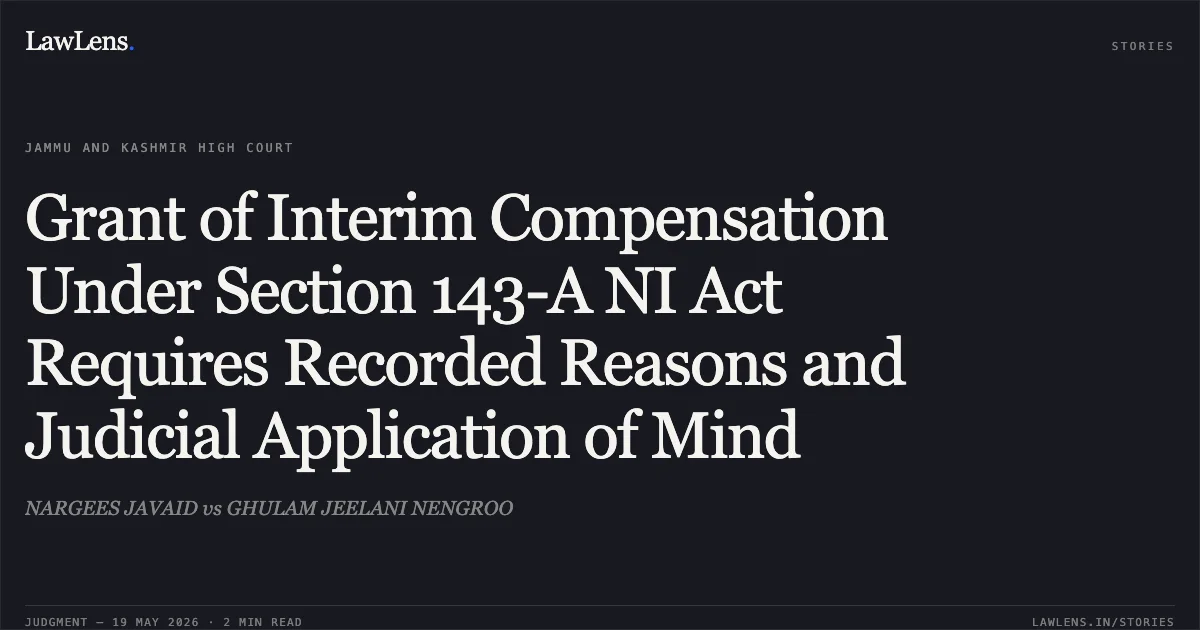
The petitioner challenged an order dated 16.03.2026 passed by the Special Mobile Magistrate, Pulwama, which directed the petitioner to pay 10% of the total cheque amount as interim compensation
Source reference: para. 1, 6The respondent had filed a complaint under Section 138 of the Negotiable Instruments (NI) Act involving eleven cheques totaling several lakhs
Source reference: para. 2-3Upon appearing, the petitioner pleaded not guilty and specifically denied her signatures on the cheques, requesting forensic examination
Source reference: para. 4, 7During the proceedings, the Trial Court allowed the respondent’s application for interim compensation under Section 143-A of the NI Act without addressing the petitioner's specific defense or providing a detailed rationale for the 10% quantum
Source reference: para. 6-7Issues
1. Whether the power to grant interim compensation under Section 143-A of the Negotiable Instruments Act, 1881, is mandatory or discretionary
Source reference: para. 172. Whether the Trial Court's order was legally sustainable given the lack of recorded reasons for the grant and the specific quantum of compensation
Source reference: para. 20-22Law Applied
Section 143-A of the Negotiable Instruments Act, 1881, which empowers courts to order interim compensation not exceeding 20% of the cheque amount
Source reference: para. 15Supreme Court's interpretation in Rakesh Ranjan Shrivastava v. State of Jharkhand (2024), establishing that the word "may" in Section 143-A makes the power discretionary and directory, requiring courts to record brief reasons following a prima facie evaluation of both the complainant's merit and the accused's defense
Source reference: para. 23Nazir Ahmad Chopan v. Abdul Rehman Chopan (2022), which mandates that the court must justify the specific percentage (1% to 20%) awarded through reasoned analysis
Source reference: para. 27-28Reasoning
The High Court observed that the Trial Court exercised its power in a "mechanical" and "routine" manner
Source reference: para. 20, 24It noted that the Magistrate failed to perform a prima facie evaluation of the petitioner’s specific defense regarding the denial of signatures, which is crucial since the presumption under Section 139 is rebuttable
Source reference: para. 10, 21The Court found that the impugned order merely reiterated the statutory provision without explaining why 10% was the appropriate quantum in this specific case
Source reference: para. 22, 26Since Section 143-A allows a range of compensation, the failure to provide "cogent reasons" for selecting a specific figure rendered the order arbitrary and "in the teeth of the settled position of law"
Source reference: para. 23, 26Holding
The High Court answered that the power under Section 143-A is discretionary and requires a reasoned, non-mechanical approach
The Court allowed the petition, quashed the order dated 16.03.2026, and remanded the matter to the Special Mobile Magistrate, Pulwama
Source reference: para. 29The Trial Court was directed to pass a fresh order expeditiously, ensuring that if it grants interim compensation, it must record reasons considering all relevant factors and the specific defenses raised by the petitioner
Source reference: para. 29The parties were directed to appear before the Trial Court on 27.04.2026
Source reference: para. 31Acts & Sections Cited
7 provisions across 2 statutes referred to in this judgment. Each provision opens on LawLens.
Bharatiya Nagarik Suraksha Sanhita, 20233
Negotiable Instruments Act, 18814
Original Court PDF
NARGEES JAVAIDvsGHULAM JEELANI NENGROO
Click to open original judgment
Original judgment, available to read, download and summarize on LawLens.in