Facts
On 22 October 2025, the police received information regarding a village assault and found Lekh Raj, Rupinder Singh, Chuna Devi, Sudesh, Somti Devi and Nisha Kumari injured at the hospital.
Source reference: p. 2, para. 2The prosecution alleged that the accused persons, including Phool Singh, attacked Somti Devi, Lekh Raj, Rupinder Singh and Chuna Devi with sticks, bricks and a *kassi* (pickaxe/spade).
Source reference: p. 2, para. 2The prosecution case was that Phool Singh repeatedly struck Chuna Devi, Lekh Raj and Rupinder Singh with the *kassi*, including a blow to Lekh Raj’s head; CCTV footage and witness statements were relied upon by the police.
Source reference: p. 2, para. 2Lekh Raj suffered a depressed parietal fracture with extradural haemorrhage, while the injuries to Lekh Raj, Rupinder Singh and Chuna Devi were medically certified as grievous.
Source reference: p. 2, para. 2; p. 10, para. 14Although the weapon allegedly recovered by the police did not contain blood, the police filed a charge-sheet for offences under Sections 191(2), 191(3), 115(2), 117(2), 109 and 190 of the Bharatiya Nyaya Sanhita, 2023 (“BNS”).
Source reference: p. 2, paras. 2–3The Trial Court framed charges, including under Section 109 read with Section 190 BNS.
Source reference: p. 3, para. 4Phool Singh challenged the framing of charges, principally contending that the injuries were not life-threatening, the weapon had no bloodstains, and the material did not establish an offence equivalent to attempt to murder.
Source reference: p. 3, para. 4Issues
1. Whether the material on record disclosed a prima facie case warranting framing of a charge under Section 109 read with Section 190 BNS, corresponding to attempt to murder under Section 307 IPC, despite the absence of a fatal or expressly life-threatening injury?
Source reference: pp. 8–11, paras. 13–152. Whether the Trial Court, at the stage of framing charges, was required to evaluate the evidentiary reliability of the witness statements, CCTV material, medical evidence and absence of blood on the recovered weapon?
Source reference: pp. 5–7, paras. 9–11; p. 11, para. 153. Whether the revision petition disclosed any other error in the charges framed by the Trial Court, including the alleged framing of charges under the Scheduled Castes and the Scheduled Tribes (Prevention of Atrocities) Act?
Source reference: p. 12, para. 16Law Applied
At the stage of framing charges, the Court must determine whether the prosecution material establishes a prima facie case and must not conduct a detailed examination of its probative value or decide whether conviction is certain; this principle was drawn from *Vishnu Kumar Shukla v. State of U.P.*, *Ram Prakash Chadha v. State of U.P.* and *Yuvraj Laxmilal Kanther v. State of Maharashtra*.
Source reference: pp. 5–8, paras. 9–11Limited sifting of the material is permissible to determine whether sufficient grounds exist to proceed, but a detailed assessment of admissibility, credibility or ultimate evidentiary weight is impermissible at that stage.
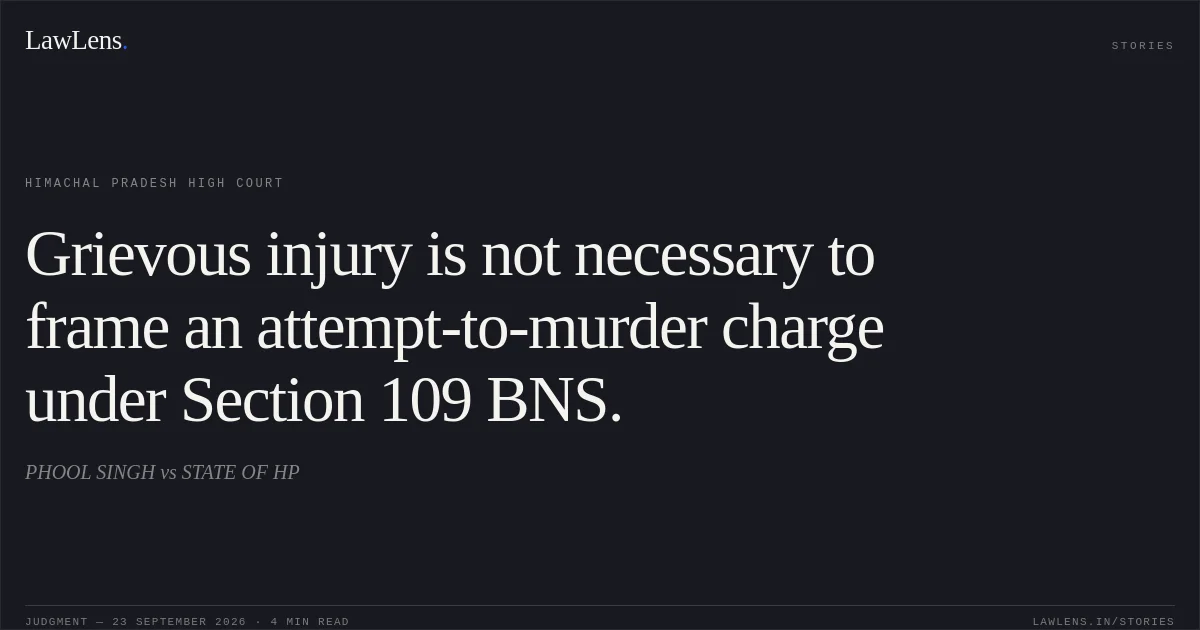
Source reference: pp. 6–8, paras. 10–11Section 109 BNS corresponds to Section 307 IPC; an injury need not be fatal, grievous, or independently capable of causing death to attract the provision. The decisive consideration is whether the act was accompanied by the intention or knowledge that, if death had resulted, the accused would have been guilty of murder.
Source reference: pp. 8–10, para. 13The nature of the weapon, the part of the body targeted, the number of blows and the surrounding circumstances may prima facie establish the requisite intention or knowledge.
Source reference: p. 10, para. 13Reasoning
The Court held that the prosecution material, if accepted at face value for the limited purpose of charge, showed that Phool Singh used a *kassi*, a potentially deadly weapon, to repeatedly strike the victims and specifically inflicted a blow on Lekh Raj’s head, a vital part of the body.
Source reference: p. 10, para. 14The medical record showing a depressed skull fracture and extradural haemorrhage, together with the allegation that the assault continued after Lekh Raj fell, was sufficient to support a prima facie inference of intention to cause death or knowledge that death could result.
Source reference: p. 10, para. 14The absence of a fatal injury did not negate the charge under Section 109 BNS, because grievousness or fatality of the injury is not an essential ingredient where the requisite intention or knowledge can be inferred from the circumstances.
Source reference: pp. 8–10, para. 13The Court declined to assess at the revision stage whether the recovered *kassi* was the actual weapon or whether the absence of blood on it undermined the prosecution case. Those matters concerned the evidentiary value of the prosecution material and could be tested during trial, not while framing charges.
Source reference: p. 11, para. 15The Court further noted that no charge under the SC/ST Act had in fact been framed, rendering that objection factually incorrect.
Source reference: p. 12, para. 16Holding
The High Court held that the Trial Court had sufficient material to frame charges under Section 109 read with Section 190 BNS, along with the other charged offences.
The alleged use of a *kassi* on the head, the repeated blows and the serious cranial injury constituted a prima facie basis for inferring the requisite intention or knowledge; the absence of blood on the recovered weapon and the alleged inconsistencies in the medical evidence were matters for trial.
Source reference: pp. 10–11, paras. 14–15Finding no error in the order dated 3 August 2026, the Court dismissed the revision petition and directed that its observations remain confined to the disposal of the revision and not affect the merits of the trial.
Source reference: p. 12, paras. 18–20Acts & Sections Cited
8 provisions across 3 statutes referred to in this judgment. Each provision opens on LawLens.
Bharatiya Nyaya Sanhita, 20235
Code of Criminal Procedure, 19732
Indian Penal Code, 18601
Original Court PDF
PHOOL SINGHvsSTATE OF HP
Click to open original judgment
Original judgment, available to read, download and summarize on LawLens.in