Facts
On 28 April 2013, Sunil Kisku attacked several people at a dhaba with a darat (sickle), causing simple and grievous injuries.
Source reference: para. 1–7The Sessions Court convicted him under Sections 324 and 326 IPC, but acquitted him under Section 307 IPC and Sections 25 and 27 of the Arms Act.
Source reference: para. 1–7It sentenced him to two years’ rigorous imprisonment under Section 326 and one year under Section 324, with fines; Kisku did not appeal his convictions and had served the sentences.
Source reference: para. 8–18The State appealed both for enhancement of sentence and against the acquittals.
Source reference: para. 8–18Issues
1. Whether the evidence established the intention or knowledge required to convict Kisku under Section 307 IPC
Source reference: para. 18, 24–322. Whether possession or use of the darat established offences under Sections 25 and 27 of the Arms Act
Source reference: para. 18, 20–233. Whether the sentences imposed under Sections 324 and 326 IPC warranted enhancement
Source reference: para. 6, 33Law Applied
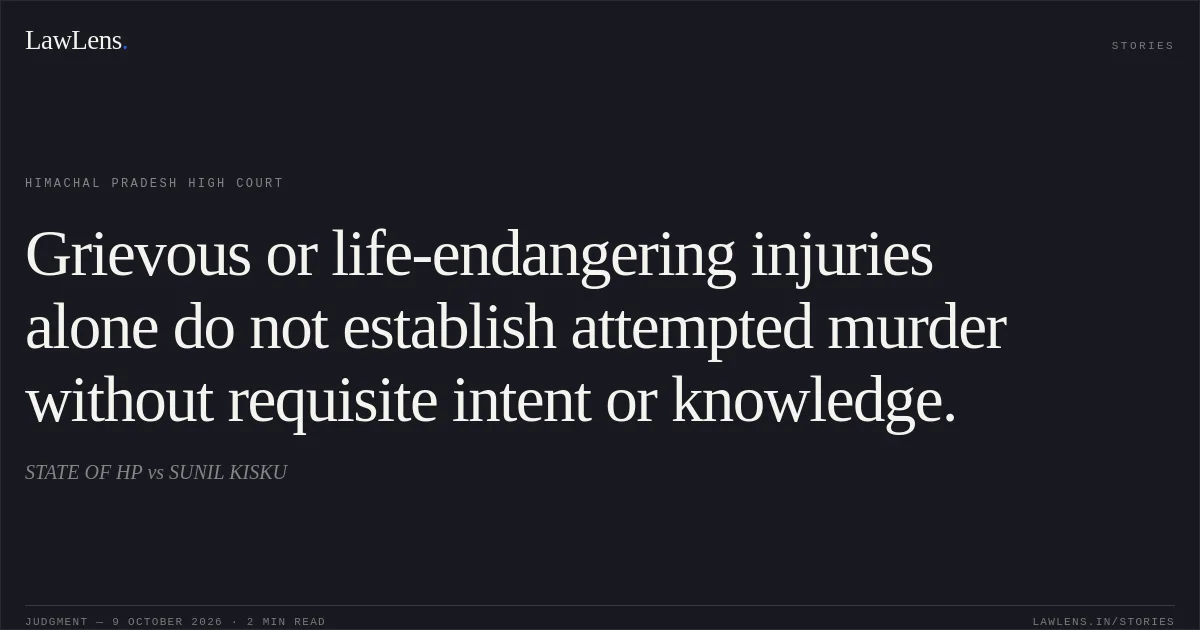
Section 307 IPC requires an overt act accompanied by the intention or knowledge that would make the act murder if death resulted; the nature or severity of the injury alone does not establish that mental element
Source reference: para. 24–30; Amit Rana alias Koka v. State of Haryana, para. 25; State of H.P. v. Shamsher Singh, para. 26; Roshan Lal v. State of Haryana, para. 27; Surender Kumar v. State of Haryana, para. 28Under Sections 25 and 27 of the Arms Act, criminal liability depends on proof of the relevant statutory prohibition or licensing requirement; Section 2(a)(i) defines prohibited arms, and Section 7 prohibits possession or use of prohibited arms without special authorisation.
Source reference: para. 20–23In assessing enhancement, the Court considered the circumstances and genesis of the incident, its spontaneous nature, the absence of premeditation, and the time elapsed since the offence.
Source reference: para. 33Reasoning
Although some injuries were grievous and a doctor considered certain injuries potentially dangerous to life, the evidence did not establish that Kisku acted with an intention or knowledge to cause death.
Source reference: para. 29–32He was unknown to the injured persons, the incident was spontaneous, and the witnesses did not describe conduct demonstrating an intent to kill; injury severity alone could not supply the missing mens rea.
Source reference: para. 29–32As to the Arms Act, the prosecution produced no Central Government notification declaring a darat or sickle to be a prohibited arm, nor identified a provision requiring a licence for its possession.
Source reference: para. 22–23The Court also found no basis to enhance the sentences, given the spontaneous nature of the incident, the absence of premeditation or prior animosity, and the passage of time.
Source reference: para. 33Holding
The High Court dismissed both State appeals.
It declined to interfere with the acquittals under Section 307 IPC and Sections 25 and 27 of the Arms Act, and refused to enhance the sentences under Sections 324 and 326 IPC.
Source reference: para. 34–35Acts & Sections Cited
17 provisions across 4 statutes referred to in this judgment. Each provision opens on LawLens.
Indian Penal Code, 18606
Arms Act, 19595
Code of Criminal Procedure, 19735
Bharatiya Nagarik Suraksha Sanhita, 20231
Original Court PDF
STATE OF HPvsSUNIL KISKU
Click to open original judgment
Original judgment, available to read, download and summarize on LawLens.in