Facts
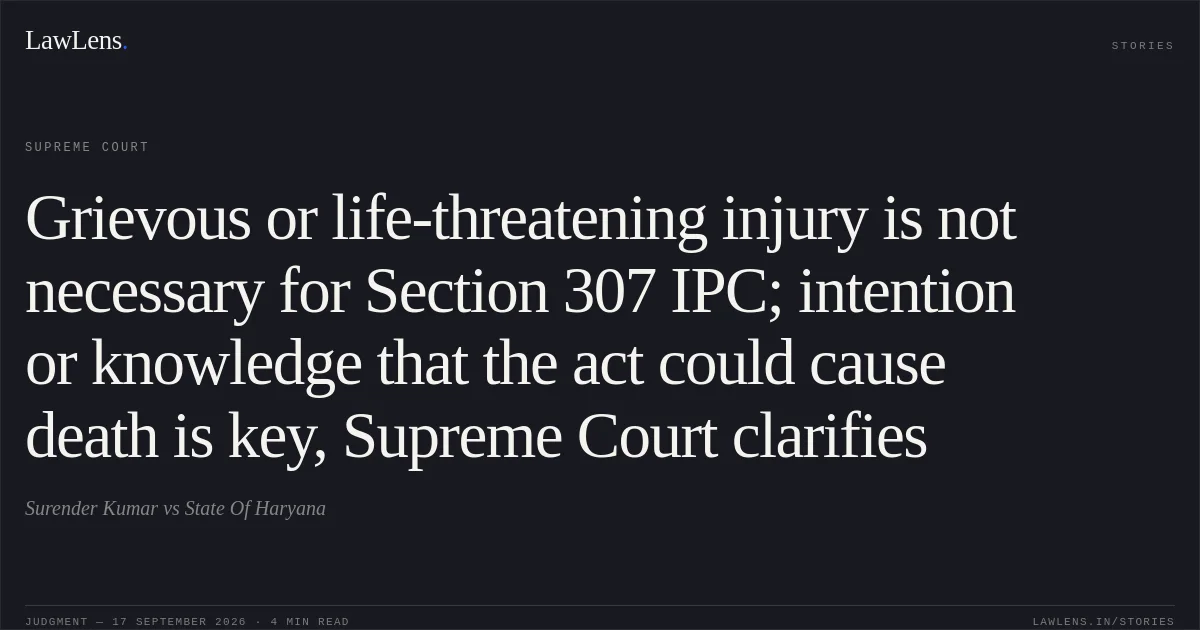
A dispute concerning waterlogging and the draining of rainwater led to an assault on the petitioner, his brother and uncle by six accused persons. The petitioner and his brother sustained multiple injuries, including a fracture of the right parietal bone with underlying haemorrhagic contusion suffered by the brother.
Source reference: p.1The FIR was registered under Sections 147, 148, 149, 323, 325 and 506 of the IPC, and charges were framed accordingly.
Source reference: p.1A neurosurgeon opined that the brother’s injury could have been dangerous to life, whereas a Medical Board constituted during investigation found the injuries grievous but not dangerous to life.
Source reference: pp.1–2After substantial completion of the prosecution evidence, the petitioner sought alteration of the charge to Section 307 IPC. The Magistrate rejected the application, relying principally on the Medical Board’s opinion; the Sessions Court and High Court affirmed the decision.
Source reference: pp.2–3The petitioner thereafter approached the Supreme Court by special leave.
Source reference: pp.2–3Issues
1. Whether the absence of a fatal or life-endangering injury, or the presence of only simple or grievous hurt, precludes alteration of the charge under Section 307 IPC.
Source reference: pp.4–72. Whether, on the facts of the case and at the late stage of trial, the charge ought to have been altered to include Section 307 IPC.
Source reference: pp.7–83. Whether the court retains the power to alter a charge at any stage of the trial when supported by evidence and a sound, justifiable cause.
Source reference: p.8Law Applied
The Court applied Section 307 IPC, which requires an overt act accompanied by such intention or knowledge that, if death had resulted, the accused would have been guilty of murder; the nature or gravity of the injury is not an essential ingredient. Hurt may be simple or grievous, and where hurt is caused, Section 307 provides for enhanced punishment.
Source reference: pp.4–5Relying on State of Madhya Pradesh v. Kashiram, (2009) 4 SCC 26, the Court held that intent coupled with an overt act is sufficient and that a bodily injury capable of causing death is unnecessary.
Source reference: p.5Chimanbhai Jagabhai Patel v. State of Gujarat, (2009) 11 SCC 273, identified the relevant ingredients as an overt act, the requisite intention or knowledge, and absence of justification for incurring the risk of death or such injury.
Source reference: p.5The Court also relied on Pasupuleti Siva Ramakrishna Rao v. State of Andhra Pradesh, (2014) 5 SCC 369, and State of M.P. v. Saleem, (2005) 5 SCC 554, for the distinction between the punishment where hurt is and is not caused, and for the principle that a simple injury does not negate an intention to kill.
Source reference: p.6State of M.P. v. Kanha, (2019) 3 SCC 605, and Jage Ram v. State of Haryana, (2015) 11 SCC 366, establish that the absence of a fatal injury does not exclude Section 307, although the injury, weapon and surrounding circumstances may assist in inferring intention or knowledge.
Source reference: pp.6–7Reasoning
The Court held that the Magistrate, Sessions Court and High Court erred to the extent that they treated the Medical Board’s conclusion—that the injury was not dangerous to life—as determinative of the applicability of Section 307 IPC.
Source reference: pp.3–4, 7The statutory focus is the accused’s intention or knowledge, assessed from the overt act and surrounding circumstances, rather than merely the medical seriousness of the injury.
Source reference: pp.4–7However, the Court found that the petitioner’s application was made only after the trial had substantially progressed, although both medical opinions were available when the chargesheet was filed.
Source reference: pp.7–8Neither the FIR, the stage of cognizance, the evidence led, nor the investigation disclosed an allegation or material indicating the requisite intention or knowledge to attract Section 307. The existence of injuries to two accused persons also formed part of the circumstances considered by the lower courts.
Source reference: pp.2–3, 7–8Accordingly, although the medical reasoning adopted by the lower courts was legally incomplete, the ultimate refusal to add Section 307 was justified on the independent ground that the factual foundation for the requisite intention or knowledge was absent and the application was belated.
Source reference: pp.7–8Holding
The Supreme Court dismissed the Special Leave Petition, holding that the petitioner had not established sufficient grounds for incorporating Section 307 IPC at the advanced stage of the trial.
It clarified that grievous or life-threatening injury is not a mandatory requirement under Section 307; nevertheless, the prosecution must disclose an overt act accompanied by the requisite intention or knowledge.
Source reference: p.8The Court further affirmed that alteration of a charge remains within the court’s power at any stage of the continuing trial, provided that the evidence discloses a sound and justifiable basis for doing so.
Source reference: p.8Pending applications, if any, were rejected.
Source reference: p.8Acts & Sections Cited
7 provisions across 1 statute referred to in this judgment. Each provision opens on LawLens.
Indian Penal Code, 18607
Original Court PDF
Surender KumarvsState Of Haryana
Click to open original judgment
Original judgment, available to read, download and summarize on LawLens.in