Facts
The Plaintiff, nephew of the deceased Gulab Hukumatrai Gurbani, sought probate of a Will dated 30 November 2004, under which he was appointed sole executor and was made the principal beneficiary, including in respect of the deceased’s share in an immovable property at Jaipur.
Source reference: paras. 1–3; pp. 1–2The deceased died on 16 April 2005, leaving behind his wife and two sons, who filed caveats opposing the grant of probate. The testamentary petition was consequently converted into the present Testamentary Suit.
Source reference: para. 4; p. 2The Plaintiff examined himself and two attesting witnesses, including the deceased’s long-standing physician. The Defendants challenged the genuineness of the Will, alleging that the deceased had not signed it, that the Will was forged, and that the deceased’s physical illness and alleged mental incapacity created suspicious circumstances.
Source reference: paras. 6–43; pp. 3–29The Defendants principally relied upon the evidence of a handwriting expert, whose opinion was based on scanned copies and comparison signatures that had not independently been proved or admitted.
Source reference: paras. 97–101; pp. 60–63Issues
1. Whether the Plaintiff was entitled to probate of the deceased’s last Will and Testament.
Source reference: para. 5; p. 32. Whether the Plaintiff proved that the deceased had duly executed the Will dated 30 November 2004.
Source reference: para. 5; p. 33. Whether the Defendants proved that the deceased had not signed the Will.
Source reference: para. 5; p. 3Law Applied
The Court applied Section 63(c) of the Indian Succession Act, 1925, requiring execution of a Will by the testator and attestation by at least two witnesses, read with Section 68 of the Indian Evidence Act, 1872, concerning proof of execution of documents required by law to be attested.
Source reference: para. 86; pp. 52–53Relying on Sridevi v. Jayaraja Shetty, (2005) 2 SCC 784, the Court held that the propounder must establish the testator’s signature, sound and disposing state of mind, understanding of the dispositions, free volition, and due attestation; suspicious circumstances must also be satisfactorily explained.
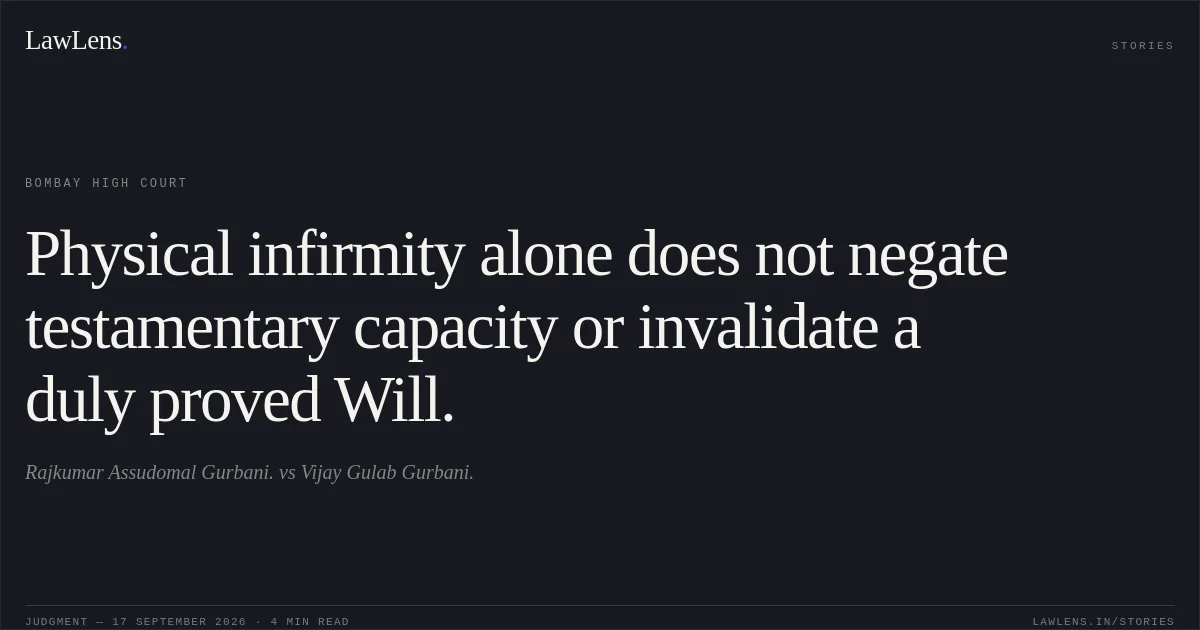
Source reference: para. 84; p. 51The Court relied on Ganpatrao Khandero v. Vasantrao, AIR 1932 Bom 588, for the principle that physical infirmity does not by itself establish testamentary incapacity.
Source reference: para. 92; p. 56The Court relied on Ramabai Padmakar Patil v. Rukminibai Vekhande, (2003) 8 SCC 537, and Pentakota Satyanarayana v. Pentakota Seetharatnam, (2005) 8 SCC 67, for the proposition that exclusion of natural heirs is not by itself a suspicious circumstance.
Source reference: para. 93; pp. 57–58The Court relied on Leela Rajagopal v. Kamala Menon Cocharan, (2014) 15 SCC 570, for the principle that a beneficiary’s participation in the execution process does not ipso facto establish undue influence or suspicion.
Source reference: para. 94; p. 58The Court also held that evidence travelling beyond the pleadings could not be relied upon, particularly where the Defendants had not pleaded unsoundness of mind, coercion, or undue influence in their caveat.
Source reference: para. 90; pp. 54–55Reasoning
The Court accepted the evidence of both attesting witnesses, who testified that the deceased read the Will, confirmed that he understood its contents and was acting voluntarily, signed it in their presence, and that they attested it in the presence of the deceased and each other. Their evidence remained substantially unshaken in cross-examination and satisfied Sections 63(c) and 68.
Source reference: paras. 85–89; pp. 51–54The deceased’s prostate cancer and restricted movement below the waist did not establish mental incapacity; the evidence of his long-standing physician, corroborated by the other attesting witness and supported by the contents of the Will, established that he possessed testamentary capacity.
Source reference: paras. 90–92; pp. 54–56The exclusion of the wife and sons was not treated as suspicious because the Will recorded reasons for the dispositions and the surrounding evidence supported the existence of strained relations.
Source reference: para. 93; pp. 57–58The Court also rejected the alleged subsequent Will, which had never been produced or proved, noting the inconsistency in the Defendants’ case that the deceased lacked testamentary capacity in November 2004 but executed another Will in January 2005.
Source reference: para. 95; pp. 59–60Finally, the handwriting expert’s opinion was given little weight because it was based on unproved comparison signatures, scanned photocopies, digitally enlarged images, and material whose provenance was uncertain; it could not displace the direct evidence of the attesting witnesses.
Source reference: paras. 97–103; pp. 60–64Holding
The Court answered Issue Nos. 1 and 2 in the affirmative and Issue No. 3 in the negative.
It held that the Plaintiff proved the due execution and attestation of the Will dated 30 November 2004 and that the Defendants failed to prove that the deceased had not signed it.
Source reference: paras. 96, 103–104; pp. 60–64Testamentary Suit No. 74 of 2006 was decreed, and the Prothonotary and Senior Master was directed to issue probate of the deceased’s last Will and Testament in favour of the Plaintiff upon compliance with the requisite formalities.
Source reference: para. 105; p. 65The grant was directed to be issued expeditiously, with no order as to costs.
Source reference: para. 105; p. 65Acts & Sections Cited
1 provisions across 1 statute referred to in this judgment. Each provision opens on LawLens.
Indian Succession Act, 19251
Original Court PDF
Rajkumar Assudomal Gurbani.vsVijay Gulab Gurbani.
Click to open original judgment
Original judgment, available to read, download and summarize on LawLens.in