Facts
The petitioner challenged an assessment order dated 3 April 2023 and a consequential DRC-07 order dated 5 April 2023, contending that notices uploaded to the GST portal had not come to its attention and that no personal hearing was provided before the orders were made.
Source reference: pp. 2–3, paras. 1, 4The petitioner also submitted that it had paid approximately 60% of the disputed tax.
Source reference: p. 3, para. 5The Revenue accepted that no personal hearing had been provided and sought remand of the matter.
Source reference: p. 3, para. 6Issues
Whether portal-uploaded notices, in the circumstances of the case, provided an effective opportunity to respond before the assessment orders were passed.
Source reference: pp. 3–4, paras. 8–10Whether the impugned orders should be set aside and the matter remitted for fresh consideration, with consequential relief concerning the petitioner’s attached bank account.
Source reference: pp. 5–6, para. 11Law Applied
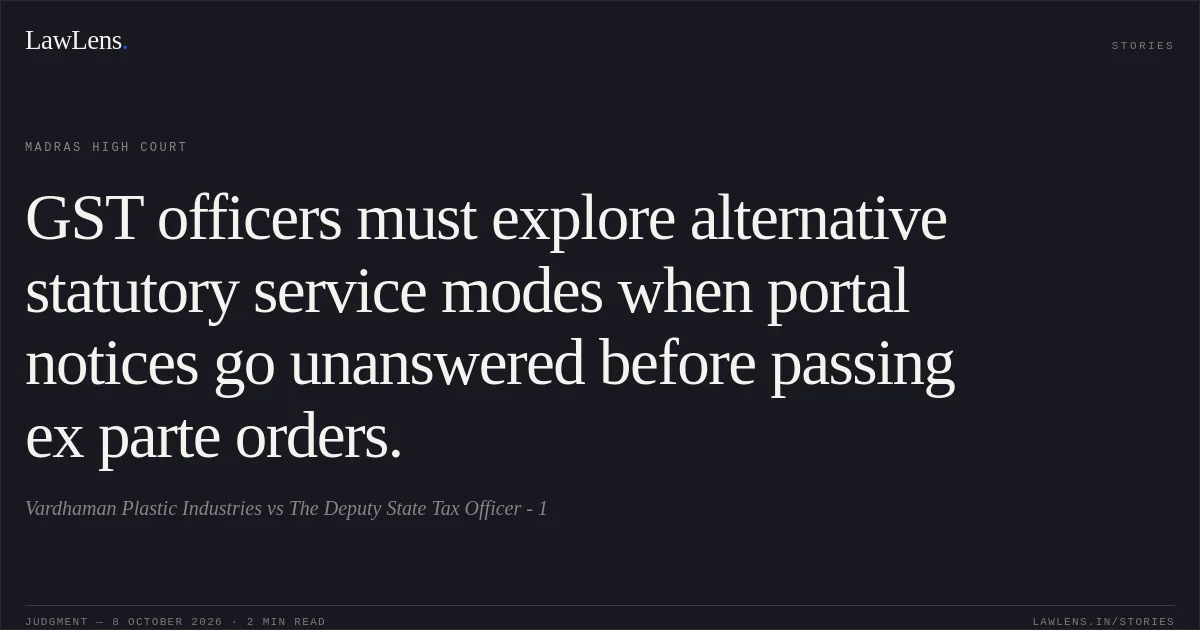
Section 169(1) of the GST Act recognises the prescribed modes of service, including service through the GST portal; however, where a taxpayer does not respond to portal notices, the officer should consider other available modes of service, preferably registered post with acknowledgment due (RPAD), to ensure effective notice.
Source reference: pp. 4–5, paras. 9–10The judgment also applies the principle of natural justice that an affected taxpayer should receive a personal hearing before an adverse order is made; it cites no judicial precedents.
Source reference: pp. 3–4, paras. 6, 8Reasoning
Although the show-cause notice had been uploaded to the GST portal, the petitioner maintained that it was unaware of the notice, and the respondent acknowledged that no personal hearing had been afforded.
Source reference: pp. 3–4, paras. 6, 8The Court held that, in the absence of any response to portal notices, the officer should have explored other statutory service modes rather than proceed ex parte after merely completing formalities.
Source reference: pp. 4–5, paras. 9–10In light of the denied hearing and the petitioner’s stated payment of approximately 60% of the disputed tax, the Court considered remand appropriate.
Source reference: p. 5, para. 11Holding
The Court set aside the orders dated 3 and 5 April 2023 and remitted the matter to the first respondent for fresh consideration.
The petitioner was directed to file its reply and supporting documents within three weeks of receiving the order; upon receipt, the officer must issue 14 clear days’ notice fixing a personal hearing and then pass a fresh order on the merits and in accordance with law.
Source reference: p. 5, para. 11(ii)–(iii)The officer was also directed to instruct the bank to release the attachment and defreeze the account upon production of proof of the stated payment.
Source reference: pp. 5–6, para. 11(iv)The writ petition was disposed of without costs, and the connected miscellaneous petitions were closed.
Source reference: p. 6, para. 12Acts & Sections Cited
2 provisions across 1 statute referred to in this judgment. Linked provisions open on LawLens.
the GST Act (alias, unresolved)2
Original Court PDF
Vardhaman Plastic IndustriesvsThe Deputy State Tax Officer - 1
Click to open original judgment
Original judgment, available to read, download and summarize on LawLens.in