01Facts
The petitioners sought quashing of FIR C.R. No. I-73 of 2003, registered at Sami Police Station for offences under Sections 147, 148, 149, 324, 326, 452, 323, 504 and 506(2) of the IPC and Section 135 of the BP Act.
¶ 4–5.4 · pp. 2–3After investigation, a charge-sheet was filed and the petitioners were convicted of offences under Sections 324, 326, 452, 323 and 147 IPC and sentenced to three years’ simple imprisonment.
¶ 4–5.4 · pp. 2–3Their appeals were pending before the Sessions Court, which had suspended the sentences.
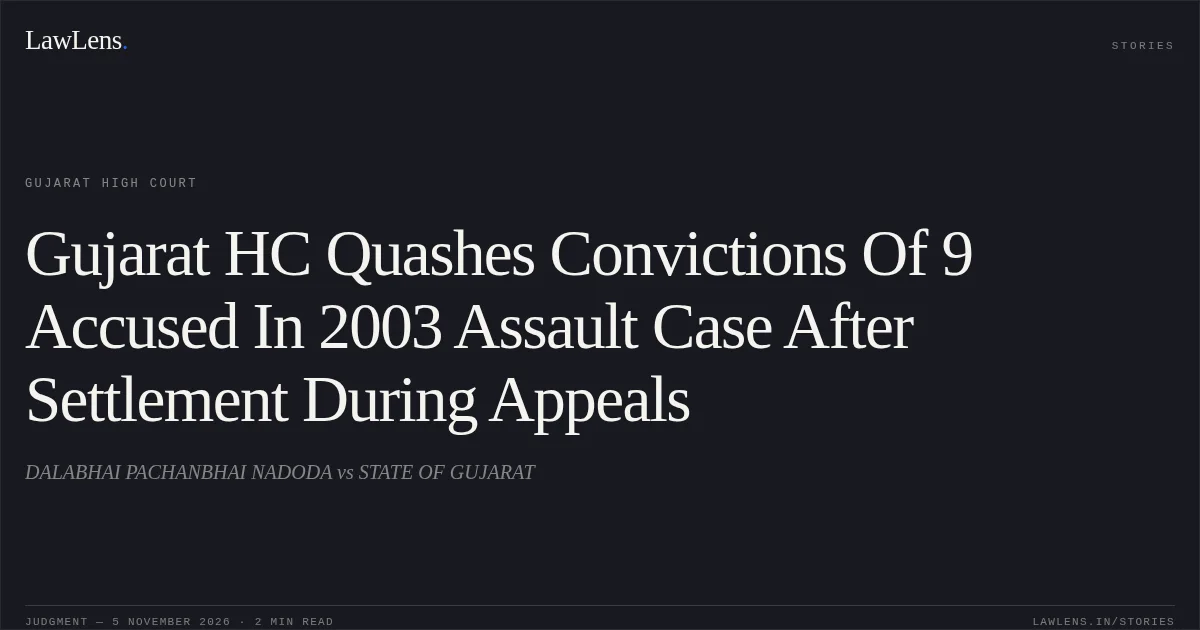
¶ 4–5.4 · pp. 2–3During the appeals, the parties settled the dispute; the complainant consented to quashing and stated that he did not wish to prosecute.
¶ 4–5.4 · pp. 2–3The application invoked Section 528 of the Bharatiya Nagarik Suraksha Sanhita, 2023, and sought quashing of the FIR, consequential proceedings and conviction.
¶ 4–5.4 · pp. 2–302Issues
i.1. Whether the High Court could quash non-compoundable criminal proceedings on the basis of a settlement where the trial had concluded in conviction and appeals were pending.
¶ 9–12 · pp. 4–7ii.2. Whether the settlement in this case justified quashing the FIR, consequential proceedings and conviction.
¶ 12–14 · pp. 7–803Law Applied
The Court relied on the inherent quashing principles stated in Gian Singh v. State of Punjab, (2012) 10 SCC 303: the High Court’s power is distinct from statutory compounding, and may be exercised to secure the ends of justice or prevent abuse of process; in private disputes, quashing may be appropriate where the possibility of conviction is remote and continuation would cause injustice, but the nature and gravity of the offence must be considered.
¶ 10 · pp. 4–6It also applied State of Madhya Pradesh v. Laxmi Narayan, (2019) 5 SCC 688, which permits quashing of non-compoundable offences of a predominantly private character after settlement, while excluding heinous offences and requiring consideration of relevant circumstances, including the accused’s antecedents and conduct.
¶ 11 · pp. 6–7The judgment states that such proceedings may be quashed even after conviction where an appeal is pending.
¶ 12 · p. 7Provisions in the judgment · 12 · Linked ones open on LawLens
Bharatiya Nagarik Suraksha Sanhita, 2023 Section 528
Indian Penal Code, 1860 9 provisions
Section 147Section 148Section 149Section 324Section 326Section 452Section 323Section 504Section 506Code of Criminal Procedure, 1973 Section 482Section 320
04Reasoning
The Court accepted that the dispute was private, that the parties had voluntarily settled it without coercion, and that the complainant no longer wished to prosecute.
¶ 8, 13 · p. 4, 7It considered the offences not so serious that quashing would override the public interest, and concluded that continuing the proceedings would serve no useful purpose and would amount to an abuse of process.
¶ 10–13 · pp. 4–7Applying the principles in Gian Singh and Laxmi Narayan, it held that the pending appeals and the prior conviction did not prevent quashing in the circumstances of this case.
¶ 10–13 · pp. 4–705Holding
The Court allowed the application and quashed the FIR, all consequential proceedings against the petitioners, and the trial court’s judgment and order of conviction dated 20 November 2024 in Criminal Case No. 147 of 2017.
¶ 14 · p. 8It directed the Sessions Judge, Patan, to pass an appropriate order in the pending Criminal Appeal Nos. 182 of 2024 and 177 of 2024; the rule was made absolute to that extent.
¶ 15–16 · p. 8Original Court PDF
DALABHAI PACHANBHAI NADODAvsSTATE OF GUJARAT
Click to open original judgment
Original judgment, available to read, download and summarize on LawLens.in