01Facts
The petitioners sought to quash an FIR registered at Sayajigunj Police Station for offences under the Scheduled Castes and the Scheduled Tribes (Prevention of Atrocities) Act, 1989, as well as other offences.
¶ 4, 6At the hearing, they did not press the petition insofar as it concerned the latter offences, limiting the application to the Atrocities Act.
¶ 4, 6The FIR alleged that the petitioners used derogatory words concerning the complainant’s caste and threatened the complainant with death.
¶ 8–9The High Court found that the FIR did not identify the words allegedly used, state that the accused and complainant belonged to the relevant caste categories, or allege that the incident occurred within public view.
¶ 1002Issues
i.1. Whether the FIR, read at face value, disclosed the essential ingredients of an offence under the Atrocities Act.
¶ 7–10, 12ii.2. Whether the Atrocities Act proceedings should be quashed under the High Court’s inherent or constitutional jurisdiction.
¶ 15–1603Law Applied
Sections 3(1)(r) and 3(1)(s) of the Atrocities Act require, respectively, intentional insult or intimidation with intent to humiliate a member of a Scheduled Caste or Scheduled Tribe in a place within public view, or abuse of such a person by caste name in a place within public view.
¶ 10–11Relying on Swaran Singh v. State and Hitesh Verma v. State of Uttarakhand, as discussed in Karuppudayar v. State, the Court stated that a place may be private yet within public view, but the alleged conduct must be capable of being witnessed or heard by members of the public.
¶ 11The Court also cited George Pentaiah v. State of Andhra Pradesh on the need for allegations disclosing the basic ingredients of the offence.
¶ 13State of Haryana v. Bhajan Lal, which permits quashing where allegations, even accepted in their entirety, do not prima facie constitute an offence.
¶ 15Provisions in the judgment · 5 · Linked ones open on LawLens
Scheduled Castes and the Scheduled Tribes (Prevention of Atrocities) Act, 1989 Section 3
Bharatiya Nagarik Suraksha Sanhita, 2023 Section 528
Code of Criminal Procedure, 1973 Section 482Section 156Section 155
04Reasoning
The Court considered the FIR on its face and concluded that its general allegation of derogatory caste-related words did not disclose the words used or otherwise show that the statutory elements of Sections 3(1)(r) or 3(1)(s) were met.
¶ 10It also found no allegation establishing the relevant caste status or that the alleged insult occurred within public view, including the presence of a third party.
¶ 10Applying the Bhajan Lal principle, the Court held that continuing the Atrocities Act proceedings on those allegations would amount to an abuse of process.
¶ 15.105Holding
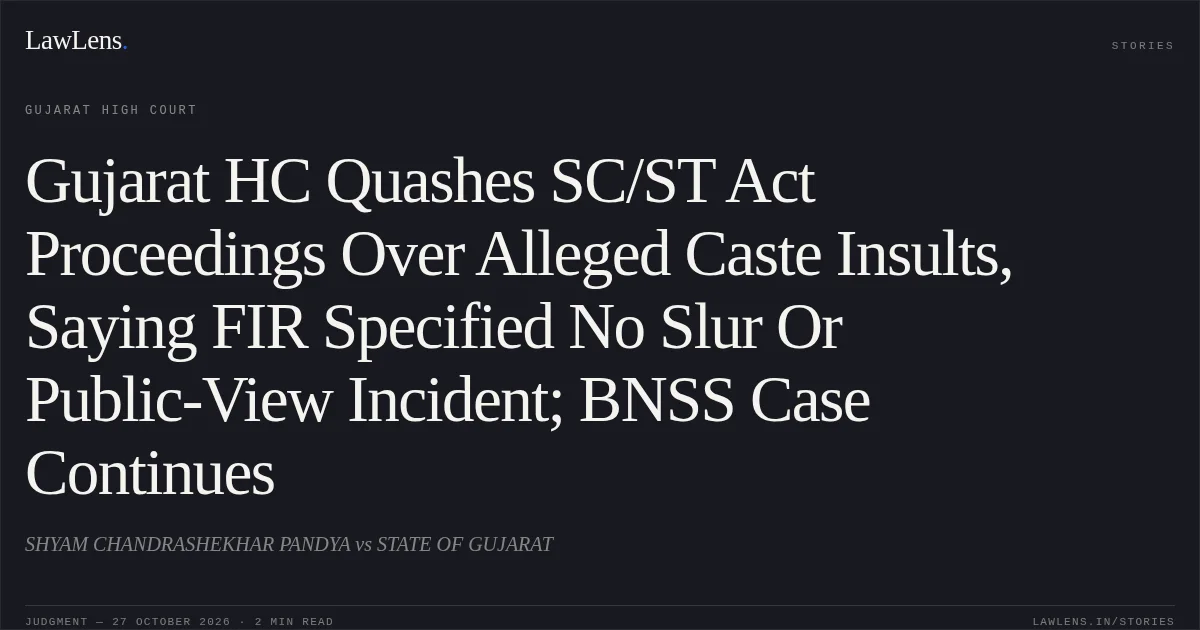
The High Court allowed the petition and quashed the FIR and consequential proceedings against the petitioners insofar as they concerned offences under the Atrocities Act.
¶ 16Proceedings for the other offences were expressly left undisturbed and were to continue without being influenced by the Court’s observations.
¶ 17The Court also acceded to the APP’s request for recovery of any compensation paid to the complainant.
¶ 18Original Court PDF
SHYAM CHANDRASHEKHAR PANDYAvsSTATE OF GUJARAT
Click to open original judgment
Original judgment, available to read, download and summarize on LawLens.in