01Facts
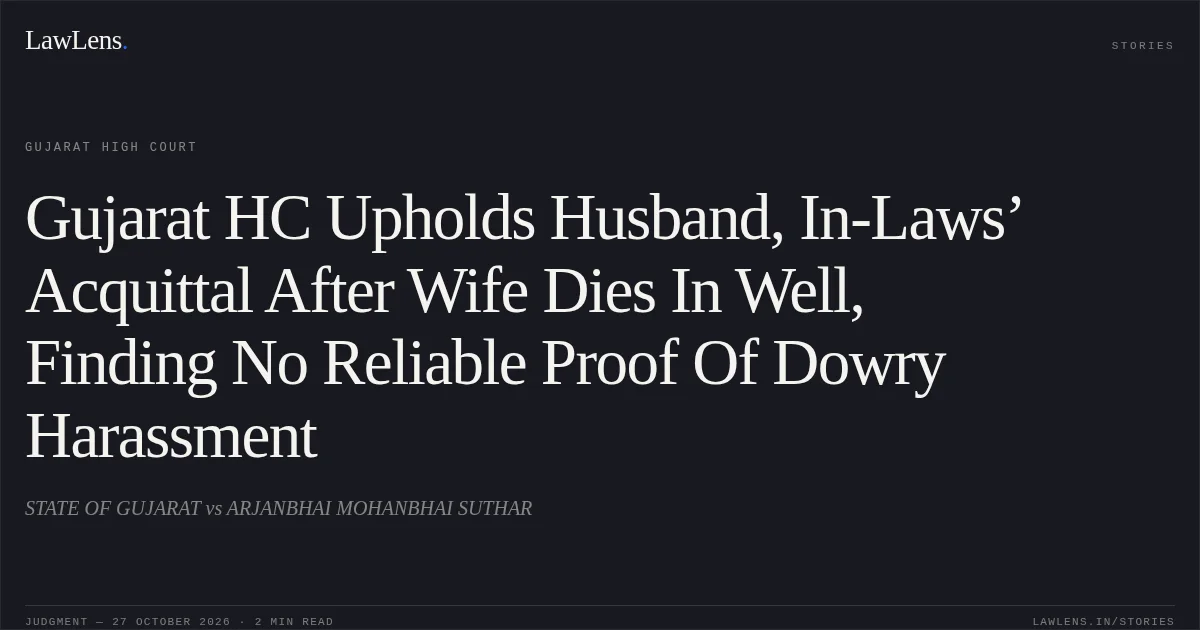
Pushpaben, married to respondent No. 1 for approximately six years, died after falling into a well. The prosecution alleged that her husband and his relatives harassed her over demands for a television and a plot, and because she had not conceived; her father lodged the complaint.
¶ 2, 7The respondents were charged under Sections 498A, 306 and 114 of the Indian Penal Code (IPC). The Sessions Court acquitted them on 11 March 2016, and the State appealed under Section 378(1)(3) of the Code of Criminal Procedure.
¶ 1–2.302Issues
i.1. Whether the Trial Court erred in acquitting the respondents on the charges under Sections 498A, 306 and 114 IPC.
¶ 6ii.2. Whether the Trial Court committed an error of law or fact in appreciating the prosecution evidence.
¶ 6iii.3. Whether the acquittal was illegal or perverse so as to warrant appellate interference.
¶ 603Law Applied
Section 498A IPC criminalises a husband’s or relative’s cruelty, including wilful conduct likely to drive a woman to suicide or harassment connected with an unlawful demand.
¶ 15Under Sections 306 and 107 IPC, abetment of suicide requires proof of instigation, conspiracy, or intentional aid.
¶ 15–16Section 113A of the Indian Evidence Act permits a presumption of abetment where a married woman commits suicide within seven years of marriage and cruelty by her husband or his relative is established; the Court also considered the asserted presumptions under Sections 113A and 113B, holding that they could not be invoked without cogent foundational evidence.
¶ 12, 15–16On an appeal against acquittal, the appellate court may review the evidence, but must account for the strengthened presumption of innocence; where two reasonable views are possible, the acquittal should not be disturbed [applying Chandrappa v. State of Karnataka, (2007) 4 SCC 415, and subsequent authorities].
¶ 19–22Provisions in the judgment · 5 · Linked ones open on LawLens
Code of Criminal Procedure, 1973 Section 378Section 209
Indian Penal Code, 1860 Section 306Section 114Section 107
04Reasoning
The Court found material weaknesses in the evidence of alleged demands and cruelty. The complainant said he paid Rs. 25,000 for a television, while PW-3 testified to Rs. 30,000; the independent witness said to have been present was not examined.
¶ 10, 13The mother gave no specific details of cruelty, and the panch witness did not support the prosecution; utensils near the well were consistent with the possibility that Pushpaben had gone there to fetch water and fallen accidentally.
¶ 10Although the death occurred within seven years of marriage, the prosecution had not established cruelty or harassment sufficient to trigger a statutory presumption, nor had it proved conduct amounting to abetment of suicide.
¶ 11–14, 17The acquittal was therefore a reasonable view of the evidence, not a perverse one warranting appellate intervention.
¶ 19–2405Holding
The High Court held that the prosecution had failed to prove the charges beyond reasonable doubt and found no error, illegality, or perversity in the Trial Court’s decision.
¶ 23–24The State’s appeal was dismissed, the acquittal was confirmed, the respondents’ bail bonds were cancelled, and the record and proceedings were directed to be returned to the Trial Court.
¶ 25Original Court PDF
STATE OF GUJARATvsARJANBHAI MOHANBHAI SUTHAR
Click to open original judgment
Original judgment, available to read, download and summarize on LawLens.in