01Facts
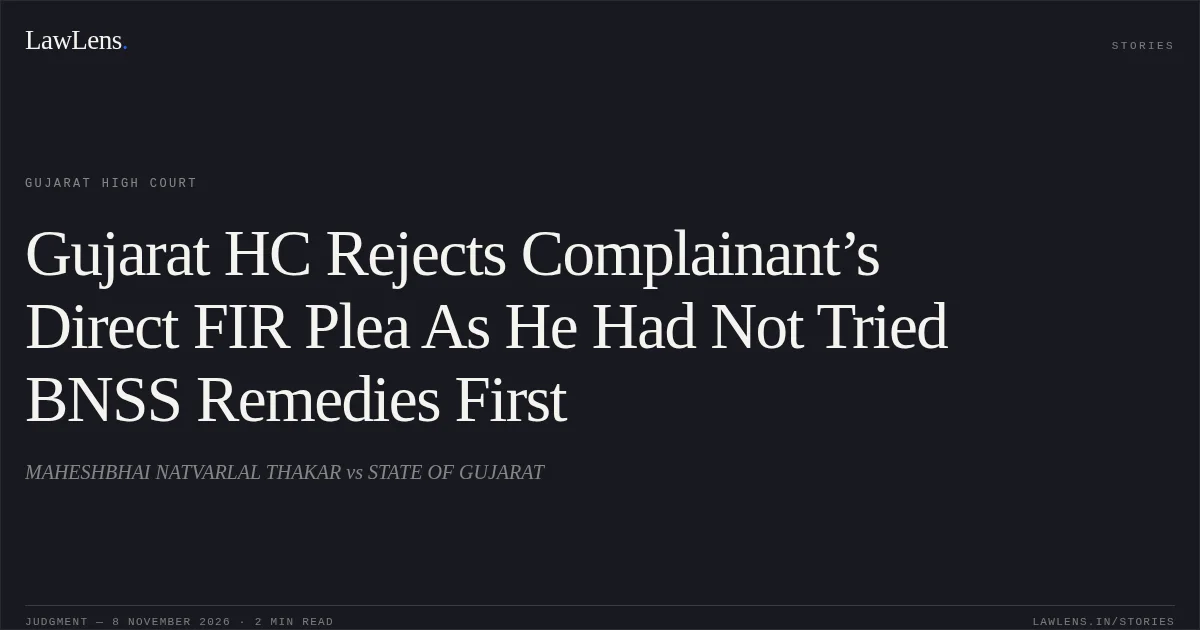
The petitioner alleged that he submitted a written complaint to the Police Inspector, Maninagar Police Station, on 1 March 2026, disclosing a cognizable offence, but no FIR was registered
¶ 4 · p. 3He petitioned under Articles 14, 21, 226 and 227 of the Constitution seeking directions to register and investigate the FIR; the State opposed the petition on the ground that alternative remedies were available
¶ 1, 5–6 · pp. 1–302Issues
i.Whether the High Court should direct registration of an FIR under its writ jurisdiction when the petitioner has not first pursued the statutory remedies available under the BNSS, 2023?
¶ 6–9 · pp. 3–6ii.Whether the petition should be dismissed without examining the merits of the complaint?
¶ 9 · p. 603Law Applied
Under Sakiri Vasu v. State of U.P., (2008) 2 SCC 409, a person aggrieved by non-registration of an FIR should ordinarily pursue the remedies before the police and the Magistrate rather than approach the High Court in the first instance; the existence of an alternative remedy is not an absolute bar to writ jurisdiction, but ordinarily weighs against its exercise
¶ 7 · pp. 3–5Under Sections 173(1), 173(4) and 175(3) of the BNSS, 2023, the statutory sequence is to provide information to the police station, approach the Superintendent of Police if registration is refused, and then seek recourse before the Magistrate
¶ 8 · p. 5Sujal Vishwas Attavar v. State of Maharashtra, 2026 INSC 442, reiterates that writ jurisdiction should ordinarily not be invoked before exhausting those remedies, unless the circumstances warrant otherwise
¶ 8 · pp. 5–6Provisions in the judgment · 7 · Linked ones open on LawLens
Code of Criminal Procedure, 1973 Section 482Section 154Section 36Section 156Section 200
Bharatiya Nagarik Suraksha Sanhita, 2023 Section 173Section 175
04Reasoning
The Court noted that the petitioner had complained to the police station but had not shown that he pursued the further remedies under the BNSS before approaching the High Court
¶ 6, 9 · p. 3, 6Applying Sakiri Vasu and Sujal Vishwas Attavar, it held that the statutory remedies were efficacious and should ordinarily be exhausted first. The petition was therefore premature; the Court did not assess whether the complaint disclosed an offence warranting registration of an FIR
¶ 8–9 · pp. 5–605Holding
The Court dismissed the petition as devoid of merit at that stage, without entering into the merits of the complaint.
¶ 9 · p. 6It left the petitioner at liberty to pursue the other efficacious remedies available under law and discharged the Rule
¶ 9 · p. 6Original Court PDF
MAHESHBHAI NATVARLAL THAKARvsSTATE OF GUJARAT
Click to open original judgment
Original judgment, available to read, download and summarize on LawLens.in