01Facts
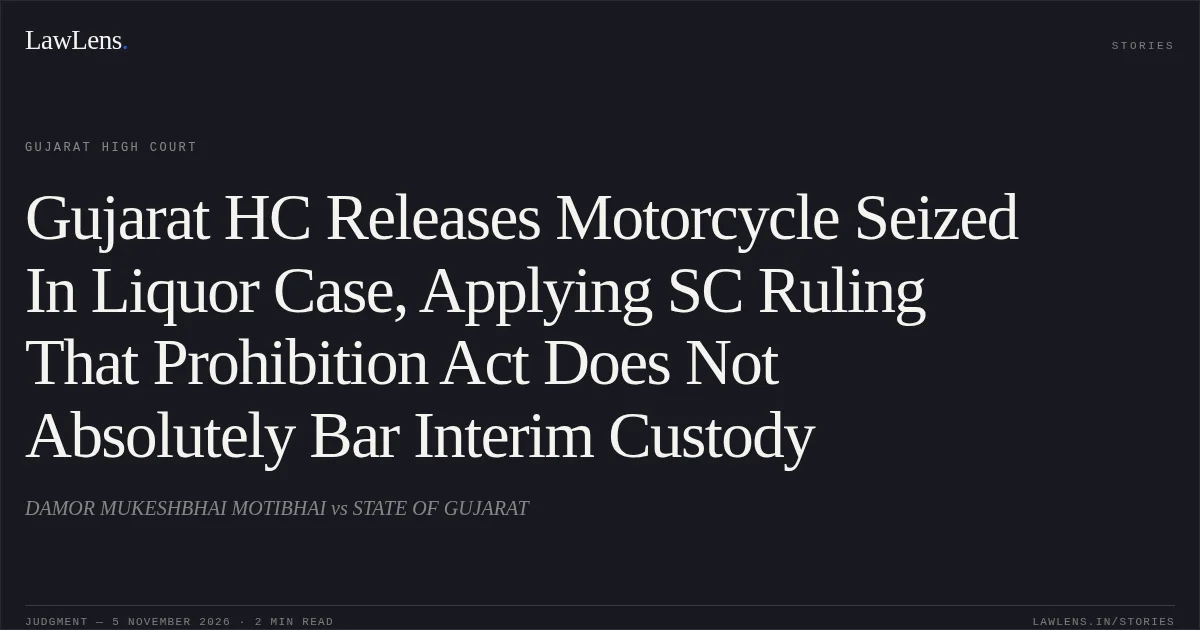
The petitioner, the registered owner of a Pulsar motorcycle, sought its interim release after it was seized in connection with an FIR alleging offences under Sections 65(a), 65(e) and 98(2) of the Gujarat Prohibition Act, 1949.
p. 1The Magistrate rejected his release application, and the Sessions Court dismissed his revision.
pp. 1–3The petitioner argued that continued retention would cause deterioration of the vehicle and produced a finance company’s no-objection certificate.
pp. 1–3The State relied on the Act’s confiscation provisions but did not dispute the High Court’s power to order release.
pp. 1–302Issues
i.1. Whether the High Court could order interim release of a vehicle seized in a prohibition offence despite the confiscation provisions in Section 98(2) of the Gujarat Prohibition Act, 1949
pp. 3–4ii.2. Whether the vehicle should be released to the petitioner subject to conditions securing its production and preventing its transfer pending trial
pp. 4–503Law Applied
Articles 226 and 227 of the Constitution of India and Section 497 of the Bharatiya Nagarik Suraksha Sanhita, 2023 empower the Court to order appropriate interim custody of seized property.
p. 3In Sunderbhai Ambalal Desai v. State of Gujarat, the Supreme Court held that seized vehicles should not be left to deteriorate at police stations and may be handed over on appropriate bonds, guarantees and security.
p. 3The Court also relied on Musa Khan Jat v. State of Gujarat, in which a vehicle was released in an analogous case, and M/s ABC Express v. State of Gujarat, which held that Section 98(2) of the Gujarat Prohibition Act does not impose an absolute bar on interim release of a seized vehicle pending trial.
p. 4Provisions in the judgment · 4 · Linked ones open on LawLens
Bharatiya Nagarik Suraksha Sanhita, 2023 Section 497
Gujarat Prohibition Act, 1949. Section 65Section 98
Code of Criminal Procedure, 1973 Section 451
04Reasoning
The petitioner was the registered owner of the seized motorcycle, and the record included the finance company’s no-objection certificate.
pp. 2–5The Court considered the risk that continued police custody would cause the vehicle to deteriorate, applying the reasoning in Sunderbhai Ambalal Desai.
pp. 2–5It concluded that Section 98(2) did not prevent interim release, while conditions requiring security, an undertaking against transfer and production of the vehicle would protect the proceedings.
pp. 2–505Holding
The High Court allowed the petition and directed release of the motorcycle upon the petitioner furnishing solvent surety equal to the vehicle’s price stated in the FIR, undertaking not to transfer it until final disposal of the trial, and producing it as directed.
pp. 4–5The Court further directed that the vehicle be photographed and a panchnama prepared before release, that the material be included with the charge-sheet papers, and that the relevant RTO be notified of the restraint on transfer.
pp. 4–5The order also provided for confiscation of the vehicle in the event of a subsequent offence.
pp. 4–5Original Court PDF
DAMOR MUKESHBHAI MOTIBHAIvsSTATE OF GUJARAT
Click to open original judgment
Original judgment, available to read, download and summarize on LawLens.in