01Facts
The landlord let the tenant premises comprising a room, kitchen, bathroom and toilet.
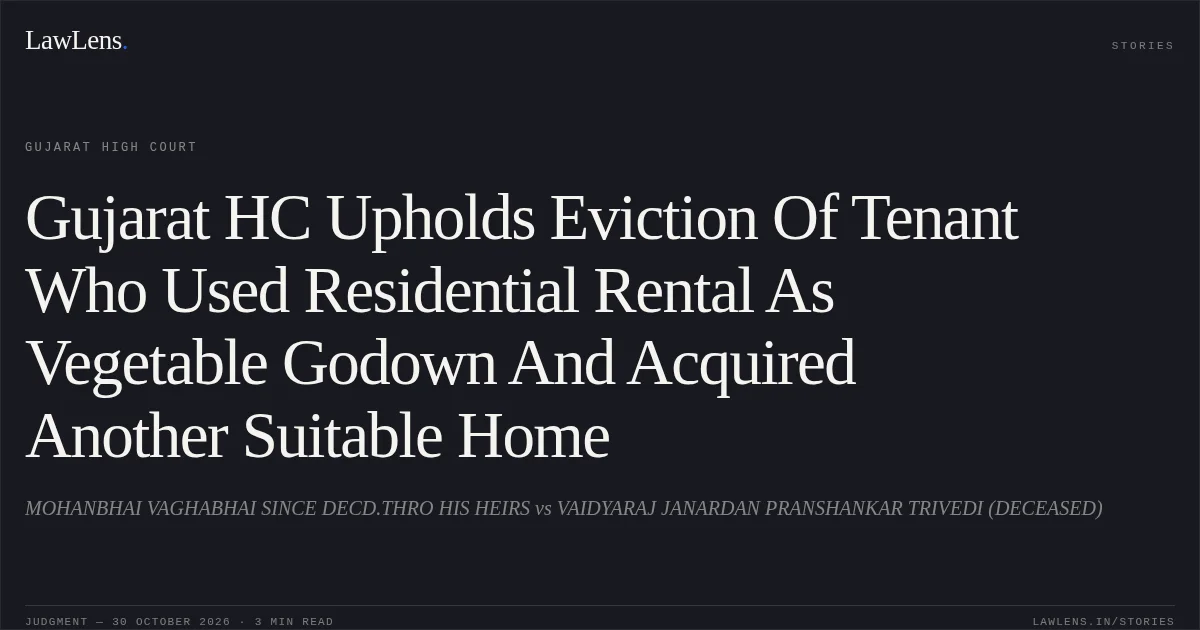
¶ 2–6The landlord alleged that the premises had been let for residential use but were used by the tenant as a vegetable-storage godown, and that the tenant had acquired another suitable residence.
¶ 2–6The tenant disputed the original purpose of the letting. The Trial Court ordered eviction under Sections 13(1)(k) and 13(1)(l) of the Bombay Rents, Hotel and Lodging House Rates Control Act, 1947; the Appellate Court affirmed. The tenant challenged the concurrent decisions in revision under Section 29(2).
¶ 2–6The High Court heard the tenant’s submissions; no respondent appeared despite service.
¶ 1, 802Issues
i.Whether the concurrent finding that the premises were let for residential use and later used commercially, without reasonable cause, disclosed grounds for eviction under Section 13(1)(k).
¶ 11–13ii.Whether the tenant’s acquisition of another suitable residence justified eviction under Section 13(1)(l).
¶ 11, 14iii.Whether the lower courts’ findings or their treatment of additional evidence warranted interference or remand in revision.
¶ 9–10.1, 15–1703Law Applied
Section 13(1)(k) of the Rent Act permits recovery of possession where premises have, without reasonable cause, not been used for the purpose for which they were let for a continuous period of six months immediately preceding the suit; Section 13(1)(l) permits recovery where, after the Act came into operation, the tenant has built, acquired vacant possession of, or been allotted a suitable residence.
¶ 11Under Section 29(2), the High Court’s revisional jurisdiction is not a fresh appeal: Hindustan Petroleum Corporation Ltd. v. Dilbahar Singh, (2014) 9 SCC 78, permits interference with factual findings where they are perverse, unsupported by evidence, reached by ignoring or misreading material evidence, or otherwise grossly erroneous, but not merely because another view is possible.
¶ 10–10.1Order XLI Rule 27 CPC concerns additional evidence at the appellate stage; the judgment also considered whether the tenant had sought an opportunity to prove that evidence orally.
¶ 7.2, 15Provisions in the judgment · 1 · Linked ones open on LawLens
Transfer of Property Act, 1882 Section 108
04Reasoning
The Court found no perversity in the concurrent conclusion that the letting was residential: the premises were in a residential zone and residential neighbourhood, included residential facilities, and the landlord occupied the upper floor; the municipality had also issued a notice against commercial use.
¶ 11.1–14The tenant admitted using the premises as a godown, acquiring another residence, and that the premises were in a residential zone, but produced no material establishing commercial use from the outset.
¶ 11.1–14On the balance of probabilities, the Court upheld the finding of change of use and the finding that the tenant had acquired suitable accommodation.
¶ 11.1–14As to additional evidence, counsel acknowledged that no request had been made to the Appellate Court to lead oral evidence; the tenant also failed to show that the documents would establish commercial use from inception. The Court therefore found no basis for remand.
¶ 15–15.1Applying the limited revisional standard, it declined to reassess the evidence merely because another view might be possible.
¶ 10.1, 1705Holding
The High Court held that the landlord had established grounds for eviction under Sections 13(1)(k) and 13(1)(l), and that no error warranting revisional interference had been shown.
¶ 16–17The revision application was dismissed, the interim relief was vacated, the Rule was discharged, and the landlord’s legal representatives were permitted to execute the eviction decree in accordance with law.
¶ 18No order as to costs; the record and proceedings were directed to be returned forthwith.
¶ 18Original Court PDF
MOHANBHAI VAGHABHAI SINCE DECD.THRO HIS HEIRSvsVAIDYARAJ JANARDAN PRANSHANKAR TRIVEDI (DECEASED)
Click to open original judgment
Original judgment, available to read, download and summarize on LawLens.in