Facts
The petitioner and respondent no. 2 were married on 16 April 2017 and had two daughters.
Source reference: paras. 2–3; pp. 1–2Their younger daughter died on 12 November 2022, while their elder daughter, Km. Nanika Dora, born on 15 December 2018, was the corpus.
Source reference: paras. 2–3; pp. 1–2Following strained relations, the parties began living separately, and the petitioner alleged that his interaction with the child, including telephonic and video communication, was completely restricted.
Source reference: paras. 2–3; pp. 1–2Respondent no. 2 had already instituted a child-custody case under Section 35 of the Uniform Civil Code, Uttarakhand, 2024, before the Principal Judge, Family Court, Dehradun.
Source reference: paras. 2–3; pp. 1–2The petitioner appeared in that case and filed an application seeking visitation and telephonic/video-call access, which remained pending.
Source reference: paras. 2–3; pp. 1–2He consequently filed the present habeas corpus petition seeking production and custody of the child.
Source reference: paras. 2–3; pp. 1–2Issues
1. Whether a habeas corpus petition under Article 226 of the Constitution is maintainable to seek custody or visitation of a minor child when a child-custody proceeding is already pending before the competent Family Court.
Source reference: paras. 5–9; pp. 2–42. Whether the custody of the minor child with her mother could be regarded as illegal or without authority of law so as to justify issuance of a writ of habeas corpus.
Source reference: paras. 7, 10–11; pp. 3–4Law Applied
The Court applied Article 226 of the Constitution and the principle that habeas corpus is an extraordinary remedy available in child-custody matters where the minor is in illegal custody or is detained by a person without legal authority.
Source reference: paras. 5, 8Relying on Tejaswini Gaud v. Shekhar Jagdish Prasad Tewari , (2019) 7 SCC 42, particularly paragraphs 14 and 19, the Court held that habeas corpus may restore custody where a minor has been wrongfully deprived of custody by a person who is not the legal or natural guardian, but is not ordinarily available merely to adjudicate competing parental custody or visitation claims.
Source reference: paras. 5, 8The Court further relied on Nirmala v. Kulwant Singh , (2024) 10 SCC 595, para 27, for the principle that there is no rigid rule regarding maintainability and that exercise of Article 226 jurisdiction depends on the facts of each case.
Source reference: para. 9The paramount consideration in child-custody matters is the welfare and overall interest of the child.
Source reference: para. 7Reasoning
The Court held that the petitioner’s grievance principally concerned visitation and parental interaction, for which he had already moved an application in the pending child-custody case before the competent Family Court.
Source reference: paras. 3, 10The pendency of that application did not, by itself, render the ordinary remedy legally ineffective so as to warrant extraordinary habeas corpus jurisdiction.
Source reference: paras. 3, 10Since the child was in the custody of her mother, who was treated by the Court as her natural guardian, the custody could not be characterised as illegal or without authority of law.
Source reference: paras. 7, 10Accordingly, the essential condition for invoking habeas corpus in a minor-custody matter, namely unlawful or unauthorised detention, was absent.
Source reference: paras. 8, 10–11Holding
The Court answered the issues against the petitioner.
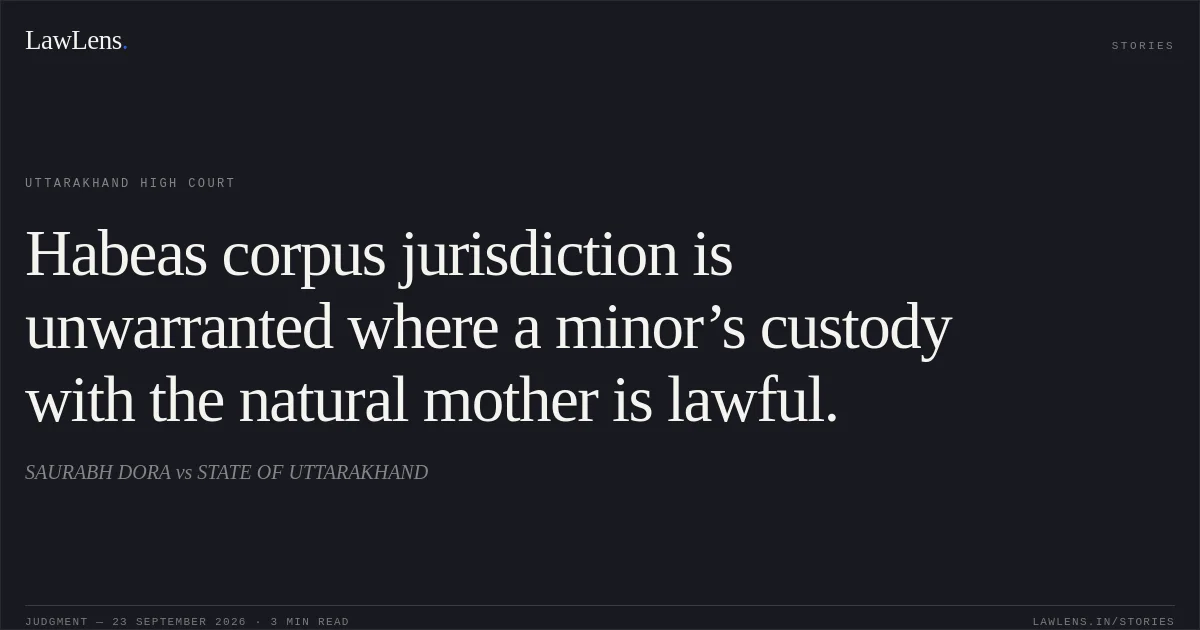
It held that Article 226 jurisdiction should not be invoked where the minor is in the lawful custody of her mother and an appropriate child-custody proceeding, including the petitioner’s visitation application, is pending before the competent Family Court.
Source reference: paras. 10–11The habeas corpus petition was dismissed in limine at the admission stage, with no direction for production or transfer of the child’s custody.
Source reference: para. 12Acts & Sections Cited
1 provisions across 1 statute referred to in this judgment. Linked provisions open on LawLens.
Uttarakhand Uniform Civil Code, 20241
Original Court PDF
SAURABH DORAvsSTATE OF UTTARAKHAND
Click to open original judgment
Original judgment, available to read, download and summarize on LawLens.in