Facts
In 1997, Appellant No. 1 (PCP), a German company, entered into a Joint Venture (JV) with Respondents 6 and 7, leading to the incorporation of Respondent No. 5 (PIP).
Source reference: para 2-4In 2004, a second JV agreement (JVA-II) was signed to increase PCP’s stake, but PCP terminated the agreement in 2005 and established a Wholly Owned Subsidiary, Appellant No. 2 (PCM).
Source reference: para 5-7PCP invested approximately ₹55 crores in PCM under the "automatic route," declaring it had no previous JV in the same field.
Source reference: para 8-9PIP challenged this, alleging violation of Press Note 1 (2005 Series), which requires prior Government approval if a foreign investor has an existing JV in the "same field".
Source reference: para 10-12In 2007, the Government found a prima facie violation of FDI policy.
Source reference: para 21PCP subsequently applied for ex-post facto approval in 2009.
Source reference: para 28A Committee constituted by the Foreign Investment Promotion Board (FIPB) heard both parties on 17.03.2010.
Source reference: para 32However, the Committee was later reconstituted, and a new Chairperson conducted the final meeting on 04.08.2010 without a fresh oral hearing.
Source reference: para 35-37Based on the Committee's recommendation that no "jeopardy" was caused to the Indian partner, the Government granted ex-post facto approval on 29.09.2010.
Source reference: para 37-39A Single Judge set aside this approval on 29.10.2024, citing a violation of natural justice as the Chairperson who heard the matter did not decide it.
Source reference: para 43PCP appealed this decision.
Source reference: para 1Issues
1. Whether the Government's decision to grant ex-post facto approval under Press Note 1 (2005 Series) constitutes a policy decision, and what is the permissible scope of judicial review under Article 226?
Source reference: para 73, 812. Whether the reconstitution of the Committee and the subsequent grant of approval without a fresh oral hearing by the new Chairperson violated the principles of natural justice?
Source reference: para 73, 91Law Applied
The Court applied the guidelines of Press Note 1 (2005 Series) and Press Note 3 (2005 Series), which regulate foreign investment in existing JVs.
Source reference: para 12-13It relied on LIC v. Escorts Ltd. (1986), establishing that statutory "permission" may include ex-post facto validation unless the statute expressly requires "prior" or "previous" permission.
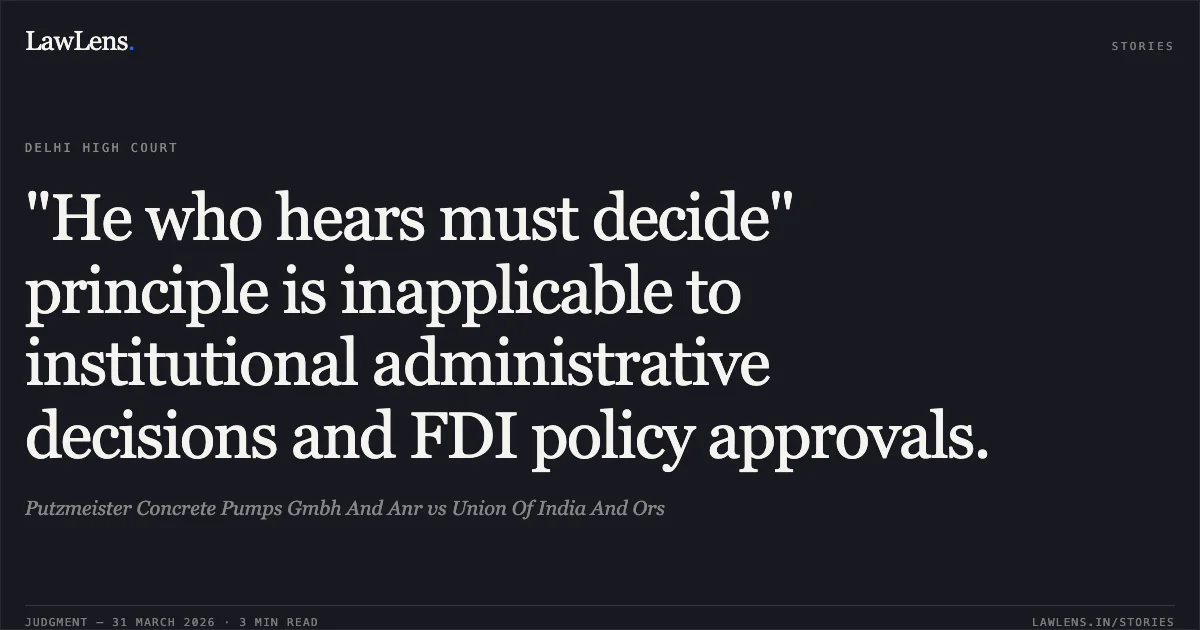
Source reference: para 105Regarding natural justice, the Court distinguished Gullapalli Nageswara Rao v. APSRTC (1959), which held "he who hears must decide" in quasi-judicial contexts.
Source reference: para 93It instead applied the doctrine of "Institutional Decisions" as discussed in Ossein and Gelatine Manufacturers' Assn. v. Modi Alkalies (1989) and Kalinga Mining Corpn. v. Union of India (2013), which permits administrative decisions to be reached through departmental processes where the decision-maker is the institution rather than a specific officer.
Source reference: para 108-113Reasoning
The Court reasoned that granting FDI approval is a policy decision aimed at the "ease of doing business" and national economic interest.
Source reference: para 78, 81Judicial review of such decisions is limited to instances of constitutional violation, malice, or gross arbitrariness.
Source reference: para 84The Court found that the FIPB and its Committee were merely recommendatory bodies aiding the Government's administrative function.
Source reference: para 89Unlike quasi-judicial proceedings (e.g., blacklisting), where the "he who hears must decide" rule is stringent, the current matter involved an "institutional decision".
Source reference: para 94-96, 108The Court noted that the reconstituted Committee considered all previous minutes, written representations, and inter-departmental opinions before concluding that the Indian partner suffered no "jeopardy".
Source reference: para 114-115It held that in administrative policy matters, a written representation often suffices, and since the material facts were known to all parties, the lack of a second oral hearing by the new Chairperson did not vitiate the process.
Source reference: para 88-90Holding
The Division Bench allowed the appeal and set aside the Single Judge's judgment.
The Court held that the ex-post facto approval dated 29.09.2010 was a valid administrative/policy decision that did not suffer from procedural infirmity.
Source reference: para 84, 115The Court concluded that the requirements of natural justice were met as the parties had ample opportunity to submit written evidence and were heard by the initial Committee, whose records were considered by the final decision-making authority.
Source reference: para 90, 114The Government's approval was restored.
Source reference: para 117Acts & Sections Cited
2 provisions across 2 statutes referred to in this judgment. Each provision opens on LawLens.
Delhi School Education Act, 19731
Van (Sanrakshan Evam Samvardhan) Adhiniyam, 19801
Original Court PDF
Putzmeister Concrete Pumps Gmbh And AnrvsUnion Of India And Ors
Click to open original judgment
Original judgment, available to read, download and summarize on LawLens.in