Facts
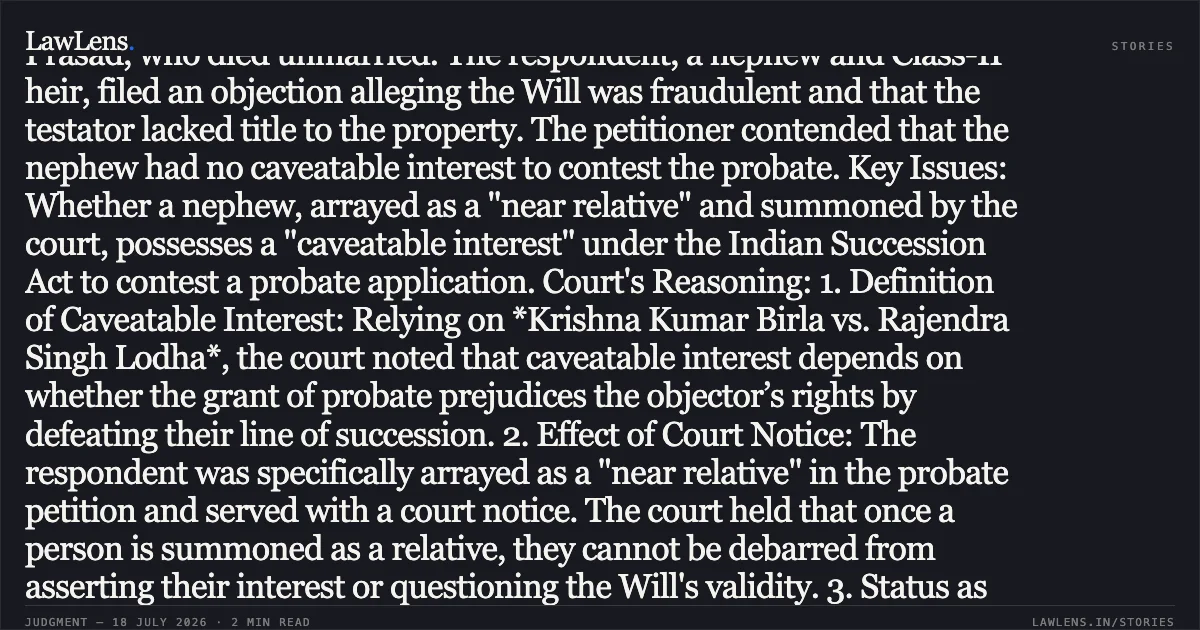
The petitioner filed Probate Case No. 08 of 2015 seeking probate of a registered Will dated 14.10.2009 executed by Late Ghanshyam Prasad
Source reference: para. 3The respondent, the nephew of the deceased, was arrayed as a "near relative" in the probate petition and served with a court notice
Source reference: para. 5, 6The respondent filed an objection/caveat, asserting that the deceased died unmarried and without issue, making the respondent and other Class-II heirs the legal successors to the property (House No. MIG 40, Gaya)
Source reference: para. 6The respondent further alleged that the Will was fraudulent and that the petitioner had suppressed the existence of another sister of the deceased
Source reference: para. 7, 8This application seeks to quash the lower court's order dated 22.09.2015, which allowed the respondent's participation
Source reference: para. 2Issues
Whether the respondent, being the nephew and a Class-II heir of the testator, possesses a "caveatable interest" to contest the grant of probate
Source reference: para. 9Law Applied
Section 284 of the Indian Succession Act, 1925, which governs the filing of caveats against the grant of probate
Source reference: para. 14, 15Krishna Kumar Birla v. Rajendra Singh Lodha (2008) 4 SCC 300, which establishes that "caveatable interest" is not defined by strict qualification but depends on whether the grant of probate prejudices the caveator’s right by defeating another line of succession
Source reference: para. 10, 13G. Gopal v. C. Baskar & Ors., noting that even a "slight interest" in the estate entitles a person to file a caveat
Source reference: para. 12Reasoning
The court reasoned that since the respondent is a Class-II heir under the Hindu Succession Act, he would have a right to the property via intestate succession if the Will were found invalid
Source reference: para. 6, 17The court noted that the petitioner himself arrayed the respondent as a "near relative" and the court issued summons to him; therefore, debarring him from asserting his interest would render the summoning process meaningless
Source reference: para. 14The court found that the petitioner’s failure to implead another Class-II heir (the testator's sister, Savitri Devi) suggested a lack of bona fide intention
Source reference: para. 17Applying the "prejudice" test from Krishna Kumar Birla, the court determined that because the probate would defeat the respondent's potential line of succession, a substantial caveatable interest exists
Source reference: para. 10, 17Holding
The court answered the issue in the affirmative, holding that the respondent possesses a caveatable interest in the subject matter of the Will
the Civil Miscellaneous application was dismissed, and the lower court's order allowing the respondent's objection was upheld
Source reference: para. 18Acts & Sections Cited
1 provisions across 1 statute referred to in this judgment. Each provision opens on LawLens.
Indian Succession Act, 19251
Original Court PDF
Tripurari Sharan PandeyvsArun kumar Sinha
Click to open original judgment
Original judgment, available to read, download and summarize on LawLens.in