01Facts
Respondent No. 1, a retired officer of Vijaya Bank, was covered under the Indian Banks’ Association health insurance scheme after Vijaya Bank’s merger with Bank of Baroda. He paid the requisite premium for coverage from 1 November 2021 to 31 October 2022, with annual coverage of ₹9,00,000.
¶ 2–3He was undergoing treatment for Stage IV prostate carcinoma, including chemotherapy at HCG Hospital, Bengaluru, and was prescribed periodic Zoladex and Xgeva injections as part of his continuing cancer treatment.
¶ 4, 13.1–13.8Although the insurer reimbursed several hospitalisation-related expenses, it declined reimbursement of the expenses incurred towards the injections. Respondent No. 1 consequently claimed ₹2,85,470 before the Permanent Lok Adalat under Section 22-C of the Legal Services Authorities Act, 1987.
¶ 5–6After recording failure of conciliation, the Permanent Lok Adalat adjudicated the dispute and directed payment of ₹2,85,470 with interest at 6% per annum, together with ₹25,000 as compensation.
¶ 8–9On an application under Section 152 of the Code of Civil Procedure, the operative portion was modified to place the payment liability on the petitioners-insurers.
¶ 10The insurers challenged both orders under Articles 226 and 227 of the Constitution, contending that the injections were outpatient treatment and did not fall within the policy definitions of “Day Care Treatment” or “Hospitalisation”.
¶ 11–12.1802Issues
i.1. Whether the matter should be remanded to the Permanent Lok Adalat for undertaking or continuing the conciliation process contemplated under Section 22-C of the Legal Services Authorities Act, 1987?
¶ 17, Point No. 1ii.2. Whether the Permanent Lok Adalat’s award directing reimbursement of the expenses incurred towards Zoladex and Xgeva injections suffered from any legal or jurisdictional infirmity warranting interference under Articles 226 and 227 of the Constitution?
¶ 17, Point No. 203Law Applied
The Court applied Section 22-C(4)–(8) of the Legal Services Authorities Act, 1987, under which a Permanent Lok Adalat must first conduct conciliation and assist the parties in reaching an amicable settlement; if settlement fails, it may decide the dispute on merits.
¶ 12.1–12.4, 19.2–19.3The Court considered Clauses 2.10 and 2.19 of the insurance policy, defining “Day Care Treatment” and “Hospitalisation,” respectively.
¶ 12.10It reaffirmed that insurance contracts must ordinarily be construed according to their terms, but exclusionary provisions in health insurance policies must be read in the context of the policy as a whole and cannot be applied through an unduly restrictive or isolated interpretation where the treatment is demonstrably connected with the insured disease.
¶ 20.13, 20.17The Court also applied the limited scope of writ review over an adjudicatory award, holding that interference is unwarranted unless the decision is legally erroneous, perverse, unreasonable, or jurisdictionally defective.
¶ 20.15, 20.20Provisions in the judgment · 1 · Linked ones open on LawLens
Code of Civil Procedure, 1908 Section 152
04Reasoning
The Court accepted that conciliation is an important statutory stage, but held that remand would serve no useful purpose because the insurers had categorically stated that they would make no settlement offer and denied any liability whatsoever.
¶ 19.5–19.13On the merits, the Court found that Zoladex and Xgeva were medically prescribed as part of the continuing management of Respondent No. 1’s Stage IV prostate cancer and were not treatments for unrelated conditions.
¶ 20.2–20.4The fact that the injections were administered periodically and without hospitalisation did not sever their connection with the insured disease.
¶ 20.5–20.12Hospitalisation was treated as a mode of treatment rather than an end in itself; denying coverage merely because medical advancement made hospitalisation unnecessary would produce an anomalous and unduly technical result.
¶ 20.5–20.12Since the insurer had reimbursed other cancer-treatment expenses and did not dispute the disease, prescriptions, or actual expenditure, the Permanent Lok Adalat’s conclusion was neither perverse nor contrary to the policy so as to justify writ interference.
¶ 20.11, 20.15, 20.2005Holding
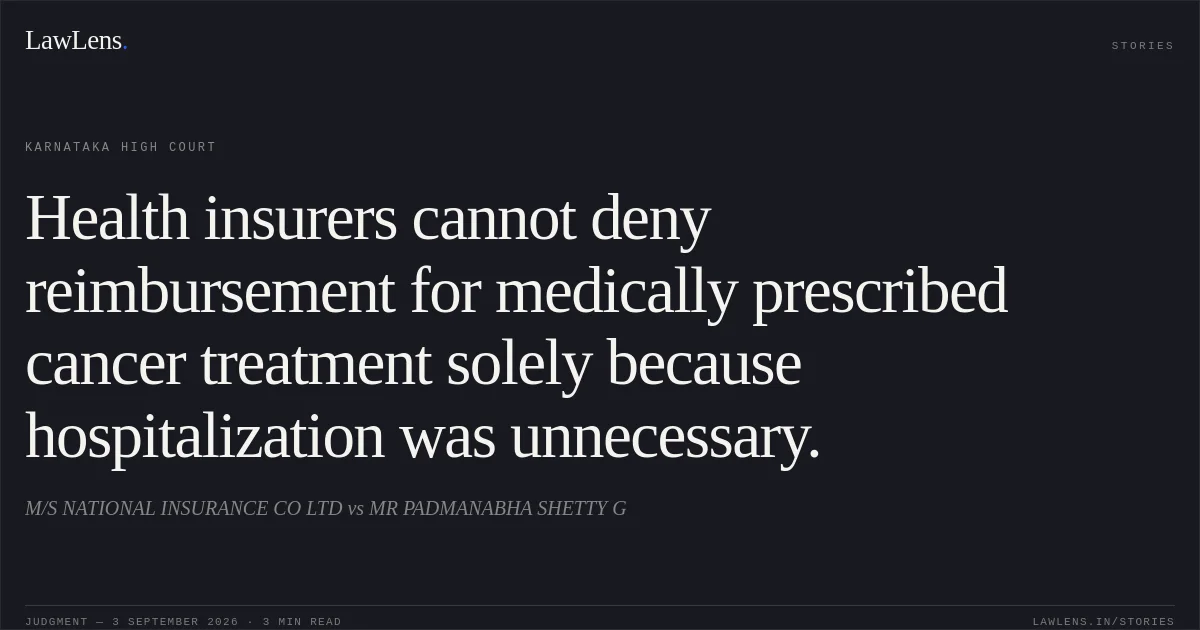
The Court answered the first issue against remand, holding that although conciliation is integral to the Section 22-C procedure, remand was unnecessary in the absence of any realistic prospect of settlement.
¶ 19.14It answered the second issue in the negative, holding that the Permanent Lok Adalat’s award did not suffer from any legal or jurisdictional infirmity and that reimbursement of the Zoladex and Xgeva expenses was sustainable.
¶ 20.21The writ petition was dismissed with nominal costs of ₹50,000 payable by the insurers to Respondent No. 1 within 30 days.
¶ 21.1The insurers were further directed to pay the amounts awarded by the Permanent Lok Adalat, with up-to-date interest, within 30 days of receiving the order.
¶ 21.1Original Court PDF
M/S NATIONAL INSURANCE CO LTDvsMR PADMANABHA SHETTY G
Click to open original judgment
Original judgment, available to read, download and summarize on LawLens.in