Facts
The deceased, Yogeshbhai Mansingbhai, was driving a tractor owned by Defendant No. 2 (Respondent), which had been borrowed by a friend for agricultural purposes
Source reference: para. 4, 10The deceased lost control of the vehicle, causing it to turn turtle, resulting in his death
Source reference: para. 4The heirs of the deceased filed a claim petition under Section 166 of the Motor Vehicles Act (MVA), 1988, alleging negligence. The Tribunal awarded ₹9,45,000/- with 9% interest, holding the Insurance Company and owner jointly and severally liable
Source reference: para. 1The Insurance Company appealed, contending that the deceased was the tortfeasor and not a "third party," and that there was a breach of policy conditions regarding the driver's license
Source reference: para. 4, 4.1Issues
1. Whether a claim petition under Section 166 of the MVA, 1988, is maintainable by the heirs of a deceased driver who was the sole tortfeasor in an accident involving no other vehicle
Source reference: para. 8, 92. Whether the deceased driver could be classified as a "paid driver" or "third party" to fix statutory liability on the insurance company
Source reference: para. 8, 103. Whether the Insurance Company proved a breach of policy terms regarding the lack of a valid driving license
Source reference: para. 13Law Applied
The court applied Section 166 of the MVA, 1988, which is based on the principle of "fault liability"
Source reference: para. 9It relied on Ningamma v. United India Insurance Co. Ltd. [(2009) 13 SCC 710], which establishes that a borrower of a vehicle steps into the shoes of the owner and cannot claim compensation for their own negligence under Section 166 or 163-A
Source reference: para. 11Regarding the driver's license, the court applied National Insurance Co. Ltd. v. Swaran Singh [(2004) 3 SCC 297], holding that the insurer bears the burden of proving a "breach" by the insured
Source reference: para. 4.2, 13the court noted the contractual liability for Personal Accident (PA) cover under the insurance policy
Source reference: para. 12Reasoning
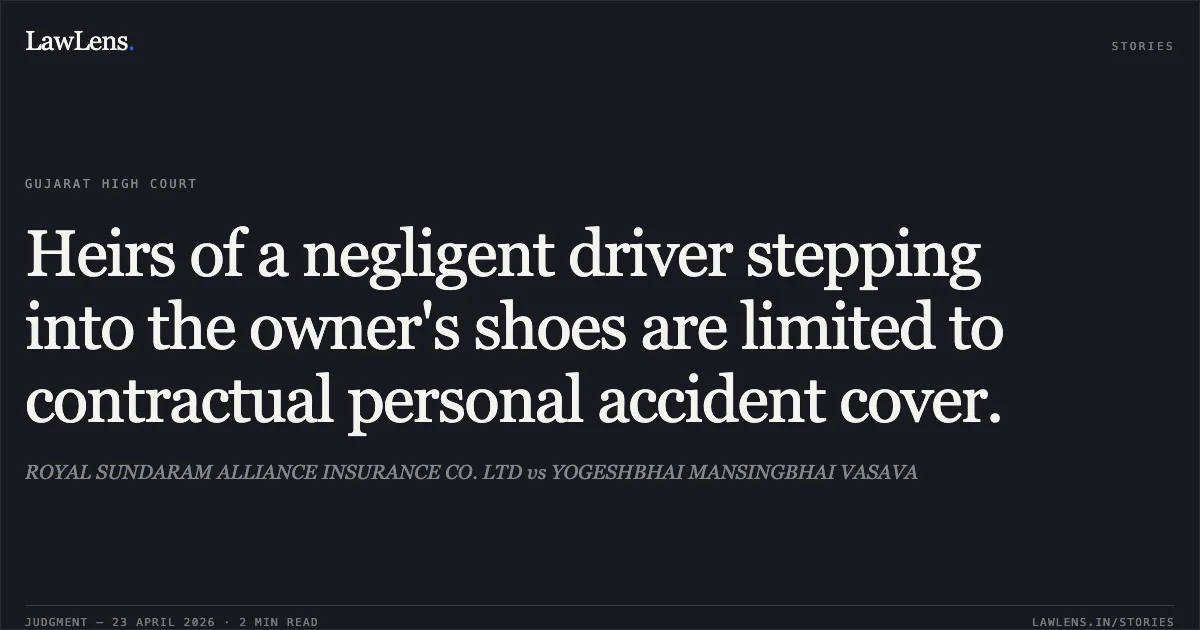
The Court reasoned that since Section 166 requires proof of negligence by another party, the heirs of the deceased—who was the sole tortfeasor—cannot maintain a claim against the insurer of the vehicle he was driving
Source reference: para. 9Because the deceased was hired by a borrower and not the insured owner, he did not qualify as a "paid driver" under the policy's specific legal liability (IMT 28) but rather stepped into the owner's shoes
Source reference: para. 10, 14the court found that the policy (Exh. 40) included a premium for Personal Accident benefits for the owner/driver
Source reference: para. 12Regarding the driving license, the court held the Insurance Company failed to meet its burden of proof; the owner's testimony that he was "assured" of the driver's license by the borrower remained uncontradicted by any documentary evidence from the insurer
Source reference: para. 13Holding
The claim under Section 166 was not maintainable for the full award due to the deceased's own negligence; Liability was restricted to the contractual Personal Accident cover of ₹2,00,000/- with 9% interest
The High Court allowed the appeal in part and modified the judgment. The Insurance Company was directed to be refunded the excess amount deposited (approx. ₹7,45,000/-) from the Tribunal
Source reference: para. 17, 18, 19Acts & Sections Cited
3 provisions across 1 statute referred to in this judgment. Each provision opens on LawLens.
Motor Vehicles Act, 19883
Original Court PDF
ROYAL SUNDARAM ALLIANCE INSURANCE CO. LTDvsYOGESHBHAI MANSINGBHAI VASAVA
Click to open original judgment
Original judgment, available to read, download and summarize on LawLens.in