Facts
The petitioner sought quashing of FIR Crime No. 298/2024 registered at Police Station Aishbagh, Bhopal, for offences under Sections 354 and 506 IPC and Sections 7 and 8 of the POCSO Act.
Source reference: para. 2The prosecution alleged that on 28 May 2024, when the minor victim was alone at home, the petitioner entered the house, attempted to outrage her modesty, and threatened her with death if she disclosed the incident.
Source reference: para. 2The victim supported the allegations in statements recorded under Sections 161 and 164 CrPC.
Source reference: para. 2After investigation, the police filed a charge-sheet, and the case was pending before the II Additional Sessions Judge, Bhopal, as Special Case No. SC/298/2024.
Source reference: para. 2The petitioner claimed false implication arising from a house-related dispute with the victim’s father, relied on his alleged 98% visual disability, and referred to an earlier NCR and police representation made by him against the victim’s father.
Source reference: para. 3The State opposed quashing, contending that the defence materials and allegations of false implication could not be adjudicated in proceedings under Section 482 CrPC/Section 528 BNSS and were matters for trial.
Source reference: para. 4Issues
Whether the FIR and consequential criminal proceedings disclosed a prima facie commission of offences under Sections 354 and 506 IPC and Sections 7 and 8 of the POCSO Act so as to justify their continuation.
Source reference: paras. 2, 19–20Whether the High Court could rely upon the petitioner’s external defence materials, including his disability certificate, prior NCR, and alleged house dispute, to quash the FIR under Section 482 CrPC/Section 528 BNSS.
Source reference: paras. 3–4, 16Whether the High Court could assess the truthfulness, reliability, or sufficiency of the victim’s statements and other investigative material at the stage of quashing.
Source reference: paras. 17–19Law Applied
The Court exercised its inherent jurisdiction under Section 528 of the Bharatiya Nagarik Suraksha Sanhita, corresponding to Section 482 CrPC, to determine whether quashing was necessary to prevent abuse of process or secure the ends of justice.
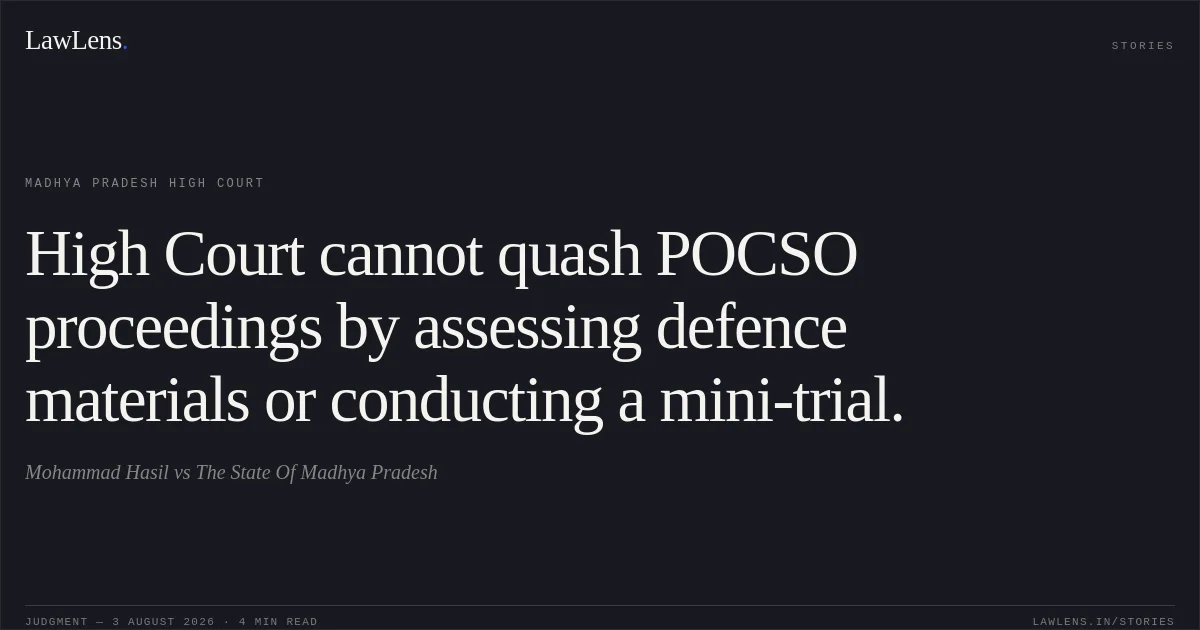
Source reference: paras. 6, 10It applied the principles in Supriya Jain v. State of Haryana, Amit Kapoor v. Ramesh Chander, and State of Haryana v. Bhajan Lal, namely that quashing is an exceptional power to be exercised sparingly; the Court must examine whether the uncontroverted allegations prima facie constitute an offence; and it must not conduct a mini-trial or assess the reliability of evidence.
Source reference: paras. 6–7The Court further relied on CBI v. Aryan Singh, Abhishek v. State of M.P., Mahendra K.C. v. State of Karnataka, State of Maharashtra v. Maroti, and Manik B. v. Kadapala Sreyes Reddy, holding that factual disputes, evidentiary sufficiency, and witness credibility must be determined at trial.
Source reference: paras. 8–9, 13, 17–18Materials produced by the accused that were not part of the prosecution record could not ordinarily be considered for quashing.
Source reference: paras. 11–16The Court also relied on Iqbal v. State of U.P. for the principle that, after filing of the charge-sheet, the trial court should assess the material collected by the investigating agency, including in a discharge application.
Source reference: para. 19Reasoning
The FIR and the victim’s statements attributed to the petitioner specific conduct amounting, at least prima facie, to an attempt to outrage the victim’s modesty and criminal intimidation, with the victim being a minor for purposes of the POCSO allegations.
Source reference: paras. 2, 4, 19Since the investigation had concluded and a charge-sheet had been filed, the Court considered that the prosecution material disclosed sufficient grounds for the petitioner to face trial.
Source reference: paras. 2, 19The petitioner’s reliance on his visual disability, the alleged property dispute, the prior NCR, and the asserted false implication constituted matters of defence and external material; they could not be used by the High Court to undertake a factual inquiry or weigh competing versions in a quashing petition.
Source reference: paras. 3, 4, 16Whether the allegations were truthful, whether the victim’s statements were reliable, and whether the prosecution could ultimately prove the offences were matters for the trial court and could not be decided through a mini-trial under Section 482 CrPC/Section 528 BNSS.
Source reference: paras. 8, 17–19Holding
The Court held that the case was not a fit one for exercise of inherent jurisdiction because the FIR, victim’s statements, and charge-sheet disclosed a prima facie case requiring trial.
The petition under Section 528 BNSS was dismissed, and the FIR and consequential criminal proceedings were not quashed.
Source reference: para. 21The Court clarified that its observations were confined to adjudication of the quashing petition and would not influence the trial court, which was directed to decide the matter independently and in accordance with law.
Source reference: para. 22Acts & Sections Cited
17 provisions across 4 statutes referred to in this judgment. Each provision opens on LawLens.
Bharatiya Nagarik Suraksha Sanhita, 20231
Code of Criminal Procedure, 1973
Indian Penal Code, 18603
Original Court PDF
Mohammad HasilvsThe State Of Madhya Pradesh
Click to open original judgment
Original judgment, available to read, download and summarize on LawLens.in