Facts
The petitioner sought quashing of FIR Crime No. 538/2024 registered at Police Station Aishbagh, Bhopal, under Sections 296, 115(2) and 351(2) of the Bharatiya Nyaya Sanhita, 2023, and the consequential criminal proceedings under Section 528 of the Bharatiya Nagarik Suraksha Sanhita, corresponding to Section 482 of the Code of Criminal Procedure.
Source reference: p.1, para.1The prosecution alleged that the petitioner, who is the victim’s paternal aunt, entered the victim’s house when she was alone, abused her, slapped her, and threatened to kill her if she disclosed the incident.
Source reference: p.1, para.2After investigation, the police filed a charge-sheet, and the case was registered as Case No. RCT/14723/2024 before the XIX Civil Judge, Senior Division, Bhopal.
Source reference: p.1, para.2The petitioner contended that the FIR arose from a civil dispute concerning ownership and possession of the house, and that the complaint was lodged falsely due to an earlier dispute between her husband and the victim’s father.
Source reference: pp.1–2, para.3The State opposed the petition, relying on the named FIR, the allegations of assault and abuse, the material collected during investigation, and the filing of the charge-sheet.
Source reference: p.2, para.4Issues
Whether the FIR and consequential criminal proceedings should be quashed under Section 528 of the BNSS/Section 482 of the CrPC on the ground that the allegations were false, civil in nature, or motivated by mala fides.
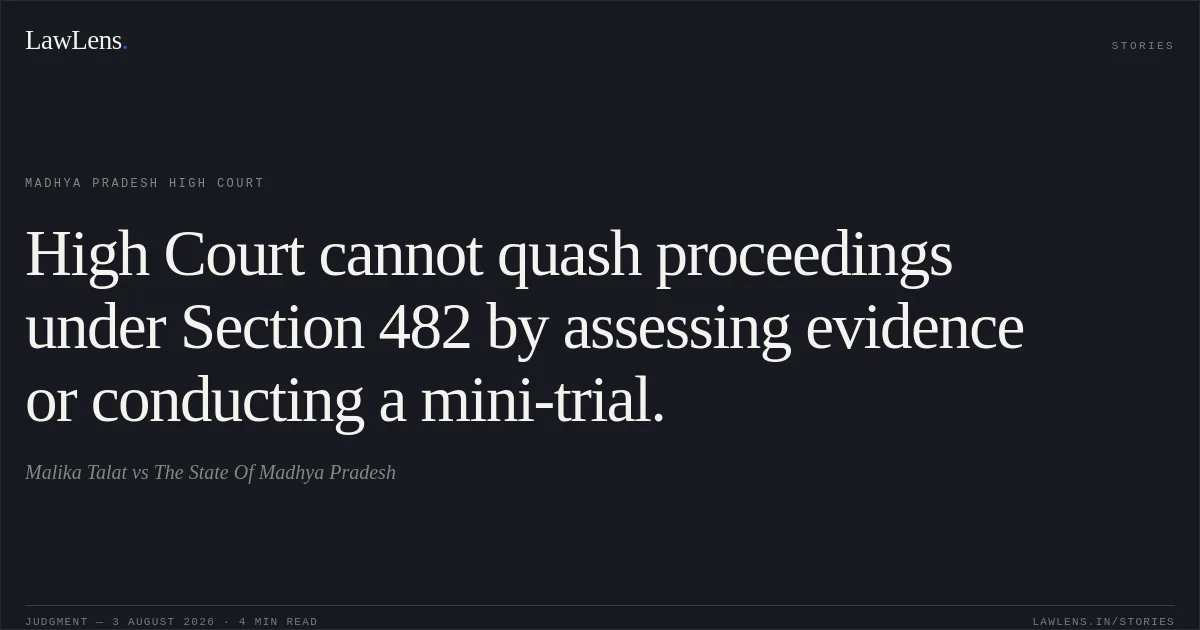
Source reference: pp.1–2, paras.1–4, 10, 20Whether the High Court, while exercising its inherent jurisdiction, could assess the truthfulness, reliability, sufficiency, or admissibility of the prosecution material or conduct a mini-trial.
Source reference: pp.4–7, paras.6–10; pp.15–18, paras.17–19Whether the allegations in the FIR and the material accompanying the charge-sheet prima facie disclosed the offences alleged so as to justify continuation of the prosecution.
Source reference: p.19, paras.19–20Law Applied
The Court applied Section 528 of the BNSS and the corresponding principles governing Section 482 of the CrPC, under which the High Court may quash criminal proceedings to prevent abuse of process or secure the ends of justice, but must exercise that power sparingly and with circumspection.
Source reference: pp.3–7, para.6Relying on Amit Kapoor v. Ramesh Chander, as reiterated in Supriya Jain v. State of Haryana, the Court held that quashing is justified only where the uncontroverted allegations do not prima facie constitute an offence, are patently absurd or inherently improbable, or where continuation would amount to abuse of process.
Source reference: pp.3–7, para.6The Bhajan Lal categories, cited through Gulam Mustafa v. State of Karnataka, were applied as illustrative grounds for quashing, including absence of a cognizable offence, inherent improbability, legal bar, or proceedings instituted maliciously for an ulterior purpose.
Source reference: pp.8–10, para.7The Court further relied on CBI v. Aryan Singh, Abhishek v. State of M.P., Mahendra K.C. v. State of Karnataka, State of Maharashtra v. Maroti, and Manik B. v. Kadapala Sreyes Reddy for the rule that the High Court cannot conduct a mini-trial, appreciate disputed evidence, or determine the truthfulness and admissibility of prosecution material at the quashing stage.
Source reference: pp.10–18, paras.8–18It also relied on Iqbal v. State of U.P. for the principle that, once the charge-sheet has been filed, the trial court should ordinarily assess the investigation material, including through a discharge application where appropriate.
Source reference: p.18, para.19Reasoning
The Court found that the FIR contained specific allegations that the petitioner entered the victim’s house, abused her, assaulted her, and threatened her, and that the victim had supported the prosecution case in her statement recorded during investigation.
Source reference: pp.1, 19, paras.2, 19These allegations, taken at face value, prima facie disclosed the offences alleged and were neither patently absurd nor inherently improbable.
Source reference: pp.3–7, para.6; p.19, paras.19–20The petitioner’s assertions concerning the house dispute, prior complaints by her husband, and the alleged false implication constituted matters requiring factual examination and reliance on material outside the prosecution record; such matters could not be adjudicated in proceedings under Section 528 BNSS/Section 482 CrPC.
Source reference: pp.1–2, para.3; pp.13–15, paras.12–16Since the investigation was complete and a charge-sheet had been filed, the Court held that evaluating the credibility of the victim or the sufficiency and admissibility of the evidence would amount to a mini-trial, which was impermissible at that stage.
Source reference: pp.15–18, paras.17–19The existence of an underlying civil dispute did not, by itself, exclude criminal liability where the allegations also disclosed criminal offences.
Source reference: p.5, para.6Holding
The Court answered the issues against the petitioner and held that the case was not an appropriate one for exercising the inherent power to quash the FIR or the consequential criminal proceedings.
The petition under Section 528 of the BNSS was dismissed.
Source reference: p.19, para.21The Court clarified that its observations were confined to the quashing petition and would not influence the trial court, which was directed to proceed and decide the case in accordance with law.
Source reference: p.19, para.22Acts & Sections Cited
15 provisions across 4 statutes referred to in this judgment. Each provision opens on LawLens.
Bharatiya Nagarik Suraksha Sanhita, 20231
Code of Criminal Procedure, 1973
Bharatiya Nyaya Sanhita, 20233
Indian Penal Code, 18601
Original Court PDF
Malika TalatvsThe State Of Madhya Pradesh
Click to open original judgment
Original judgment, available to read, download and summarize on LawLens.in