Facts
The petitioner, married to respondent No. 5 on 06.02.2022, alleged that matrimonial disputes led to registration of FIR No. 305/2025 under Section 85 of the Bharatiya Nyaya Sanhita, 2023 and Section 4 of the Dowry Prohibition Act.
Source reference: paras. 2–5He stated that the High Court of Chhattisgarh granted him interim protection from arrest and further proceedings on 19.12.2025.
Source reference: paras. 2–5Thereafter, he alleged that police officials detained him, forcibly accessed data from his mobile phone, threatened him, and, on 23.03.2026, apprehended him from the District Court premises at Satna, Madhya Pradesh.
Source reference: paras. 2–5He further alleged that he was handcuffed, taken through Rewa to Champa, subjected to ill-treatment, and produced before the competent Court on 26.03.2026, where he was granted bail.
Source reference: paras. 2–5The petitioner sought, under Article 226 of the Constitution, directions for registration of an FIR against the police officials, an independent investigation by an SIT or other agency, departmental proceedings, and compensation for alleged violations of Articles 14, 21 and 22.
Source reference: paras. 6–9The State opposed the petition on the grounds that the allegations involved disputed questions of fact and that the principal criminal proceedings and allegations concerned Crime No. 37/2026 registered in Chhattisgarh.
Source reference: paras. 6–9The petitioner had also approached the High Court of Chhattisgarh in Writ Petition (Cr.) No. 259/2026 concerning the same incident, in which notice had been issued to respondent No. 4.
Source reference: para. 12Issues
Whether this Court should exercise its writ jurisdiction in relation to Crime No. 37/2026 and the conduct of police officials of Chhattisgarh when substantially overlapping proceedings were already pending before the High Court of Chhattisgarh?
Source reference: paras. 11–12, 19Whether the allegations of illegal inter-State arrest, handcuffing, custodial ill-treatment, unlawful detention, threats, and compelled access to mobile-phone data warranted a direction for registration of an FIR, an independent investigation, or other relief under Article 226?
Source reference: paras. 13–15, 20Whether the petitioner was entitled to compensation for alleged violations of his fundamental rights under Articles 14, 21 and 22 of the Constitution?
Source reference: para. 18Law Applied
The Court applied Article 226 of the Constitution, recognising that writ relief is discretionary and may ordinarily be declined where the claim involves seriously disputed questions of fact requiring evidentiary investigation.
Source reference: paras. 13, 15It applied the principle of territorial jurisdiction, holding that challenges concerning an FIR registered in Chhattisgarh and the principal conduct of Chhattisgarh police authorities are appropriately considered by the competent constitutional Court in that State.
Source reference: paras. 11–12The Court also relied on Prem Shankar Shukla v. Delhi Administration, (1980) 3 SCC 526, which establishes that handcuffing is not to be undertaken routinely and is permissible only in exceptional circumstances, with appropriate justification.
Source reference: para. 14The Court further recognised that compensation for constitutional violations ordinarily requires an established factual foundation demonstrating illegal detention, custodial torture, or other proven infringement of fundamental rights.
Source reference: para. 18Reasoning
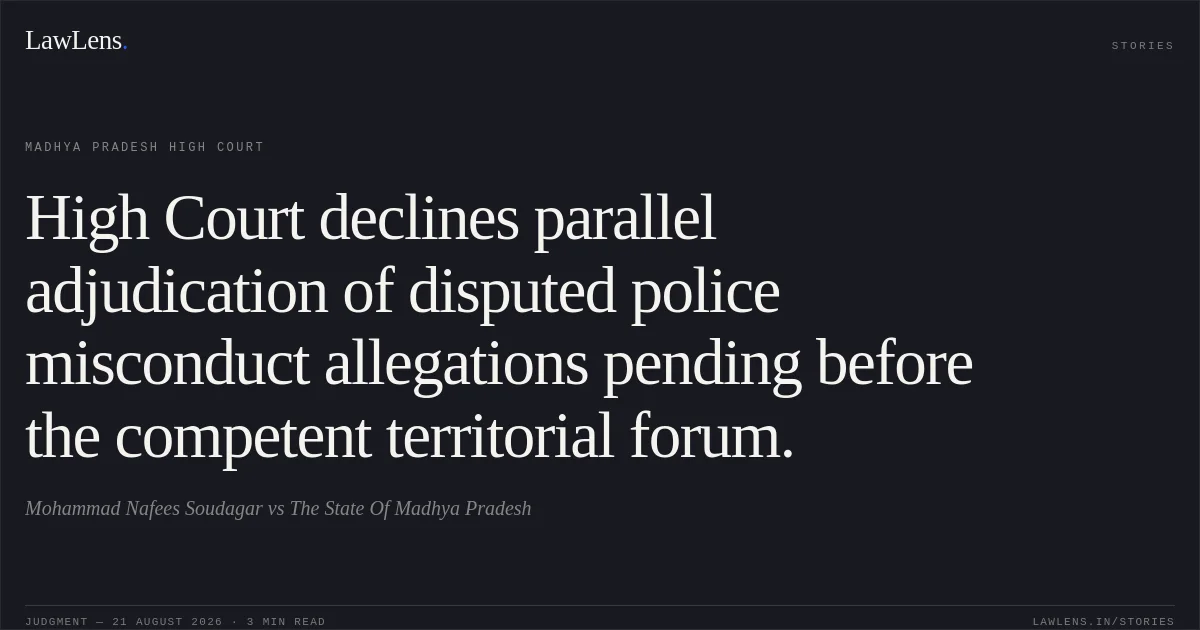
The Court held that the principal challenge concerned Crime No. 37/2026, registered in Chhattisgarh, and the actions of police officials belonging to that State; therefore, the High Court of Chhattisgarh was the appropriate forum, particularly because the petitioner had already initiated substantially overlapping proceedings there.
Source reference: paras. 11–12, 19Although the allegations of handcuffing, custodial torture, illegal confinement, threats, and compelled disclosure of the mobile-phone password were serious, the Court found that their truth could not be conclusively determined from pleadings, photographs, complaints, and order-sheets alone.
Source reference: paras. 13–15Applying the rule in Prem Shankar Shukla, the Court observed that whether handcuffing occurred, whether exceptional circumstances existed, and whether reasons were recorded were all factual matters requiring proper inquiry.
Source reference: para. 14In the absence of an undisputed violation established on the record, the Court declined to direct registration of an FIR, constitution of an SIT, disciplinary action, or payment of compensation.
Source reference: paras. 15, 18, 20Holding
The writ petition was dismissed.
The Court declined to direct registration of an FIR, an SIT or independent investigation, departmental proceedings, or compensation at that stage.
Source reference: paras. 20, 22The petitioner was granted liberty to pursue his complaints and other remedies before the competent authorities and forums, including the High Court of Chhattisgarh.
Source reference: paras. 20, 22–23The Court expressly clarified that it had not ruled on the legality of Crime No. 37/2026, the merits of the criminal allegations, or the truth of the petitioner’s allegations against the police officials; all such questions were left open for determination by the competent Court or authority.
Source reference: paras. 21, 23Acts & Sections Cited
2 provisions across 2 statutes referred to in this judgment. Each provision opens on LawLens.
Bharatiya Nyaya Sanhita, 20231
Dowry Prohibition Act, 19611
Original Court PDF
Mohammad Nafees SoudagarvsThe State Of Madhya Pradesh
Click to open original judgment
Original judgment, available to read, download and summarize on LawLens.in