Facts
The petitions arose from matrimonial disputes between Maan Singh and Balwinder Kaur. Balwinder Kaur alleged that Maan Singh, his parents and sisters subjected her and her children to physical and mental cruelty, including beatings, confinement, threats and an attempt to strangulate her. On these allegations, FIR No. 111 dated 07.12.2016 was registered at Police Station Bholath, District Kapurthala, under Sections 342, 323, 120-B and 109 IPC.
Source reference: p.3–5; paras 3–4Balwinder Kaur subsequently filed Complaint No. COMA 525 dated 06.02.2018 under Section 12 of the Protection of Women from Domestic Violence Act, 2005, seeking, inter alia, a protection order under Section 17. The complaint substantially reproduced the allegations forming the basis of the FIR.
Source reference: p.5; para 5The parties entered into a compromise dated 28.12.2016. They thereafter initiated divorce proceedings by mutual consent under Section 13-B of the Hindu Marriage Act. Balwinder Kaur stated during the first motion that the matrimonial disputes, maintenance, dowry articles and other claims had been settled; that she would not pursue the FIR or the related criminal proceedings; and that Maan Singh would pay Rs.8,50,000 for the children and their education.
Source reference: p.5–8; paras 6 and 10The marriage was dissolved by mutual consent on 17.07.2017. The agreed amount was paid partly to Balwinder Kaur and partly deposited in the accounts of the parties’ two children. Balwinder Kaur also made a statement before the investigating officer confirming the compromise and requesting cancellation of the case.
Source reference: p.8–9; paras 11–12Despite the settlement and dissolution of marriage, the FIR and Domestic Violence Act proceedings continued, leading the petitioners to invoke the High Court’s inherent jurisdiction under Section 528 of the Bharatiya Nagarik Suraksha Sanhita, 2023, corresponding to Section 482 Cr.P.C.
Source reference: p.2; paras 1–2Issues
1. Whether the High Court should exercise its inherent jurisdiction under Section 528 BNSS, 2023, corresponding to Section 482 Cr.P.C., to quash FIR No. 111 dated 07.12.2016 and all consequential proceedings on the basis of the parties’ compromise and subsequent divorce?
Source reference: p.2, p.9–10; paras 1, 12–162. Whether the criminal complaint under Section 12 of the Protection of Women from Domestic Violence Act, 2005, the summoning order and consequential proceedings should likewise be quashed after settlement of the matrimonial dispute?
Source reference: p.2, p.5, p.9–10; paras 2, 5, 15–16Law Applied
The Court applied Section 528 of the Bharatiya Nagarik Suraksha Sanhita, 2023, corresponding to Section 482 Cr.P.C., which preserves the High Court’s inherent power to prevent abuse of the process of court and secure the ends of justice.
Source reference: p.2, p.9–10; paras 1, 12–16It considered the offences under Sections 342, 323, 120-B and 109 IPC forming the basis of the FIR, as well as Section 12 of the Protection of Women from Domestic Violence Act, 2005 and the prayer for protection under Section 17 of that Act.
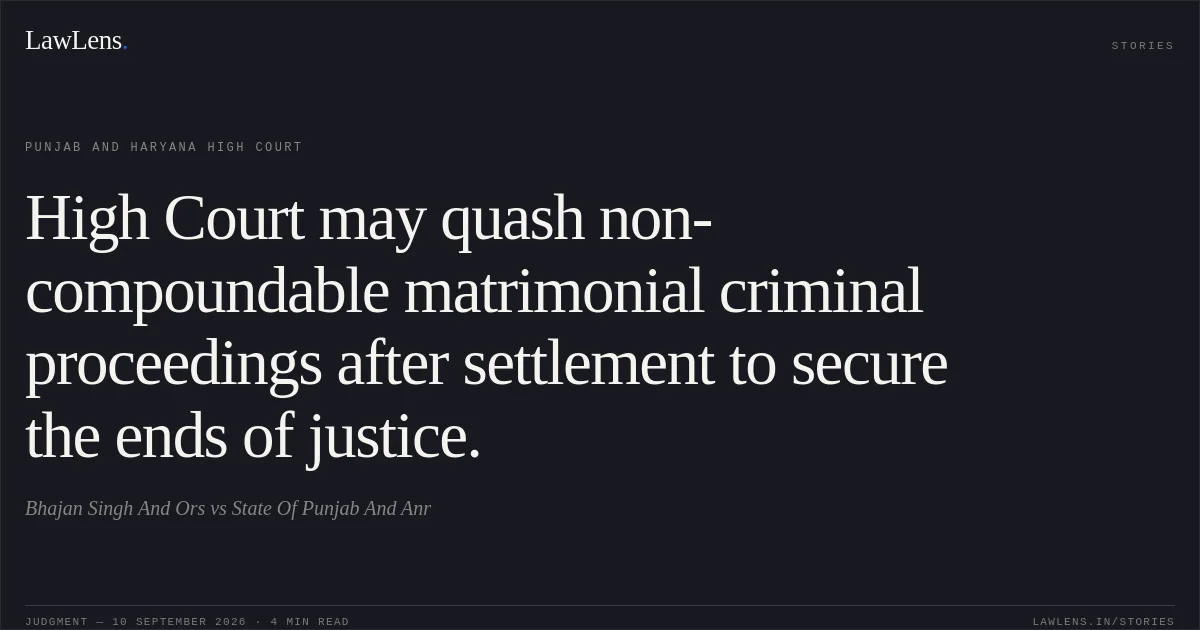
Source reference: p.2, p.5; paras 1, 2 and 5Relying on Kulwinder Singh v. State of Punjab, Gian Singh v. State of Punjab, and Narinder Singh v. State of Punjab, the Court reiterated that the High Court may quash criminal proceedings, including proceedings involving non-compoundable offences, where the dispute is essentially private or matrimonial, the parties have genuinely settled their differences, and continuation of the proceedings would constitute an abuse of process or would not serve the ends of justice.
Source reference: p.9; paras 13–15Reasoning
The Court treated the dispute as a private matrimonial conflict that had been comprehensively settled. The compromise was supported by the parties’ statements in the mutual-consent divorce proceedings, the dissolution of the marriage, payment and deposit of the agreed settlement amount, and Balwinder Kaur’s statement before the investigating officer that she did not wish to pursue the FIR.
Source reference: p.5–9; paras 6, 10–12In these circumstances, the Court found that the underlying matrimonial relationship had ended and that the complainant’s claims had been settled. Applying the principles governing the exercise of inherent jurisdiction, it held that continuing the FIR against the former husband and his family members, despite the settlement, would cause unnecessary harassment and amount to an abuse of the process of law.
Source reference: p.9–10; paras 12–15Since the Domestic Violence Act complaint was based on substantially the same allegations and arose from the same matrimonial dispute, the same reasoning applied to the complaint, summoning order and subsequent proceedings.
Source reference: p.5, p.10; paras 5, 15–16Holding
The Court answered both issues in favour of the petitioners.
It allowed the petitions and quashed FIR No. 111 dated 07.12.2016 under Sections 342, 323, 120-B and 109 IPC, registered at Police Station Bholath, District Kapurthala, together with all consequential proceedings, qua the petitioners.
Source reference: p.10; para 16It also quashed Complaint No. COMA 525 dated 06.02.2018 under Section 12 of the Protection of Women from Domestic Violence Act, 2005, the summoning order dated 06.02.2018 and all subsequent proceedings arising therefrom.
Source reference: p.10; para 16Pending applications, if any, were disposed of, and a copy of the order was directed to be placed in the connected files.
Source reference: p.10; paras 17–18Acts & Sections Cited
7 provisions across 4 statutes referred to in this judgment. Each provision opens on LawLens.
Bharatiya Nagarik Suraksha Sanhita, 20231
Code of Criminal Procedure, 19731
Indian Penal Code, 18603
Protection of Women from Domestic Violence Act, 20052
Original Court PDF
Bhajan Singh And OrsvsState Of Punjab And Anr
Click to open original judgment
Original judgment, available to read, download and summarize on LawLens.in