Facts
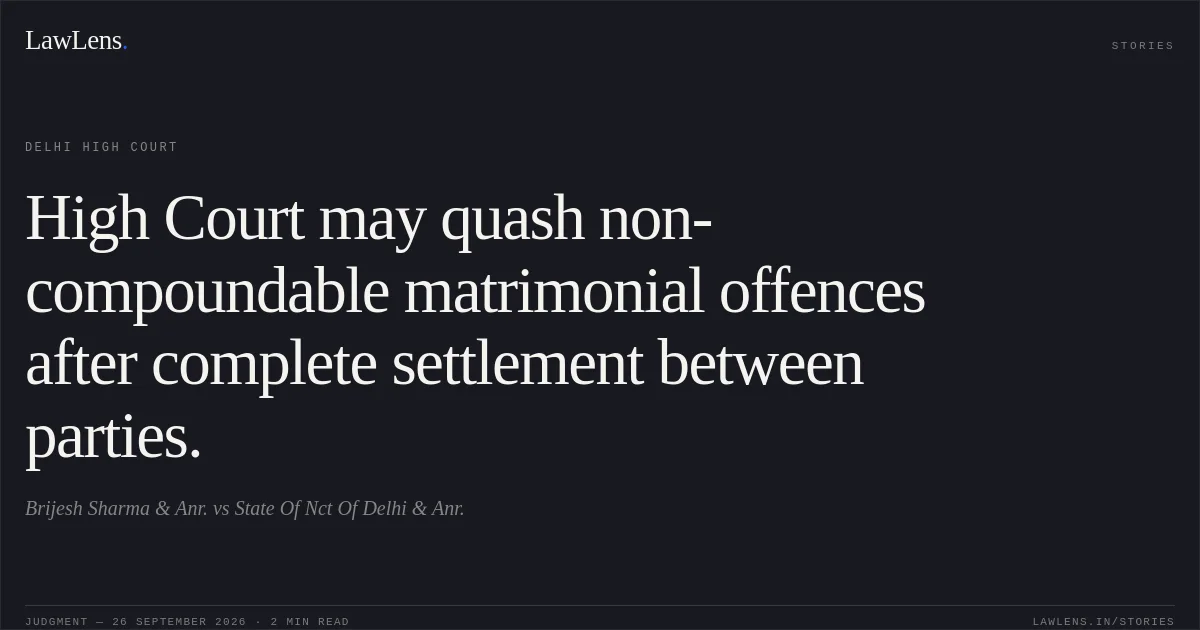
The petitioners sought quashing of FIR No. 56/2020, registered at Police Station Mahendra Park, Delhi, under Sections 498A, 406 and 34 of the Indian Penal Code, 1860, along with all consequential proceedings.
Source reference: paras. 2; p. 1During the proceedings, the parties informed the Court that they had amicably settled their disputes. Multiple settlement agreements had been executed, including the latest agreement before the Delhi Mediation Centre, Rohini District Courts, on 2 June 2026.
Source reference: paras. 3–4; pp. 1–2The complainant stated that she had received an aggregate amount of ₹6 lakhs pursuant to the settlement arrangements. This included ₹2 lakhs under the latest settlement, ₹2 lakhs paid under an earlier settlement, and a further bank draft of ₹2 lakhs handed over during the hearing.
Source reference: paras. 5–6; p. 4The complainant confirmed that all outstanding disputes had been resolved.
Source reference: para. 7; p. 4The Investigating Officer identified the parties, and the State stated that it had no objection to quashing the FIR.
Source reference: paras. 8–9; p. 4Issues
Whether the High Court should exercise its inherent jurisdiction to quash an FIR alleging offences under Sections 498A, 406 and 34 IPC when the matrimonial dispute has been amicably settled and the complainant has received the agreed settlement amount?
Source reference: paras. 2–9; pp. 1–4Whether continuation of the criminal proceedings, in view of the settlement and the complainant’s unwillingness to pursue the dispute, would serve any meaningful legal purpose?
Source reference: para. 10; pp. 4–5Law Applied
The Court considered the offences under Sections 498A, 406 and 34 of the Indian Penal Code, 1860, and exercised its inherent jurisdiction to quash the criminal proceedings.
Source reference: para. 10; pp. 4–5It relied principally on Gian Singh v. State of Punjab, (2012) 10 SCC 303, which holds that the High Court may quash non-compoundable criminal proceedings where the dispute has been amicably settled, particularly in matrimonial and family disputes having an overwhelmingly personal or civil character, if continuation of the proceedings would be futile and would defeat the ends of justice.
Source reference: para. 10; pp. 4–5The principle is subject to the limitation that serious offences involving grave mental depravity, public corruption, or offences such as murder, rape and dacoity ordinarily cannot be quashed merely on the basis of settlement.
Source reference: para. 10; pp. 4–5Reasoning
The Court found that the dispute arose from a matrimonial relationship and was essentially personal between the parties.
Source reference: no citationThe complainant confirmed receipt of ₹6 lakhs in full settlement of the dispute and expressly stated that no outstanding claims remained.
Source reference: paras. 5–7; p. 4Since the parties had resolved their disputes, the complainant supported the quashing petition, and the State raised no objection, the likelihood of a meaningful prosecution or conviction was substantially undermined.
Source reference: paras. 7–9; p. 4Applying the principle in Gian Singh, the Court concluded that continued prosecution would serve no useful purpose and that quashing the proceedings would secure the ends of justice.
Source reference: para. 10; pp. 4–5Holding
The High Court allowed the petition and quashed FIR No. 56/2020, registered at Police Station Mahendra Park, Delhi, under Sections 498A, 406 and 34 IPC, together with all consequential proceedings arising from it.
The Court also directed the petitioners to file certified copies of the annexures within two weeks in relation to the exemption application.
Source reference: para. 1; p. 1Acts & Sections Cited
2 provisions across 1 statute referred to in this judgment. Each provision opens on LawLens.
Indian Penal Code, 18602
Original Court PDF
Brijesh Sharma & Anr.vsState Of Nct Of Delhi & Anr.
Click to open original judgment
Original judgment, available to read, download and summarize on LawLens.in