01Facts
The complainant, Ritesh Panikar (Respondent No. 3), lodged a complaint leading to Crime No. 24/2025 at Dharwad Traffic Police Station against the petitioner, Rinoraj, for an offence punishable under Section 281 of the Bharatiya Nyaya Sanhita, 2023 (BNS).
¶ 3The investigation was completed and the case is pending as C.C. No. 770/2025 before the Principal Senior Civil Judge and CJM, Dharwad.
¶ 3 · ¶ 5The petitioner filed this petition under Section 482 CrPC / Section 528 BNSS to quash the entire proceedings and sought a direction to the superior police authority to examine the investigating officer's conduct.
p. 1The parties then filed I.A. No. 2/2026 under Section 320 read with Section 482 CrPC / Section 359 read with Section 528 BNSS seeking compounding.
¶ 4In his supporting affidavit, the complainant stated that he had lodged the case under the influence of "bad elements," that he is no longer interested in prosecuting it, that he has compounded voluntarily without coercion or undue influence, and that he has no objection to quashing.
¶ 4The court noted that the offence is non-compoundable in nature.
¶ 5The court also relied on the earlier decisions cited by the petitioner, namely a Co-ordinate Bench order in Crl.A. No. 102688/2025 (14.10.2025) and Crl.P. No. 200548/2026 (12.05.2026).
¶ 7 · ¶ 802Issues
i.1. Whether the High Court can quash criminal proceedings under Section 482 CrPC / Section 528 BNSS for a non-compoundable offence under Section 281 BNS on the basis of a settlement between the parties.
¶ 5ii.2. Whether the settlement, viewed under the principles in Narinder Singh, justifies quashing the proceedings, including whether the chances of conviction are remote.
¶ 6 · ¶ 903Law Applied
The court applied the inherent power under Section 482 CrPC (corresponding to Section 528 BNSS), which permits the High Court to quash proceedings even for non-compoundable offences where the parties have settled, but which must be exercised sparingly and with caution, citing Narinder Singh v. State of Punjab, (2014) 6 SCC 466, para. 31(I).
¶ 6The guiding considerations are the ends of justice and prevention of abuse of process.
¶ 6 · Narinder Singh · ¶ 31(II)Quashing is generally appropriate for cases of overwhelmingly civil character or those arising from family or private disputes, whereas heinous or serious offences affecting society are excluded.
¶ 6 · Narinder Singh · ¶ 31(III)–(IV)The court must also assess whether conviction is remote or bleak and whether continuation would cause oppression or extreme injustice.
¶ 6 · Narinder Singh · ¶ 31(V)The stage of proceedings is relevant, with greater liberality at the investigation stage.
¶ 6 · Narinder Singh · ¶ 31(VII)The court further relied on the Co-ordinate Bench decisions quashing proceedings on comparable settlements, which treat a settlement among relatives, a complainant's genuine change of position, and the minimal prospect of witnesses supporting the prosecution as relevant factors.
¶ 7–9Section 320 CrPC governs compounding by court permission for compoundable offences and does not itself confer power over non-compoundable ones.
¶ 5 · read with para. 6, Narinder Singh · ¶ 31(I)Provisions in the judgment · 10 · Linked ones open on LawLens
Code of Criminal Procedure, 1973 Section 482Section 320
Bharatiya Nyaya Sanhita, 2023 Section 281
Bharatiya Nagarik Suraksha Sanhita, 2023 Section 528Section 359
Indian Penal Code, 1860 Section 307Section 324Section 323Section 34Section 306
04Reasoning
The court treated the offence as non-compoundable but considered the settlement a sufficient basis to invoke Section 482.
¶ 5Its reasoning rests on the complainant's affidavit, which records that he lodged the complaint under a misconception and in a fit of anger, has realised his mistake, and acts on the advice of both families, who are relatives.
¶ 4 · ¶ 9The court found that elders and family members intervened and the parties have resolved their dispute and resolved to live peacefully.
¶ 9Applying the reasoning in the cited decisions, the court concluded that, even if the investigation or charge sheet were completed, the complainant's withdrawal made witness support minimal and the chances of conviction very remote.
¶ 9The court therefore held that continuing the proceedings would be unnecessary.
¶ 9The order does not expressly analyse each Narinder Singh category, such as the nature and social impact of a Section 281 BNS offence, or the stage of the case, beyond noting the charge sheet was perused.
¶ 5The order also does not address the prayer for a direction to the superior police authority regarding the investigating officer's conduct.
p. 1 · ¶ 9–1005Holding
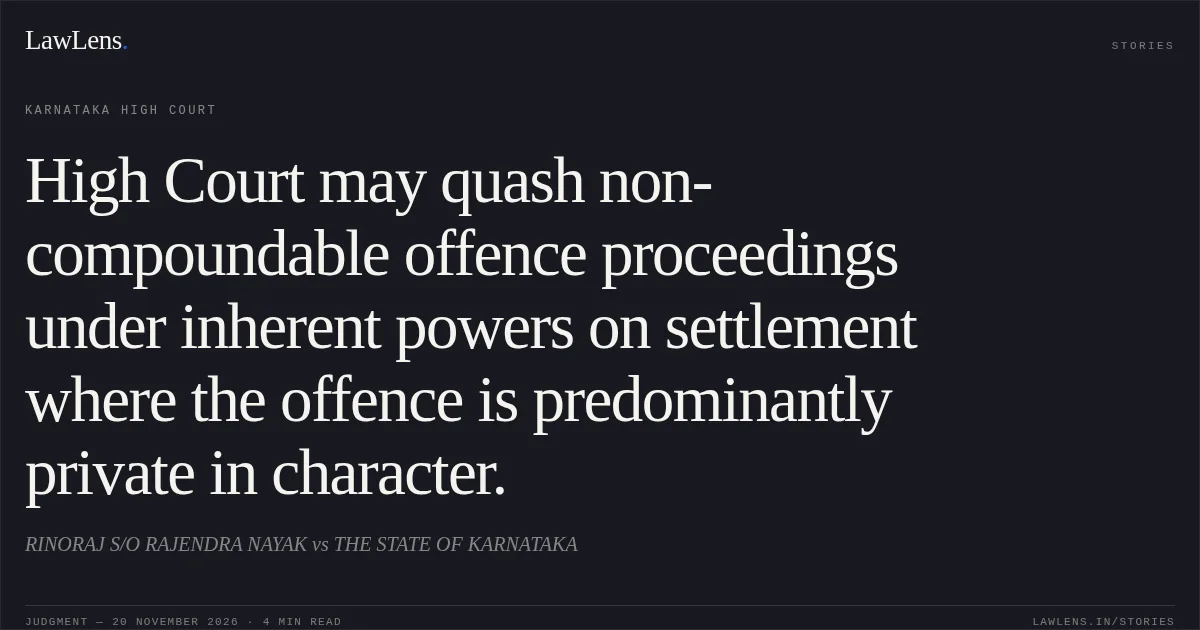
Given the complainant's voluntary settlement and the remoteness of conviction, the High Court held that the High Court can quash the proceedings for the non-compoundable offence on the basis of the settlement under Section 482 CrPC / Section 528 BNSS.
¶ 9 · ¶ 10The petition is allowed and the proceedings in C.C. No. 770/2025 (arising from Crime No. 24/2025, Dharwad Traffic P.S.) are quashed insofar as the petitioner is concerned. I.A. No. 2/2026 is allowed and pending applications are disposed of.
¶ 10, Order (i)–(iv)The order does not record any direction on the prayer to examine the investigating officer's conduct, which therefore appears to remain unadjudicated.
p. 1 · ¶ 10Original Court PDF
RINORAJ S/O RAJENDRA NAYAKvsTHE STATE OF KARNATAKA
Click to open original judgment
Original judgment, available to read, download and summarize on LawLens.in