Facts
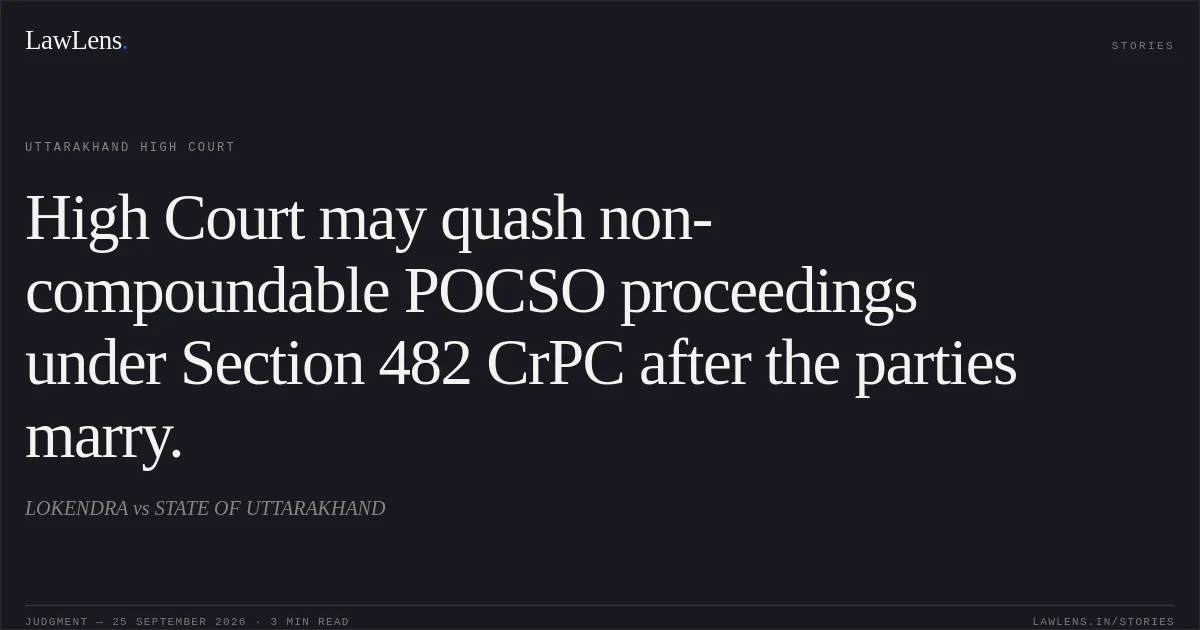
The applicant sought quashing under Section 482 of the Code of Criminal Procedure, 1973, of the charge-sheet dated 31 May 2023 and the proceedings in Special Sessions Trial No. 84 of 2023 arising from FIR No. 310 of 2023, Police Station Laksar, District Haridwar. The charge-sheet alleged offences under Sections 363, 366 and 376 of the IPC and Sections 3(a)/4 of the POCSO Act
Source reference: para. 5During the proceedings, the applicant and respondent nos. 2 and 3 filed a compounding application supported by affidavits. They stated that their disputes had been amicably resolved, that the applicant had married respondent no. 3, Anchal, and that they were living together happily. Respondent no. 2, the complainant, stated that he no longer wished to prosecute the applicant
Source reference: paras. 8–10The High Court personally interacted with the parties, who reiterated these statements
Source reference: paras. 11–12The State opposed the application on the ground that the offences were non-compoundable and offences against society
Source reference: para. 14Issues
Whether the High Court could exercise its inherent jurisdiction under Section 482 Cr.P.C. to quash proceedings involving non-compoundable offences under Sections 363, 366 and 376 IPC and Sections 3(a)/4 POCSO Act on the basis of an amicable settlement and subsequent marriage between the applicant and respondent no. 3?
Source reference: paras. 13–18Whether, in view of the parties’ marriage, their continued cohabitation and respondent no. 3’s unwillingness to prosecute, continuation of the criminal proceedings would serve the interests of justice?
Source reference: paras. 15–18Law Applied
The Court applied Section 482 Cr.P.C., which preserves the High Court’s inherent power to prevent abuse of process and secure the ends of justice. It held that this jurisdiction may, in appropriate circumstances, be exercised to quash proceedings involving non-compoundable offences despite the statutory bar on compounding.
Source reference: para. 18The Court relied on B.S. Joshi v. State of Haryana, (2003) 4 SCC 675; Nikhil Merchant v. CBI, (2008) 9 SCC 650; Gian Singh v. State of Punjab, (2012) 10 SCC 303; and Dimpey Gujral v. Union Territory of Chandigarh, Transfer Petition (Criminal) No. 115 of 2012, for the principle that criminal proceedings may be quashed where settlement makes continuation oppressive or contrary to the ends of justice.
Source reference: para. 18It also relied on Ayyub Malik v. State of Uttarakhand, 2026 SCC OnLine SC 637, where proceedings involving IPC and POCSO offences were quashed after the parties had married and were living together peacefully.
Source reference: para. 16Reasoning
The Court accepted that the alleged offences were non-compoundable and that the State had correctly raised the objection that such offences ordinarily concern society at large.
Source reference: para. 14However, it distinguished statutory compounding from the High Court’s broader inherent jurisdiction under Section 482 Cr.P.C. The applicant, the complainant and the alleged victim appeared before the Court and consistently confirmed the settlement. Respondent no. 3 stated that she had married the applicant, was living happily with him and did not wish to pursue the prosecution.
Source reference: paras. 11–15Applying the principles in the cited Supreme Court decisions, particularly Ayyub Malik, the Court concluded that continuation of the trial in these circumstances would not advance the interests of justice and that the matter should be brought to an end.
Source reference: paras. 16–18Holding
The High Court allowed the compounding application and exercised its inherent powers under Section 482 Cr.P.C.
It quashed the charge-sheet dated 31 May 2023 arising from FIR No. 310 of 2023, Police Station Laksar, District Haridwar, under Sections 363, 366 and 376 IPC and Sections 3(a)/4 of the POCSO Act, together with the entire proceedings in Special Sessions Trial No. 84 of 2023 pending before the Special Judge, POCSO/Additional Sessions Judge, Haridwar.
Source reference: paras. 19–21Pending applications, if any, were also disposed of.
Source reference: para. 22Acts & Sections Cited
9 provisions across 3 statutes referred to in this judgment. Each provision opens on LawLens.
Code of Criminal Procedure, 19731
Indian Penal Code, 18604
Original Court PDF
LOKENDRAvsSTATE OF UTTARAKHAND
Click to open original judgment
Original judgment, available to read, download and summarize on LawLens.in