Facts
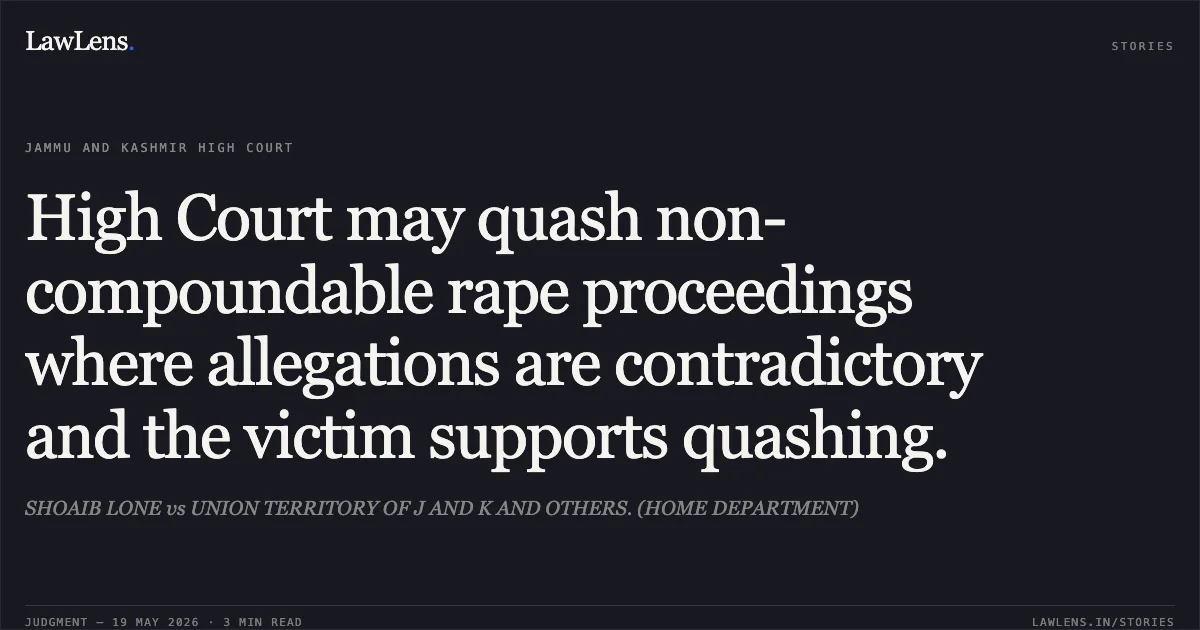
The petitioner, a social activist and former MLA, sought quashment of FIR No. 96/2023 registered at P/S Baramulla under Sections 376 (rape), 342 (wrongful confinement), and 506 (criminal intimidation) of the IPC.
Source reference: para 1The Respondent No. 5 (complainant) had filed the FIR alleging that the petitioner raped her in his Baramulla quarter.
Source reference: para 2The petitioner contended the FIR was malicious, noting that the complainant had filed two prior contradictory complaints at P/S Rajbagh and P/S Kreari, where she claimed to be his legally wedded wife.
Source reference: para 2During the pendency of this petition, the complainant appeared in court on 30.09.2025, stating that the FIR was filed under threat/coercion from unknown persons and that she had no objection to its quashment.
Source reference: para 4–5Issues
1. Whether the High Court should exercise its inherent powers under Section 482 CrPC (Section 528 BNSS) to quash an FIR involving a non-compoundable offense like rape when the allegations appear false or the parties have reached an implied settlement.
Source reference: para 9, 162. Whether the contradictory statements of the complainant and her subsequent withdrawal of allegations render the continuation of criminal proceedings an abuse of the process of law.
Source reference: para 11, 14Law Applied
Section 482 of the Criminal Procedure Code, 1973 (corresponding to Section 528 of the Bharatiya Nagarik Suraksha Sanhita, 2023), which preserves the High Court's inherent power to prevent abuse of the process of any court or to secure the ends of justice.
Source reference: para 1, 19Landmark principles in State of Haryana v. Bhajan Lal, which allow quashing where allegations are absurd or motivated by malice.
Source reference: para 1, 27Doctrine derived from Gian Singh v. State of Punjab and Narinder Singh v. State of Punjab, establishing that even non-compoundable offenses can be quashed if the possibility of conviction is remote and the dispute is essentially personal.
Source reference: para 18–21The holding in Kapil Gupta v. State (NCT of Delhi), which held that in peculiar facts, even a rape charge can be quashed to save a victim from the agony of a futile trial.
Source reference: para 20Reasoning
The court found that the complainant’s allegations were "apparently false and doubtful" due to her significant inconsistencies; she initially claimed marital status in two separate complaints before alleging rape in the third.
Source reference: para 9–10The court observed that the relationship appeared consensual based on the complainant’s own prior claims of being the petitioner’s wife.
Source reference: para 10The court highlighted the complainant’s persistent efforts to correct her statement—approaching the police, the Magistrate, and the High Court—which indicated her desire to withdraw the charges for the sake of her reputation.
Source reference: para 11Applying the Kapil Gupta precedent, the court reasoned that since the complainant no longer supported the prosecution, any trial would be a "futile exercise" and a "wastage of time," inevitably resulting in acquittal.
Source reference: para 14, 22–23The court concluded that non-interference would cause a miscarriage of justice and unnecessary oppression of the accused.
Source reference: para 26, 28Holding
The court answered both issues in the affirmative, holding that while rape is a heinous crime, the peculiar facts of this case involving contradictory previous statements and the complainant's voluntary withdrawal made it a fit case for quashing.
The petition was allowed, and FIR No. 96/2023 dated 13.05.2023 was quashed to "meet the ends of justice" and save the parties from the agony of a trial with no prospect of conviction.
Source reference: para 15, 29Acts & Sections Cited
11 provisions across 3 statutes referred to in this judgment. Each provision opens on LawLens.
Code of Criminal Procedure, 19736
Bharatiya Nagarik Suraksha Sanhita, 20232
Indian Penal Code, 18603
Original Court PDF
SHOAIB LONEvsUNION TERRITORY OF J AND K AND OTHERS. (HOME DEPARTMENT)
Click to open original judgment
Original judgment, available to read, download and summarize on LawLens.in