Facts
The petitioners (representing a faction of PSRKS affiliated with BJMS) filed Title Suit No. 633/2024 seeking a declaration that the respondents (representing a faction affiliated with BRMS) have no right to use the Union's name or banner
Source reference: p. 3-5The Trial Court granted a temporary injunction on 17.12.2024, restraining the respondents from using the Union's name
Source reference: p. 3This was challenged by the respondents in Misc. Appeal No. 1/2025, where the First Appellate Court set aside the injunction on 28.05.2025, finding a lack of prima facie case
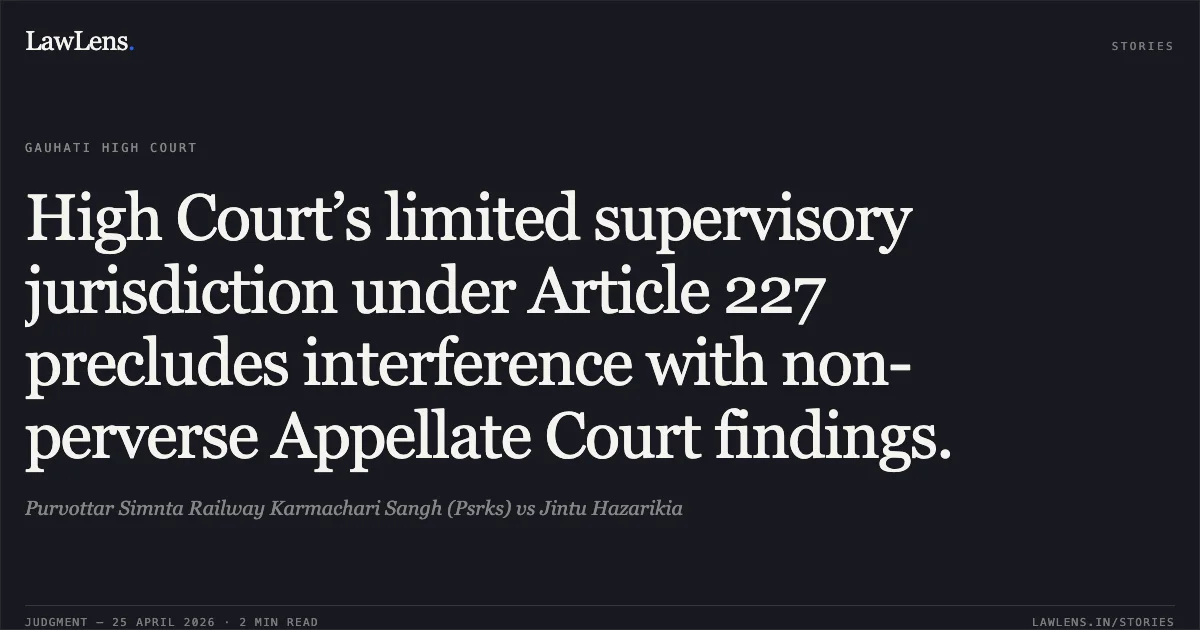
Source reference: p. 6The petitioners moved the High Court under Article 227 of the Constitution, alleging the Appellate Court exceeded its jurisdiction by interfering without finding perversity or arbitrariness in the Trial Court's order
Source reference: p. 7Issues
1. Whether the First Appellate Court was justified in setting aside the temporary injunction granted by the Trial Court
Source reference: p. 8-92. Whether the High Court, under its supervisory jurisdiction under Article 227, should interfere with the order of the First Appellate Court
Source reference: p. 12Law Applied
Article 227 of the Constitution of India, which governs the High Court's power of superintendence over subordinate courts
Source reference: p. 12The principle established in Shalini Shyam Shetty v. Rajendra Shankar Patil, holding that Article 227 is to be exercised sparingly and not as a "court of appeal" to correct mere errors of fact or law unless there is patent perversity
Source reference: p. 12Order 39 Rules 1 & 2 of the CPC (the "three golden principles": prima facie case, balance of convenience, and irreparable loss)
Source reference: p. 6, 9The principle in Wander Ltd. v. Antox India Pvt. Ltd. regarding the limited scope of appellate interference in discretionary orders
Source reference: p. 6, 9Reasoning
The High Court examined whether the Appellate Court's decision to vacate the injunction was "perverse" or merely "erroneous"
Source reference: p. 12The court noted that while it might have taken a different view on the existence of a prima facie case, the Appellate Court provided reasons for its reversal, which prevents the decision from being classified as legally perverse
Source reference: p. 13The High Court emphasized that under Article 227, it cannot substitute its own opinion for that of the lower court simply because another view is possible
Source reference: p. 12-13It observed that the core dispute—which faction is the "original" Union—is a matter for trial in the pending Title Suit, and the Appellate Court's decision to allow both factions to operate (subject to conditions) did not warrant supervisory intervention
Source reference: p. 14Holding
The High Court declined to interfere with the First Appellate Court’s order, holding that no grounds for exercising jurisdiction under Article 227 were made out
The Revision Petition was disposed of with a directive for the ends of justice: the respondents are permitted to use the name "Purvottar Simanta Railway Karmachari Sangh" during the suit's pendency, provided they specifically mention their affiliation to the "Bharatiya Railway Mazdoor Sangh (BRMS)" to distinguish them from the petitioners' BJMS-affiliated faction
Source reference: p. 13-14Acts & Sections Cited
2 provisions across 1 statute referred to in this judgment. Each provision opens on LawLens.
Code of Civil Procedure, 19082
Original Court PDF
Purvottar Simnta Railway Karmachari Sangh (Psrks)vsJintu Hazarikia
Click to open original judgment
Original judgment, available to read, download and summarize on LawLens.in