01Facts
The plaintiffs (appellants) filed O.S. No. 15/2014 seeking partition and separate possession of their alleged shares in the suit schedule properties.
¶ 1The Trial Court partly decreed the suit as to Item Nos. 3 to 8 and dismissed it as to Item Nos. 1, 2 and 9.
¶ 2The plaintiffs appealed the dismissal in R.A. No. 7/2018, and the defendants appealed the decree in R.A. No. 49/2018.
¶ 2The plaintiffs sought condonation of a 405-day delay in filing R.A. No. 7/2018, and the defendants sought condonation of a 102-day delay in filing R.A. No. 49/2018, both under Order XLI Rule 3A CPC read with Section 5 of the Limitation Act.
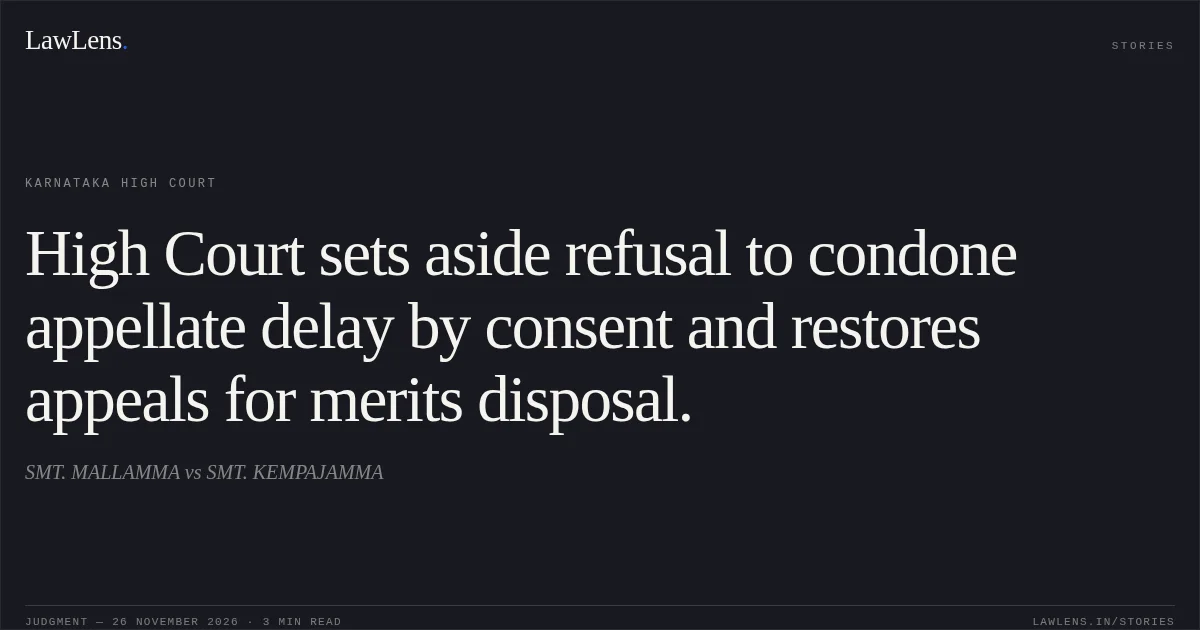
¶ 2By a common judgment dated 23.11.2018, the First Appellate Court (V Addl. District & Sessions Judge, Mandya) dismissed both condonation applications and, consequently, both appeals.
¶ 3The plaintiffs challenged this in the present Regular Second Appeal, admitted on 12.10.2026.
¶ 3The plaintiffs contended that the delay resulted from bona fide reasons and unavoidable circumstances constituting sufficient cause.
¶ 5Respondent Nos. 10(a)–(e) did not oppose setting aside the impugned order, subject to the defendants' condonation application also being allowed.
¶ 6The other respondents were served but did not appear or contest the appeal.
¶ 702Issues
i.1. Whether the First Appellate Court was justified in dismissing the appeal and the application under Order XLI Rule 3 CPC.
¶ 3ii.2. Whether the First Appellate Court was justified in dismissing the appeal as time-barred by refusing to condone the 405-day delay in filing R.A. No. 7/2018.
¶ 303Law Applied
Order XLI Rule 3A CPC governs the procedure for deciding applications to condone delay in filing an appeal.
¶ 2Section 5 of the Limitation Act, 1963 permits condonation of delay on showing sufficient cause.
¶ 2The appeal itself is a second appeal under Section 100 CPC.
The judgment cites no precedent. The Court's order rests on the principle that the First Appellate Court must decide condonation before the merits of a time-barred appeal, and that restoration of an appeal to the file of the first appellate court for disposal on merits is the appropriate remedy where delay is condoned.
¶ 8 · ¶ 9(c)–(f)The sufficiency-of-cause standard is referenced through the appellants' submission but is not separately articulated by the Court.
¶ 5Provisions in the judgment · 2 · Linked ones open on LawLens
Code of Civil Procedure, 1908 Section 100
Limitation Act, 1963 Section 5
04Reasoning
The Court did not independently examine whether sufficient cause existed for either delay. Instead, it relied on the joint submissions of both sides, including the appellants' position that the delay was due to bona fide reasons, the respondents' non-objection, and the unrepresented status of most respondents.
¶ 5 · ¶ 6 · ¶ 7Having accepted these joint submissions, the Court concluded that it was "just and appropriate" to set aside the common order of 23.11.2018 and allow both condonation applications.
¶ 8The reciprocal condition, that both delays be condoned together, linked the two appeals, so that the defendants' 102-day delay was condoned alongside the plaintiffs' 405-day delay.
¶ 6 · ¶ 8Because the delay was condoned, the First Appellate Court was directed to decide both appeals on merits without reference to limitation.
¶ 9(h)The judgment records no reasoned finding on sufficient cause, and this consent-based approach means the order is not a substantive determination on the adequacy of the explanations offered.
05Holding
The Court did not answer the substantial questions of law in express terms. It implicitly held that the First Appellate Court's refusal to condone the delays, and the consequent dismissal of both appeals, could not be sustained on the joint submissions before it.
¶ 8The Regular Second Appeal is allowed. The common judgment dated 23.11.2018 in R.A. Nos. 7/2018 and 49/2018 is set aside. Both condonation applications are allowed and the delays of 405 days (R.A. No. 7/2018) and 102 days (R.A. No. 49/2018) are condoned. Both appeals are restored to the First Appellate Court for fresh disposal on merits in accordance with law.
¶ 9(a)–(f)The parties are directed to appear before the First Appellate Court on 14.12.2026, and the court is to issue notice to non-appearing parties and dispose of both appeals expeditiously without reference to delay. All rival contentions on the merits are kept open.
¶ 9(g)–(i)Original Court PDF
SMT. MALLAMMAvsSMT. KEMPAJAMMA
Click to open original judgment
Original judgment, available to read, download and summarize on LawLens.in