01Facts
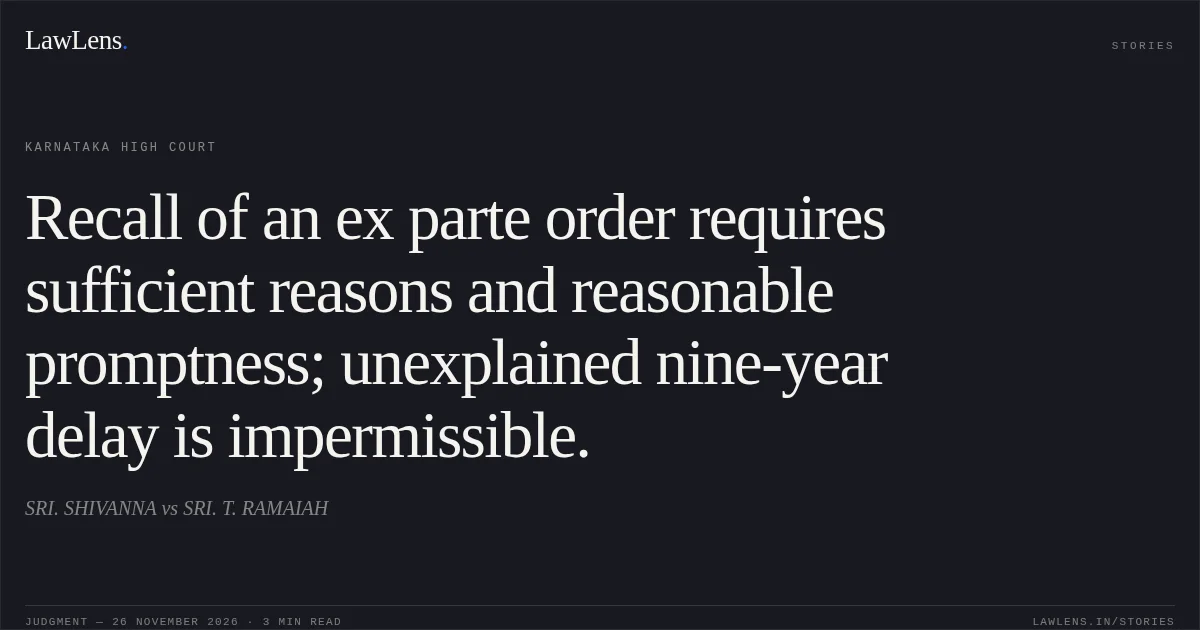
The petitioner (Defendant No. 11) was served with summons in O.S. No. 151/2016 before the Senior Civil Judge and JMFC, Magadi, but failed to appear and was placed ex parte on 30.07.2016.
¶ 2 · ¶ 5The suit is for declaration and possession, and the petitioner claims rights as purchaser of the suit schedule property.
¶ 2Nearly nine years later, the petitioner filed I.A. Nos. 30 and 31 under Order IX Rule 7 CPC to set aside the ex parte order and to file a written statement.
The supporting affidavit stated only that the non-appearance was "not intentional," offering no explanation for the non-appearance or the delay.
¶ 5 · ¶ 7The respondent contended that the application was filed after a lapse of nine years, by which time the suit had substantially progressed.
¶ 3.1The Trial Court rejected the applications, and the petitioner challenged that order under Article 227 of the Constitution.
02Issues
i.1. Whether the petitioner, placed ex parte, has established sufficient and bona fide grounds for non-appearance to warrant setting aside the ex parte order and being permitted to contest the suit.
¶ 6 · ¶ 8ii.2. Whether a delay of nearly nine years in seeking recall of the ex parte order, without satisfactory explanation, is reasonable so as to warrant the exercise of discretionary jurisdiction.
¶ 5 · ¶ 803Law Applied
Order IX Rule 7 CPC, under which the petitioner sought to set aside the ex parte order, is the procedural basis of the applications.
A party placed ex parte ought ordinarily to be afforded an opportunity to contest the suit, but this discretion is contingent upon the party establishing bona fides, assessed by the nature of the explanation for non-appearance and the delay.
¶ 6Such discretion can be exercised only where the party shows it was prevented by sufficient and compelling reasons from appearing and approaches the Court within a reasonable period.
¶ 8The writ jurisdiction under Article 227 of the Constitution was invoked as the supervisory basis for reviewing the Trial Court's order.
04Reasoning
The Court first noted that no explanation was offered for the petitioner's failure to appear despite service of summons in 2016, and that the affidavit merely asserted that non-appearance was unintentional.
¶ 5Examining the affidavit, the Court found that it set out no circumstances explaining either the non-appearance or the nine-year delay.
¶ 7Applying the bona fides requirement, the Court held that the discretion to set aside an ex parte order is conditional on showing sufficient and compelling reasons and prompt action.
¶ 6 · ¶ 8Measured against that standard, a delay of nearly nine years without satisfactory explanation was not a reasonable period, and the petitioner's claimed interest in the property did not by itself displace the requirement of bona fides.
¶ 2, 8Because the petitioner failed on both limbs, the Trial Court's rejection of the applications was held to be free of error.
¶ 905Holding
1. The petitioner did not establish sufficient, bona fide grounds for non-appearance.
¶ 7–82. The nine-year delay was unreasonable and unexplained.
¶ 7–8The Trial Court committed no error in rejecting I.A. Nos. 30 and 31.
¶ 9The writ petition under Article 227 was dismissed, and the ex parte order dated 30.07.2016 remains in force.
¶ 9 · no citationOriginal Court PDF
SRI. SHIVANNAvsSRI. T. RAMAIAH
Click to open original judgment
Original judgment, available to read, download and summarize on LawLens.in