Facts
The second respondent, a Deputy Manager at Panasonic Electrical Company, alleged that the petitioner owed him money for electrical products supplied on credit and that, after a dispute involving further unpaid supplies, the petitioner and complainant approached another person to resolve the matter through a “Kangaroo Court.” The complainant further alleged that the petitioner failed to pay the amount promised and that he was threatened when he pursued payment
Source reference: p. 2The petitioner, arrayed as the third accused, disputed the allegations and claimed that the complainant owed him Rs.49,00,000
Source reference: p. 3A final report was filed in C.C. No. 13 of 2026, alleging offences under Sections 316(2), 318(4), 308(2), 351(3), 61(2) and 3(5) of the Bharatiya Nyaya Sanhita, 2023. The petitioner sought to quash the proceedings
Source reference: pp. 1, 2Issues
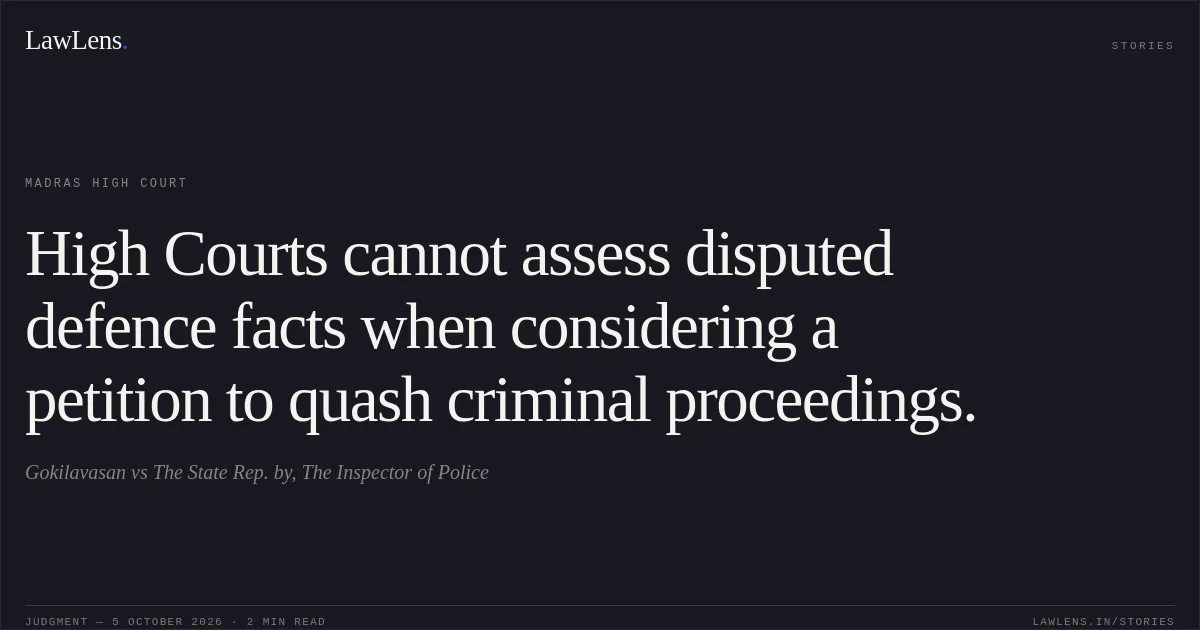
Whether the proceedings in C.C. No. 13 of 2026 should be quashed under the High Court’s inherent jurisdiction, given the petitioner’s denial of the allegations and his disputed factual defence
Source reference: pp. 3–5Whether the allegations in the final report, taken at face value, disclosed offences under the provisions of the BNS invoked against the petitioner
Source reference: p. 3Law Applied
The Court considered its inherent powers under Section 482 of the Code of Criminal Procedure, 1973, and Section 528 of the Bharatiya Nagarik Suraksha Sanhita, 2023, to quash criminal proceedings
Source reference: p. 4Relying on Central Bureau of Investigation v. Arvind Khanna, 2019 (10) SCC 686, it stated that a High Court should not decide disputed facts that require assessment at trial
Source reference: p. 4Relying on M. Jayanthi v. K.R. Meenakshi & Anr., Crl.A. No. 1817 of 2019 (2 December 2019), it stated that, in a quashing petition, the Court should assess whether the allegations, accepted in their entirety, make out the alleged offences and should not evaluate the validity of the evidence
Source reference: p. 4Reasoning
The petitioner’s account—that the complainant owed him money and had lodged a false complaint—raised disputed factual matters requiring evidence and could not be resolved in a quashing petition
Source reference: pp. 3–4On examining the final report, the Court found various averments against the petitioner which, at that stage, constituted the alleged offences. Applying the principles in Arvind Khanna and M. Jayanthi, the Court declined to assess the competing versions or the evidentiary merits, leaving those matters for trial
Source reference: pp. 3–5Holding
The Court declined to quash C.C. No. 13 of 2026 and dismissed the Criminal Original Petition, leaving the petitioner at liberty to raise his grounds before the trial court
His personal appearance was dispensed with, subject to representation by counsel after an appropriate application; he was required to attend for furnishing of copies, framing of charges, questioning under Section 351 of the BNSS, and pronouncement of judgment. The connected miscellaneous petitions were closed
Source reference: p. 5Acts & Sections Cited
9 provisions across 3 statutes referred to in this judgment. Each provision opens on LawLens.
Bharatiya Nyaya Sanhita, 20236
Bharatiya Nagarik Suraksha Sanhita, 20232
Code of Criminal Procedure, 19731
Original Court PDF
GokilavasanvsThe State Rep. by, The Inspector of Police
Click to open original judgment
Original judgment, available to read, download and summarize on LawLens.in