Facts
The petitioners—employees and directors of M/s Narsingh Ispat Udyog Pvt. Ltd.—were accused in Dhansar P.S. Case No. 155 of 2021 concerning an alleged conspiracy to induce the informant to pay approximately ₹4.63 crores as advance for imported coking coal. The prosecution alleged that, instead of supplying genuine imported coking coal, the petitioners supplied inferior waste coal, misrepresented its origin through tax invoices, and committed cheating, criminal breach of trust, forgery, criminal intimidation and allied offences
Source reference: paras. 5–8The petitioners’ earlier attempt to quash the FIR was rejected by a co-ordinate Bench, which found prima facie material regarding non-supply or supply of sub-standard coal, cheating, abuse and threats. The Supreme Court dismissed the challenge to that order, leaving the merits open before the competent court. After investigation, the police submitted a charge-sheet for offences under Sections 406, 420, 120B, 467, 468, 471, 504 and 506/34 IPC. The Magistrate initially took cognizance only under Sections 420, 120B and 506 IPC. On the informant’s revision, the revisional court set aside that order and directed fresh consideration. That revisional order attained finality after the petitioners withdrew their challenge before the High Court
Source reference: paras. 3–4Pursuant thereto, the Magistrate passed the impugned order dated 22 September 2025, taking cognizance of all the offences mentioned in the charge-sheet. The petitioners invoked Section 528 BNSS, 2023, seeking quashing of the cognizance order
Source reference: paras. 2, 4Issues
1. Whether the High Court should quash the order dated 22 September 2025 taking cognizance under Sections 406, 420, 120B, 467, 468, 471, 504 and 506/34 IPC in exercise of its jurisdiction under Section 528 BNSS, 2023?
Source reference: paras. 2, 24–292. Whether the existence of a commercial suit and the alleged civil nature of the dispute justified quashing the criminal proceedings as an abuse of process?
Source reference: paras. 11–12, 24, 283. Whether the allegations and materials relating to cheating, criminal breach of trust and forgery were matters requiring examination at the stage of framing of charge rather than quashing under Section 528 BNSS?
Source reference: paras. 13–18, 23–284. Whether the Magistrate was bound by the revisional court’s final direction to reconsider and take cognizance of the offences disclosed by the police report?
Source reference: paras. 4, 21, 23, 26Law Applied
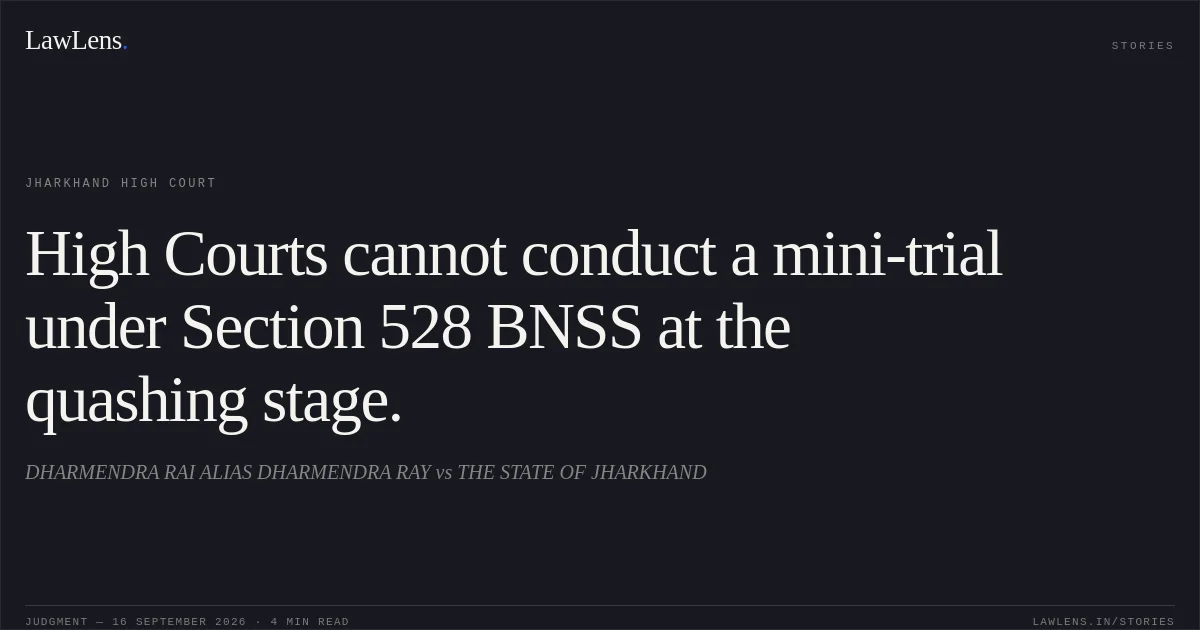
The Court applied Section 528 BNSS, 2023, corresponding to the High Court’s inherent jurisdiction under Section 482 CrPC, while emphasizing that such power must not be used to conduct a mini-trial or assess disputed evidence
Source reference: paras. 27–28Under State of Gujarat v. Girish Radhakrishnan Varde, (2014) 3 SCC 659, a Magistrate dealing with a police report cannot add or subtract offences at the stage of taking cognizance; the appropriateness of particular offences is ordinarily determined at the stage of framing of charge, where the prosecution and accused may advance their respective contentions
Source reference: para. 25Under State of U.P. v. Akhil Sharda, the High Court cannot appreciably evaluate evidence or conduct a mini-trial while exercising inherent jurisdiction
Source reference: para. 27The Court further applied the principle that a final order of a revisional court is binding on the subordinate Magistrate
Source reference: para. 26The Court held that the prior order refusing to quash the FIR, having survived challenge before the Supreme Court, precluded reconsideration of whether the FIR disclosed the basic ingredients of the alleged offences
Source reference: paras. 24, 26Reasoning
The Court held that the FIR contained specific allegations that the petitioners had induced the informant to part with substantial money, supplied inferior material in place of imported coking coal, used allegedly false tax invoices, and threatened or influenced witnesses
Source reference: paras. 5–8Those allegations had already been held prima facie sufficient by the co-ordinate Bench, and the police, after investigation, had found them substantiated and filed a charge-sheet
Source reference: paras. 3, 24The petitioners’ contentions—that most of the coal had been supplied, that Sections 406 and 420 IPC could not coexist, that the invoice discrepancy was a typographical error, and that the dispute was essentially civil—required evaluation of defence material and disputed facts. Such an exercise would amount to a mini-trial and was impermissible under Section 528 BNSS
Source reference: paras. 10–18, 27–28The existence of a commercial suit did not, by itself, extinguish the criminality alleged.
Source reference: no citationFurther, the Magistrate was required to act consistently with the final revisional order directing fresh consideration of all offences disclosed in the police report
Source reference: paras. 21–23, 26Holding
The High Court answered the issues against the petitioners. It held that the FIR and charge-sheet disclosed sufficient prima facie material for the alleged offences, that the civil/commercial proceedings did not warrant quashing, and that the disputed questions concerning cheating, breach of trust and forgery were appropriately left for consideration at the stage of framing of charge or trial
The petition under Section 528 BNSS was accordingly dismissed, and the impugned cognizance order dated 22 September 2025 was left undisturbed
Source reference: para. 29Acts & Sections Cited
14 provisions across 3 statutes referred to in this judgment. Each provision opens on LawLens.
Bharatiya Nagarik Suraksha Sanhita, 20231
Indian Penal Code, 18608
Code of Criminal Procedure, 19735
Original Court PDF
DHARMENDRA RAI ALIAS DHARMENDRA RAYvsTHE STATE OF JHARKHAND
Click to open original judgment
Original judgment, available to read, download and summarize on LawLens.in