Facts
Respondent No. 2 alleged that the petitioner and co-accused Jagdish Nain induced him to invest approximately ₹77 lakhs on the representation that he would be made a 10% partner in an NH-40 road-maintenance contract, but that the promised arrangement was never implemented and only ₹17 lakhs were returned.
Source reference: paras. 20–22, 29–30, 41FIR No. 07/2024 was consequently registered at Police Station, Economic Offences Wing, Crime Branch, Jammu, under Sections 420 and 120-B IPC, followed by a notice under Section 160 Cr.P.C. dated 26 February 2024.
Source reference: paras. 08, 41The petitioner contended that the dispute arose from a separate proposed purchase of a Gurugram plot, which was cancelled by mutual agreement, and that substantial amounts—allegedly ₹61.59 lakhs—had already been paid or adjusted through banking and cash transactions.
Source reference: paras. 02–07, 10–15The petitioner sought quashing of the FIR and the Section 160 notice under Section 482 Cr.P.C., corresponding to Section 528 BNSS.
Source reference: para. 09Issues
Whether the allegations contained in FIR No. 07/2024 prima facie disclose the commission of cognizable offences under Sections 420 and 120-B IPC?
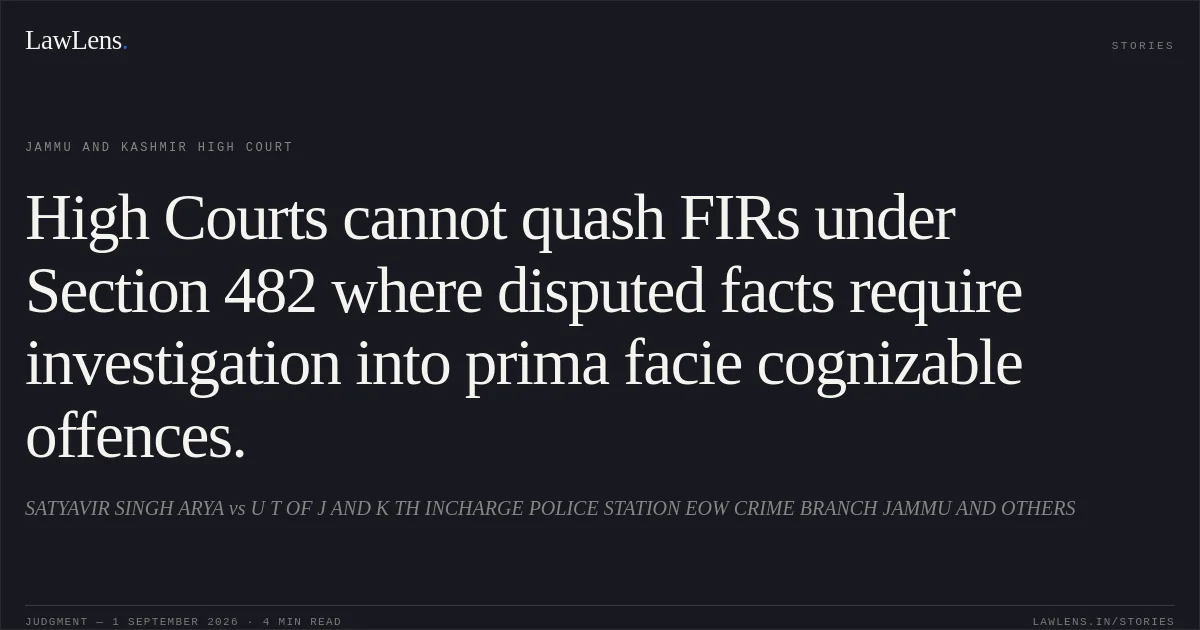
Source reference: para. 40; paras. 41–59Whether the disputed factual issues and the petitioner’s defence warranted interference by the High Court under its inherent jurisdiction under Section 482 Cr.P.C.?
Source reference: para. 40; paras. 60–78Law Applied
The Court applied Section 482 Cr.P.C., corresponding to Section 528 BNSS, under which the High Court may quash criminal proceedings to prevent abuse of process or secure the ends of justice, but must exercise the power sparingly and with circumspection.
Source reference: paras. 61–67Under State of Haryana v. Bhajan Lal, 1992 Supp (1) SCC 335, quashing may be justified where the FIR, even if accepted in entirety, does not disclose an offence, where investigation is legally barred, or where proceedings are manifestly mala fide.
Source reference: para. 45Dineshbhai Chandubhai Patel v. State of Gujarat, (2018) 3 SCC 104, establishes that the High Court cannot act as an investigating or appellate court, appreciate disputed evidence, or draw its own factual inferences at the FIR stage.
Source reference: para. 49Emperor v. Khwaja Nazir Ahmad, AIR 1945 PC 18, and R.P. Kapur v. State of Punjab, AIR 1960 SC 866, recognise the statutory domain of the police to investigate cognizable offences and restrict the High Court from assessing evidentiary reliability in inherent-jurisdiction proceedings.
Source reference: paras. 62–64The Court also relied on State of Orissa v. Saroj Kumar Sahoo, (2005) 13 SCC 540, and M/s Neeharika Infrastructure Pvt. Ltd. v. State of Maharashtra, (2021) 19 SCC 401, holding that criminal proceedings should not ordinarily be scuttled at the investigation stage and that stay of investigation is an exceptional measure.
Source reference: paras. 65, 68Reasoning
The Court held that the FIR contained specific allegations that the complainant had parted with substantial money pursuant to representations concerning the NH-40 contract, that the petitioner and co-accused acted pursuant to an alleged concerted design, and that the complainant was promised a 10% partnership which never materialised.
Source reference: paras. 41–47These allegations, taken at face value, disclosed the factual foundation of cheating and conspiracy and therefore required investigation.
Source reference: paras. 41–47The petitioner’s reliance on the Gurugram agreements, bank records, alleged repayments, and retention of property documents raised a competing factual version; however, the respondents disputed that those transactions related to the NH-40 investment.
Source reference: paras. 43–44, 51, 54Determining whether the two transactions were connected, whether the payments constituted repayment, and whether dishonest intention existed from the inception would require examination of documents, bank records, and witness testimony, amounting to an impermissible mini-trial under Section 482 Cr.P.C.
Source reference: paras. 50, 58, 66, 71–72The Court further declined to conclusively decide the petitioner’s objection to the jurisdiction of the Economic Offences Wing, observing that the alleged inter-State transactions and their consequences required examination during investigation.
Source reference: para. 55Since the FIR was neither devoid of criminal allegations nor inherently absurd or mala fide, the case did not fall within the exceptional categories warranting quashing or continuation of the interim stay.
Source reference: paras. 57, 74–78Holding
The Court answered both issues against the petitioner.
It held that FIR No. 07/2024 prima facie disclosed cognizable offences under Sections 420 and 120-B IPC and that the disputed transactions and repayment claims could not be adjudicated in a petition under Section 482 Cr.P.C.
Source reference: paras. 59, 78The petition was accordingly dismissed; the interim order dated 27 March 2024 staying investigation was vacated; and the investigating agency was permitted to proceed with and conclude the investigation expeditiously in accordance with law.
Source reference: para. 83The Court clarified that its observations were confined to the quashing proceedings and would not affect the merits of the allegations, the petitioner’s defence, or the evidentiary value of the material collected.
Source reference: para. 84Acts & Sections Cited
8 provisions across 3 statutes referred to in this judgment. Each provision opens on LawLens.
Code of Criminal Procedure, 19735
Bharatiya Nagarik Suraksha Sanhita, 20231
Indian Penal Code, 18602
Original Court PDF
SATYAVIR SINGH ARYAvsU T OF J AND K TH INCHARGE POLICE STATION EOW CRIME BRANCH JAMMU AND OTHERS
Click to open original judgment
Original judgment, available to read, download and summarize on LawLens.in