Facts
Opposite Party No. 2, the petitioner’s wife, filed a complaint alleging cruelty arising from non-fulfilment of dowry demands.
Source reference: p.1, para. 2The Sub-Divisional Judicial Magistrate, Jamui, took cognizance against the petitioner under Section 498A of the Indian Penal Code and Sections 3/4 of the Dowry Prohibition Act by order dated 22 October 2022.
Source reference: p.1, paras. 2–3The petitioner, who was the husband of the complainant, challenged the cognizance order under the High Court’s inherent jurisdiction, contending that the dispute was a matrimonial discord that had been exaggerated and did not disclose the alleged offences.
Source reference: p.2, para. 4During the proceedings, the parties entered into a joint compromise dated 12 August 2025.
Source reference: p.2, para. 5Under the settlement, they agreed to seek quashing of the criminal and maintenance proceedings; the petitioner also undertook to maintain a corpus fund, deposit ₹15,000 per month in the wife’s bank account, and deposit an additional ₹2,50,000 within six months from the date of judgment.
Source reference: p.2, para. 5The compromise was stated to have been executed voluntarily, without threat, pressure, or coercion.
Source reference: p.3, para. 6Issues
Whether the High Court should exercise its inherent jurisdiction under Section 482 of the Code of Criminal Procedure to quash proceedings under Section 498A IPC and Sections 3/4 of the Dowry Prohibition Act after the matrimonial dispute has been amicably settled by the parties?
Source reference: p.1, paras. 2–4; p.4, para. 8Whether continuation of the criminal proceedings, in light of the compromise and restoration of peace between the spouses, would amount to an abuse of the process of the Court and defeat the ends of justice?
Source reference: p.5, para. 9Law Applied
The Court considered the offences under Section 498A of the Indian Penal Code and Sections 3/4 of the Dowry Prohibition Act, and applied the inherent jurisdiction under Section 482 CrPC to prevent abuse of process and secure the ends of justice.
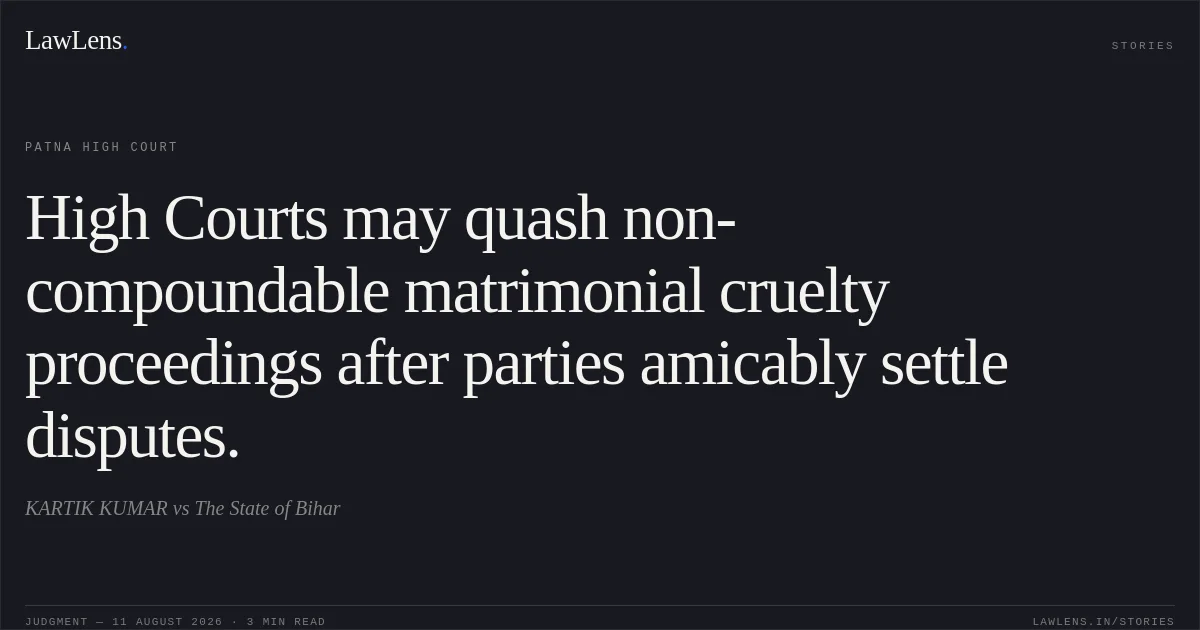
Source reference: p.1, para. 2; p.4, para. 8Relying on Gian Singh v. State of Punjab, (2012) 10 SCC 303, as quoted in Mange Ram v. State of Madhya Pradesh & Anr., 2025 SCC OnLine SC 1681, the Court held that even where offences are non-compoundable, criminal proceedings arising from matrimonial or family disputes may be quashed when the parties have genuinely settled their differences, continuation is unlikely to result in conviction, and refusal to quash would defeat justice.
Source reference: p.4, para. 8The Court further relied on Mange Ram for the principle that, where a marital dispute has been resolved and the proceedings no longer serve a legitimate purpose, quashing may be necessary to prevent misuse of the criminal process and to bring finality to the dispute.
Source reference: p.4, paras. 8–9Reasoning
The Court found that the dispute arose from a matrimonial relationship and that the parties had voluntarily resolved their differences through a written compromise.
Source reference: p.2, para. 5; p.3, para. 6The settlement addressed not only withdrawal or quashing of the pending proceedings but also financial security for the wife and future arrangements concerning their conjugal life.
Source reference: p.2, para. 5; p.3, para. 6Applying the principles governing quashing of matrimonial criminal proceedings, the Court concluded that continuation of the prosecution after settlement would serve no useful or legitimate purpose, would prolong the matrimonial discord, and would amount to an abuse of the process of the Court.
Source reference: p.5, para. 9The petitioner’s undertaking regarding the agreed financial deposits was also recorded by the Court.
Source reference: p.2, para. 5Holding
The High Court held that, in view of the voluntary compromise and restoration of peace between the parties, continuation of the criminal proceedings would be futile and contrary to the ends of justice.
It accordingly quashed the order dated 22 October 2022 passed by the Sub-Divisional Judicial Magistrate, Jamui, taking cognizance under Section 498A IPC and Sections 3/4 of the Dowry Prohibition Act, and allowed the criminal miscellaneous application.
Source reference: p.5, paras. 9–11Acts & Sections Cited
3 provisions across 2 statutes referred to in this judgment. Each provision opens on LawLens.
Code of Criminal Procedure, 19731
Original Court PDF
KARTIK KUMARvsThe State of Bihar
Click to open original judgment
Original judgment, available to read, download and summarize on LawLens.in