Facts
An altercation arose between the petitioner and respondent nos. 3 and 4 concerning the supply of canal water to their respective agricultural fields.
Source reference: para. 4–5During the incident, the petitioner allegedly used a country-made pistol, causing an injury to respondent no. 4’s left palm, for which medical treatment and stitches were required.
Source reference: para. 4–5An FIR was registered at Police Station Manglaur, District Haridwar, alleging offences under Sections 109(1), 351(2) and 352 of the Bharatiya Nyaya Sanhita, 2023 (“BNS”).
Source reference: para. 4–5During the pendency of the writ petition, the parties entered into a voluntary settlement with the intervention of village elders and filed a compounding application supported by affidavits.
Source reference: para. 6–7The petitioner and the complainant/injured appeared personally before the Court and confirmed the genuineness and voluntariness of the compromise, stating that the injured no longer wished to prosecute the petitioner.
Source reference: para. 8, 13The State opposed quashing on the ground that the offence under Section 109 BNS was non-compoundable, while not disputing the compromise.
Source reference: para. 9Issues
Whether the High Court could exercise its jurisdiction under Article 226 of the Constitution to quash the FIR and consequential criminal proceedings on the basis of a settlement, notwithstanding that the offence under Section 109 BNS was non-compoundable?
Source reference: para. 4, 9, 12Whether, considering the nature of the dispute, the voluntary settlement and the complainant/injured’s unwillingness to prosecute, continuation of the criminal proceedings would amount to an abuse of the process of law?
Source reference: para. 11–14Law Applied
The Court exercised its extraordinary jurisdiction under Article 226 of the Constitution to consider quashing of the FIR and consequential proceedings.
Source reference: no citationIt relied on Gian Singh v. State of Punjab, (2012) 10 SCC 303, and Narinder Singh v. State of Punjab, (2014) 6 SCC 466, which establish that the High Court’s inherent jurisdiction to quash criminal proceedings on the basis of a genuine settlement is distinct from the statutory power of a criminal court to compound offences; consequently, the non-compoundable nature of an offence does not, by itself, bar quashing where the circumstances justify such relief.
Source reference: para. 12The relevant allegations were under Sections 109(1), 351(2) and 352 BNS.
Source reference: para. 4Reasoning
The Court found that the dispute originated in a sudden altercation over canal-water supply between persons residing in the same vicinity, rather than from premeditation or an antecedent dispute.
Source reference: para. 11, 13The injured person appeared in Court, confirmed that the settlement was voluntary and genuine, and expressly stated that he no longer wished to prosecute the petitioner.
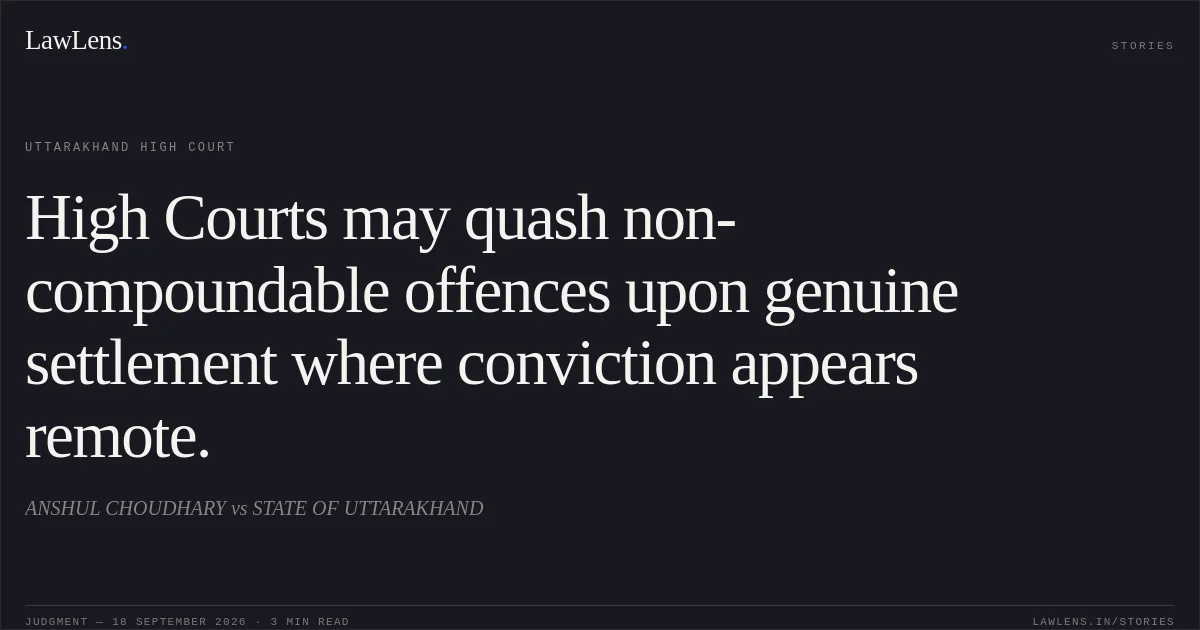
Source reference: para. 8, 13Applying the principles in Gian Singh and Narinder Singh, the Court held that the non-compoundable character of Section 109 BNS did not prevent it from exercising its constitutional jurisdiction.
Source reference: para. 12–14Given the amicable settlement, the nature of the incident, and the remote and bleak possibility of conviction, continuation of the prosecution would serve no meaningful purpose and would amount to an abuse of the process of law.
Source reference: para. 12–14Holding
The writ petition was allowed.
The Court quashed the FIR/Case Crime No. 0238 of 2026 registered at Police Station Manglaur, District Haridwar, qua the petitioner, together with all consequential proceedings arising from it.
Source reference: para. 15The compounding application and pending applications were accordingly disposed of.
Source reference: para. 16–17Note: paragraph 4 refers to FIR No. 0328 of 2026, whereas paragraph 15 records Case Crime No. 0238 of 2026; the judgment contains this apparent numerical discrepancy.
Source reference: para. 4, 15Acts & Sections Cited
3 provisions across 1 statute referred to in this judgment. Each provision opens on LawLens.
Bharatiya Nyaya Sanhita, 20233
Original Court PDF
ANSHUL CHOUDHARYvsSTATE OF UTTARAKHAND
Click to open original judgment
Original judgment, available to read, download and summarize on LawLens.in