Facts
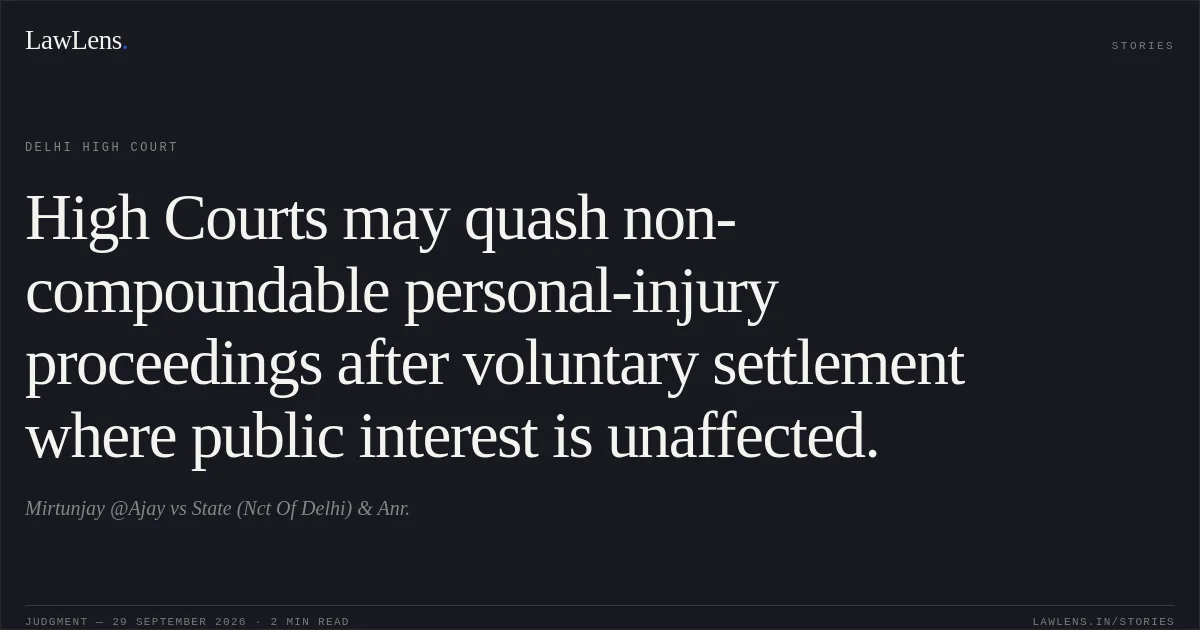
FIR No. 0255/2025 was registered at P.S. Kashmere Gate under Sections 110, 126(2), 61(2) and 3(5) of the Bharatiya Nyaya Sanhita, 2023, following respondent no. 2’s allegation that individuals acting on the petitioner’s behalf assaulted and threatened him in a dispute concerning a parking contract
Source reference: pp. 2–3, paras. 1, 4.1–4.5The parties later entered into a written settlement, effective from 18 July 2026, and sought quashing of the FIR
Source reference: p. 3, paras. 4.6–4.7Respondent no. 2 confirmed in Court that the settlement was voluntary and that he did not wish to pursue the case; the State did not oppose the petition
Source reference: p. 4, paras. 7–10Issues
1. Whether the High Court could quash the FIR and consequential proceedings under Section 528 of the BNSS on the basis of a voluntary settlement, although the alleged offence under Section 110 BNS was non-compoundable
Source reference: pp. 4–5, paras. 12–162. Whether, in the circumstances of this case, continuing the criminal proceedings would serve a meaningful purpose or be contrary to the interests of justice
Source reference: pp. 5, 8, paras. 13, 19Law Applied
Section 528 of the BNSS preserves the High Court’s inherent power to make orders necessary to secure the ends of justice or prevent abuse of the process of any court; that power is distinct from statutory compounding and may extend to non-compoundable offences in appropriate cases
Source reference: pp. 4–5, paras. 12–16Relying on Gian Singh v. State of Punjab, (2012) 10 SCC 303, the Court noted that proceedings may be quashed where the dispute is predominantly private, settlement makes conviction unlikely, and continuation would defeat the ends of justice, while serious offences affecting society ordinarily cannot be quashed merely on compromise
Source reference: pp. 5–6, para. 17It also applied Narinder Singh v. State of Punjab, (2014) 6 SCC 466, which requires cautious exercise of the power, consideration of the nature and gravity of the offence, and assessment of the prospects of conviction and the impact of continuing proceedings
Source reference: pp. 6–7, para. 18Deepak Kumar v. State (Govt. of NCT) of Delhi, 2024 SCC OnLine Del 1305, was cited for the principle that the decision depends on the circumstances of each case, including the offence’s gravity and societal impact
Source reference: p. 8, para. 20Reasoning
The Court treated the dispute as personal in nature, arising from the parties’ conflict over a parking contract, and noted that the alleged injury-related dispute had been resolved through a voluntary settlement confirmed by respondent no. 2 in Court
Source reference: pp. 3–4, paras. 4.6–4.7, 8Although Section 110 BNS was non-compoundable, the Court considered that the matter did not involve a loss or damage to the public at large and found no useful purpose in continuing the proceedings after settlement
Source reference: pp. 4–5, paras. 12–15; p. 8, para. 19Applying the cited authorities, it concluded that quashing in these circumstances would serve the interests of justice
Source reference: pp. 5–8, paras. 16–20Holding
The petition was allowed.
The Court quashed FIR No. 0255/2025, registered under Sections 110, 126(2), 61(2) and 3(5) BNS, together with all proceedings arising from it
Source reference: p. 8, paras. 21–22The parties were directed to remain bound by the Memorandum of Settlement Deed dated 10 August 2026, and the pending application was disposed of
Source reference: p. 8, paras. 23–24Acts & Sections Cited
7 provisions across 3 statutes referred to in this judgment. Each provision opens on LawLens.
Bharatiya Nagarik Suraksha Sanhita, 20231
Bharatiya Nyaya Sanhita, 20234
Code of Criminal Procedure, 19732
Original Court PDF
Mirtunjay @AjayvsState (Nct Of Delhi) & Anr.
Click to open original judgment
Original judgment, available to read, download and summarize on LawLens.in