Facts
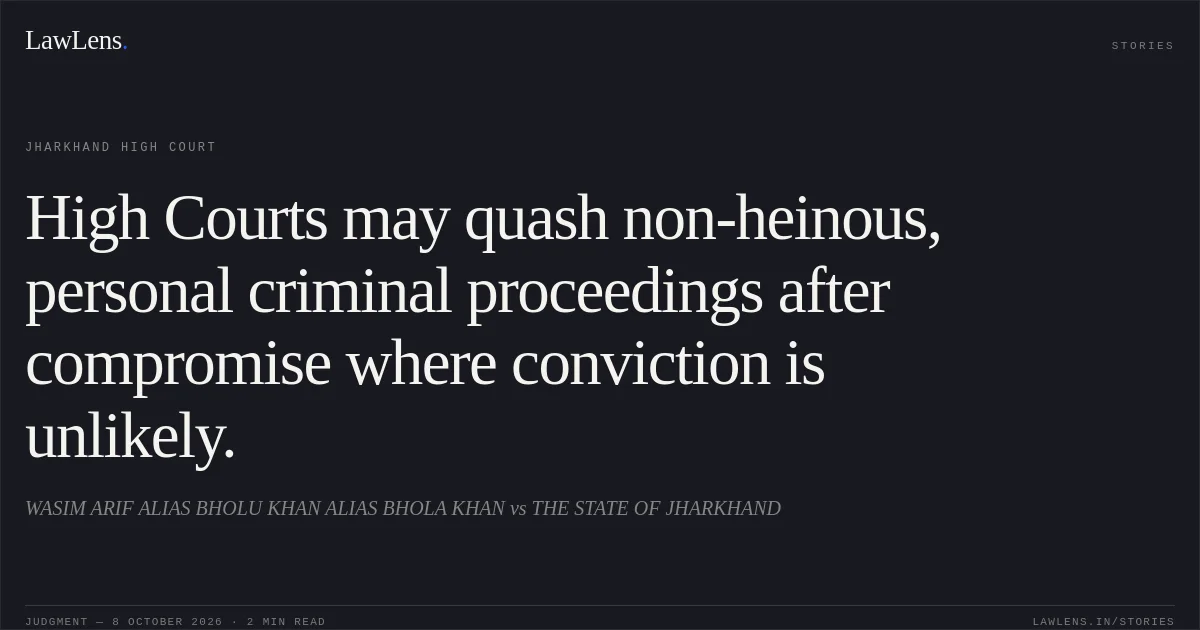
The eight petitioners sought to quash the criminal proceedings arising from Lohsingha P.S. Case No. 37 of 2025, corresponding to G.R. No. 2252 of 2026, including the cognizance order dated 17 August 2026.
Source reference: p. 2, para. 2Cognizance had been taken for offences under Sections 191(2), 191(3), 126(2), 115(2), 118(1) and 351(2) of the Bharatiya Nyaya Sanhita, 2023 (BNS).
Source reference: p. 2, para. 2The petitioners and the informant-victim filed affidavits stating that they had amicably settled their dispute and that the informant did not wish to proceed.
Source reference: pp. 2–3, paras. 3–4The State had no objection to the quashing prayer.
Source reference: pp. 2–3, paras. 3–4Issues
1. Whether the High Court could exercise its inherent jurisdiction under Section 528 of the Bharatiya Nagarik Suraksha Sanhita, 2023 (BNSS) to quash the proceedings in light of the parties’ compromise.
Source reference: p. 2, para. 2; pp. 4–6, paras. 5–72. Whether the offences and circumstances of the case were such that continuation of the proceedings would be unnecessary or contrary to the ends of justice.
Source reference: pp. 5–6, paras. 5–7Law Applied
Section 528 of the BNSS preserves the High Court’s inherent power to make orders necessary to prevent abuse of the process of any court or to secure the ends of justice.
Source reference: p. 2, para. 2; p. 4, para. 5Applying Parbatbhai Aahir @ Parbatbhai Bhimsinhbhai Karmur v. State of Gujarat, (2017) 9 SCC 641, which restated the principles in Gian Singh v. State of Punjab, (2012) 10 SCC 303, the Court noted that quashing on the basis of settlement depends on the facts and circumstances of each case.
Source reference: pp. 4–6, para. 5The High Court must consider the nature and gravity of the offence; heinous or serious offences generally cannot be quashed merely because the parties have settled.
Source reference: pp. 4–6, para. 5By contrast, proceedings involving a predominantly private dispute may be quashed where the settlement is complete, the prospect of conviction is remote, and continuation would cause injustice or amount to abuse of process.
Source reference: pp. 4–6, para. 5Reasoning
The Court accepted that the dispute had been amicably settled and that the informant-victim no longer wished to pursue the case.
Source reference: pp. 2–3, para. 3It found that the offences involved were neither heinous nor serious offences of mental depravity, and characterised the case as having arisen from a misunderstanding between the parties.
Source reference: p. 6, para. 6Given the settlement, the Court considered that continuing the proceedings would cause hardship to the petitioners and found the case suitable for exercise of its inherent jurisdiction.
Source reference: p. 6, para. 7Holding
The Court allowed the petition and quashed the entire criminal proceeding, including the cognizance order dated 17 August 2026 in Lohsingha P.S. Case No. 37 of 2025, corresponding to G.R. No. 2252 of 2026, qua the petitioners only.
The connected interlocutory application was disposed of.
Source reference: p. 7, para. 10Acts & Sections Cited
8 provisions across 3 statutes referred to in this judgment. Each provision opens on LawLens.
Bharatiya Nagarik Suraksha Sanhita, 20231
Bharatiya Nyaya Sanhita, 20235
Code of Criminal Procedure, 19732
Original Court PDF
WASIM ARIF ALIAS BHOLU KHAN ALIAS BHOLA KHANvsTHE STATE OF JHARKHAND
Click to open original judgment
Original judgment, available to read, download and summarize on LawLens.in