Facts
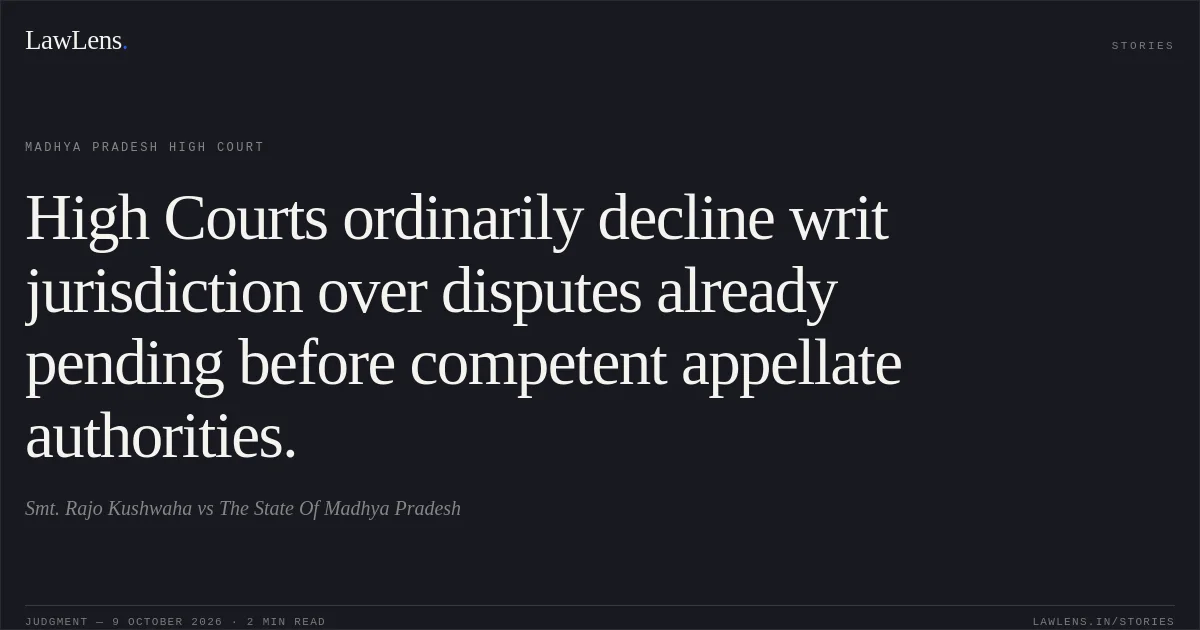
The petitioner challenged an ex parte interim stay order dated 16 July 2026 made by the Additional Commissioner, Gwalior Division, in an appeal concerning the appointment of respondent No. 5 as an Anganwadi Worker.
Source reference: para. 2–6, 10, 13The petitioner had filed a reply and an application to vacate the stay before the Additional Commissioner; the appeal remained pending when she brought this writ petition under Article 226.
Source reference: para. 2–6, 10, 13Issues
Whether the High Court should exercise its jurisdiction under Article 226 to interfere with the interim order when the statutory appeal concerning the same dispute is pending before the Additional Commissioner.
Source reference: para. 10, 12–16Whether the petitioner’s allegations concerning the ex parte stay order warranted writ intervention notwithstanding the pending appellate proceedings.
Source reference: para. 4–6, 10–15Law Applied
Article 226 confers wide discretionary jurisdiction, and the existence of an alternative statutory remedy does not oust that jurisdiction; ordinarily, however, a writ petition is not entertained where an effective remedy is available. Recognised exceptions include infringement of fundamental rights, breach of natural justice, an order or proceeding wholly without jurisdiction, and a challenge to the vires of legislation.
Source reference: para. 11The Court relied on Radha Krishan Industries v. State of Himachal Pradesh, (2021) 6 SCC 771, as cited in Tamilnadu Cements Corp. v. Unicon Engineers, (2025) 4 SCC 1, for these principles. It also referred to State of U.P. v. Ehsan, (2024) 14 SCC 269, which recognises that an alternative remedy is not an absolute bar, while identifying serious factual disputes and insufficient or inconclusive evidence as possible reasons to relegate a matter to the alternative forum.
Source reference: para. 11Reasoning
The Court noted that the Additional Commissioner was already seized of the appeal concerning the appointment and that the petitioner had placed her objections and request to vacate the interim stay before that authority.
Source reference: paras. 12–16It considered that the appellate authority could address those matters in the pending proceeding and that parallel consideration by the High Court risked conflicting decisions on the same dispute. Accordingly, the Court declined to examine the petitioner’s allegations about the stay order or respondent No. 5’s eligibility, leaving those matters for the appellate authority.
Source reference: paras. 12–16Holding
The Court declined to entertain the petition at that stage because the same dispute was pending before the competent appellate authority and the petitioner could pursue her objections and vacation application there.
It expressed no opinion on the merits and dismissed the petition; any pending applications were also disposed of.
Source reference: paras. 15–18Acts & Sections Cited
1 provisions across 1 statute referred to in this judgment. Linked provisions open on LawLens.
the Act (alias, unresolved)1
Original Court PDF
Smt. Rajo KushwahavsThe State Of Madhya Pradesh
Click to open original judgment
Original judgment, available to read, download and summarize on LawLens.in