Facts
The appellant, an Upper Division Clerk at the MCD, was accused of demanding and accepting a bribe of ₹5,000 from the complainant (PW2) on December 6, 2000, in exchange for a mutation order regarding property No. 3314.
Source reference: p. 2A trap was organized by the Anti-Corruption Branch involving a shadow witness (PW4) and a Trap Laying Officer (PW6).
Source reference: p. 11The Trial Court convicted the appellant on May 20, 2005, under Sections 7 and 13(1)(d) read with 13(2) of the Prevention of Corruption (PC) Act, 1988, sentencing him to 18 months of rigorous imprisonment.
Source reference: p. 5-6The appellant challenged this in the High Court, arguing that the complainant and shadow witness turned hostile and the demand/acceptance was never proved.
Source reference: p. 6-7Issues
1. Whether there is any infirmity in the impugned judgment regarding the proof of demand, acceptance, or recovery of the bribe amount.
Source reference: p. 82. Whether a conviction can be sustained solely on the testimony of the Trap Laying Officer (TLO) when material witnesses turn hostile.
Source reference: p. 19-20Law Applied
Section 7 (public servant taking gratification other than legal remuneration) and Section 13(1)(d) (criminal misconduct by a public servant) of the PC Act, 1988.
Source reference: p. 1-2The evidentiary value of the Trap Laying Officer's testimony as discussed in State of U.P. v. Zakaullah and DK Sharma v. State of Delhi, which suggest that while a conviction can sometimes rest on a TLO's testimony, such evidence must be direct and reliable rather than hearsay.
Source reference: p. 8, 20Reasoning
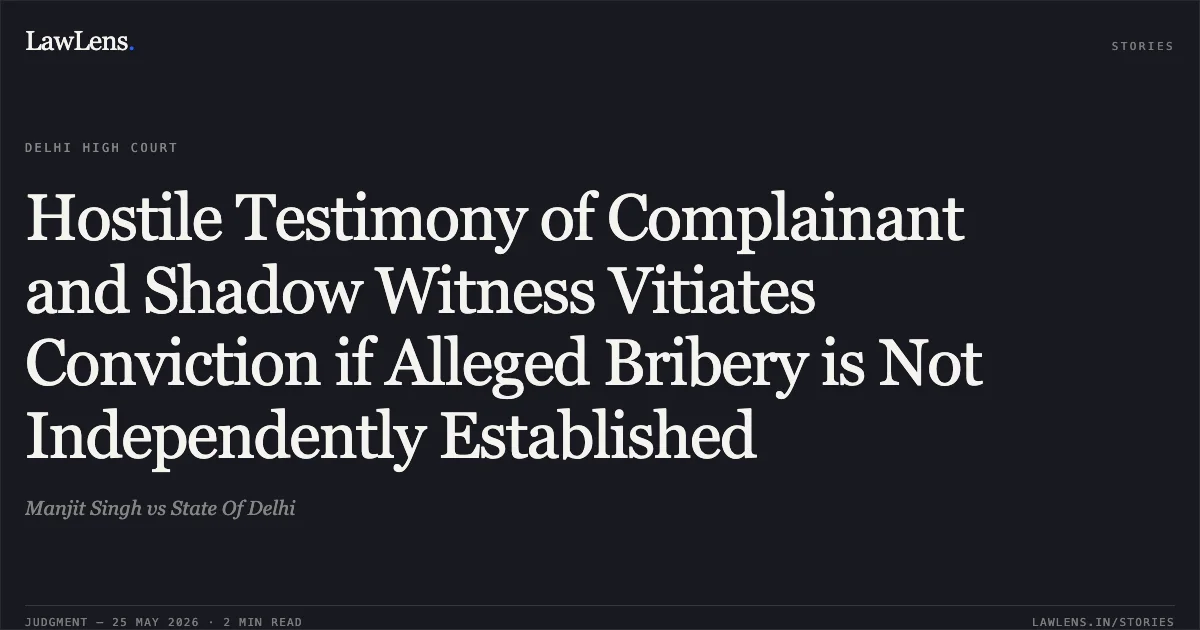
The High Court found that the prosecution's case rested on shaky foundations because both the complainant (PW2) and the shadow witness (PW4) turned hostile.
Source reference: p. 13, 16PW2 testified that the appellant refused the cash and asked for a cheque, while PW4 claimed the money fell on the ground during a scuffle and was not accepted.
Source reference: p. 13-15The Court determined his testimony was hearsay because he did not personally witness the exchange; he only acted on a signal from PW4, who subsequently denied the prosecution’s version in court.
Source reference: p. 20Furthermore, the TLO's claim that the accused "confessed and sought pardon" at the scene was not recorded in the contemporaneous raid report (Ext. PW2/K), rendering his oral testimony unreliable.
Source reference: p. 21Holding
The Court held that the prosecution failed to prove the essential ingredients of demand and acceptance beyond a reasonable doubt, as the TLO's evidence was insufficient to override the hostile testimony of the material witnesses.
The High Court allowed the appeal and set aside the conviction. The appellant was acquitted of all charges under Sections 7 and 13(1)(d) of the PC Act and ordered to be set at liberty.
Source reference: p. 21-22Acts & Sections Cited
6 provisions across 2 statutes referred to in this judgment. Each provision opens on LawLens.
Code of Criminal Procedure, 19734
Prevention of Corruption Act, 19882
Original Court PDF
Manjit SinghvsState Of Delhi
Click to open original judgment
Original judgment, available to read, download and summarize on LawLens.in