Facts
The Appellant was convicted by the Trial Court for throwing acid on the victim on November 23, 2020, near a public toilet in Pune.
Source reference: para. 1-2The victim, who had a prior relationship with the Appellant, was confronted by him after her marriage; he allegedly threatened to "break her pride" and threw liquid on her face, causing burn injuries.
Source reference: para. 2, 9During the trial, several prosecution witnesses, including the victim and her father, turned hostile.
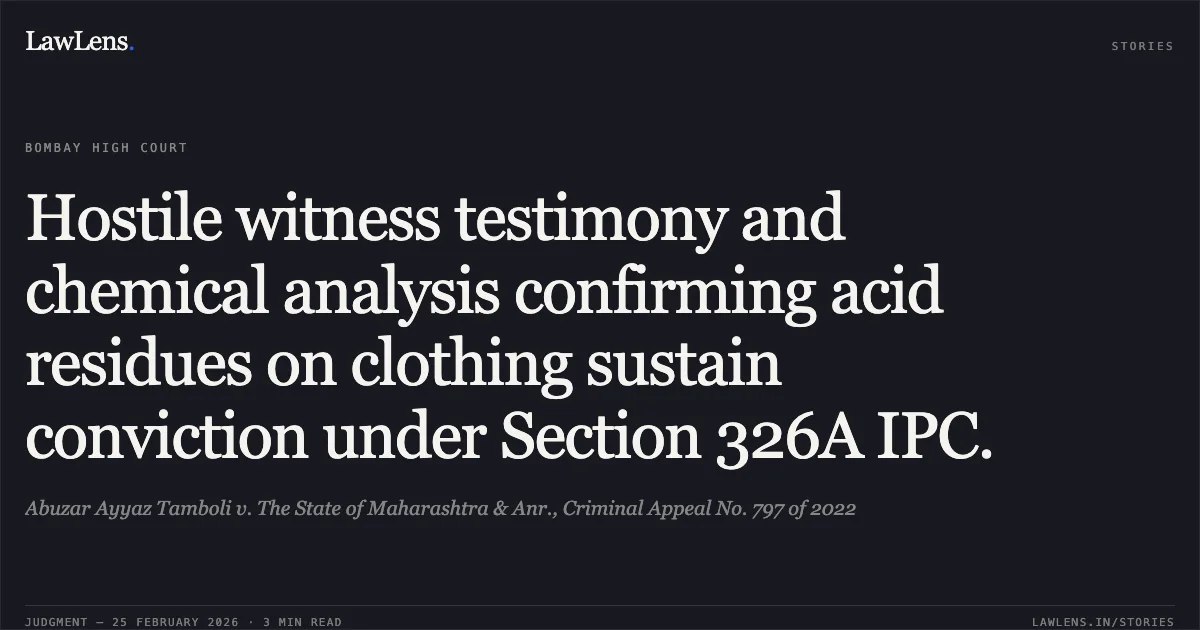
Source reference: para. 6, 8However, the victim admitted the incident during cross-examination by the APP, and Chemical Analyzer (CA) reports detected nitrate ions on the Appellant’s clothes.
Source reference: para. 9-10The Trial Court sentenced the Appellant to 10 years of imprisonment under Sections 326-A, 354-D, and 506 of the IPC, and Sections 10 and 12 of the POCSO Act.
Source reference: para. 1Issues
1. Whether the testimony of a hostile witness can be relied upon to sustain a conviction if partially corroborated by other evidence.
Source reference: para. 82. Whether the conviction under the POCSO Act is sustainable in the absence of evidence of sexual intent.
Source reference: para. 153. Whether the prosecution proved the guilt of the accused under Section 326-A of the IPC beyond reasonable doubt despite the lack of evidence regarding the procurement of the acid.
Source reference: para. 10-13Law Applied
The Court applied the settled legal principle regarding hostile witnesses, holding that the entire testimony of such a witness need not be discarded and remains admissible to the extent it is reliable.
Source reference: para. 8The Court primarily applied Section 326-A of the IPC (Voluntarily causing grievous hurt by use of acid), which mandates a minimum sentence of 10 years.
Source reference: para. 1, 17Regarding the POCSO Act, the court interpreted Section 3, noting that the act must constitute a "sexual assault" with sexual intent to invoke the statute.
Source reference: para. 15It further referenced the Indian Evidence Act concerning the burden of proof, noting that once the accused's presence and the presence of chemical residues on his clothes were established, the burden shifted to the accused to provide an explanation under Section 313 Cr.P.C.
Source reference: para. 11Reasoning
The Court reasoned that although the victim and other witnesses were declared hostile, the victim’s admissions during the APP’s cross-examination—specifically regarding the Appellant’s motive and his verbal threats—were credible.
Source reference: para. 9The Court emphasized that the CA Report (Exh. 19 & 20) confirmed the presence of nitrate ions on the Appellant's clothes, which the Appellant failed to explain.
Source reference: para. 10-11This scientific evidence, coupled with the Appellant’s admitted presence at the spot, ruled out the defense's theory that the victim’s husband committed the act.
Source reference: para. 11-12The Court dismissed the argument that the failure to trace the source of the acid was fatal, as the oral and circumstantial evidence was overwhelming.
Source reference: para. 13However, the Court found the POCSO conviction erroneous because throwing acid, while a heinous crime, did not meet the definition of "sexual assault" under Section 3 of the POCSO Act in this specific context.
Source reference: para. 15Holding
The High Court partly allowed the appeal by setting aside the conviction and sentence under the POCSO Act, as no sexual intent was established.
However, it upheld the conviction and the 10-year minimum sentence under Section 326-A of the IPC, ruling that the prosecution had proved the acid attack beyond reasonable doubt.
Source reference: para. 15, 19The court declined to grant leniency or apply the Probation of Offenders Act given the serious nature of the offense and the statutory minimum sentence.
Source reference: para. 17-18The appeal was dismissed regarding the IPC convictions.
Source reference: para. 19Acts & Sections Cited
4 provisions across 2 statutes referred to in this judgment. Each provision opens on LawLens.
Indian Penal Code, 18601
Protection of Children from Sexual Offences Act, 20123
Original Court PDF
Abuzar Ayyaz Tamboli v. The State of Maharashtra & Anr., Criminal Appeal No. 797 of 2022
Click to open original judgment
Original judgment, available to read, download and summarize on LawLens.in