Facts
The deceased, Baldevbhai Bhil, was engaged by the appellant (a contractor) to perform work at a warehouse belonging to respondent No. 2 (Central Warehouse Corporation).
Source reference: para. 3.1–3.2On August 10, 2008, while performing painting/coloring work, the deceased fell and died on the spot.
Source reference: para. 3.1–3.2The widow (respondent No. 1) filed a claim petition under the Employees Compensation Act, 1923.
Source reference: para. 2–3.4The Workmen Commissioner allowed the claim, awarding Rs. 3,45,040/- with 12% interest and a 25% penalty, holding the contractor and the corporation jointly and severally liable.
Source reference: para. 2–3.4The contractor appealed, contending that the nature of the work (painting) does not fall under the definition of employment for the purposes of compensation under the Act.
Source reference: para. 4Issues
1. Whether the death of a person engaged in a contract for painting/coloring work falls within the definition of "arising out of and in the course of employment" under Section 3(1) of the Employees Compensation Act, 1923.
Source reference: para. 42. Whether the claimant’s improved testimony regarding the deceased "changing iron sheets" could be sustained against the original pleadings of "coloring work".
Source reference: para. 9–10Law Applied
Section 3(1) of the Employees Compensation Act, 1923, which defines the employer's liability for compensation regarding accidents arising out of and in the course of employment.
Source reference: para. 2/4Supreme Court of India in Lakshminarayana Shetty v. Shantha & Anr. [2002(1) T.A.C. 130 (S.C.)], which held that a contract for painting a structure does not necessarily bring the engagement within the four corners of the Act to qualify the worker as a "workman" for such claims.
Source reference: para. 4/6Reasoning
The Court noted that in the initial statutory notice and the claim petition, the claimant explicitly stated the deceased was performing "coloring/painting work".
Source reference: para. 7During oral evidence, the claimant attempted to improve this version by stating the deceased was "changing iron sheets" to bring the case within the Act’s scope; the Court found this improved version lacked documentary support and contradicted the original pleadings.
Source reference: para. 8-9Applying the ratio in Lakshminarayana Shetty, the Court reasoned that painting work under such a contract does not satisfy the statutory requirements of Section 3(1) of the Act.
Source reference: para. 10Despite expressing sympathy for the widow, the Court held that the operation of law strictly barred the claim as the deceased did not qualify for compensation under the specific circumstances of his engagement.
Source reference: para. 10Holding
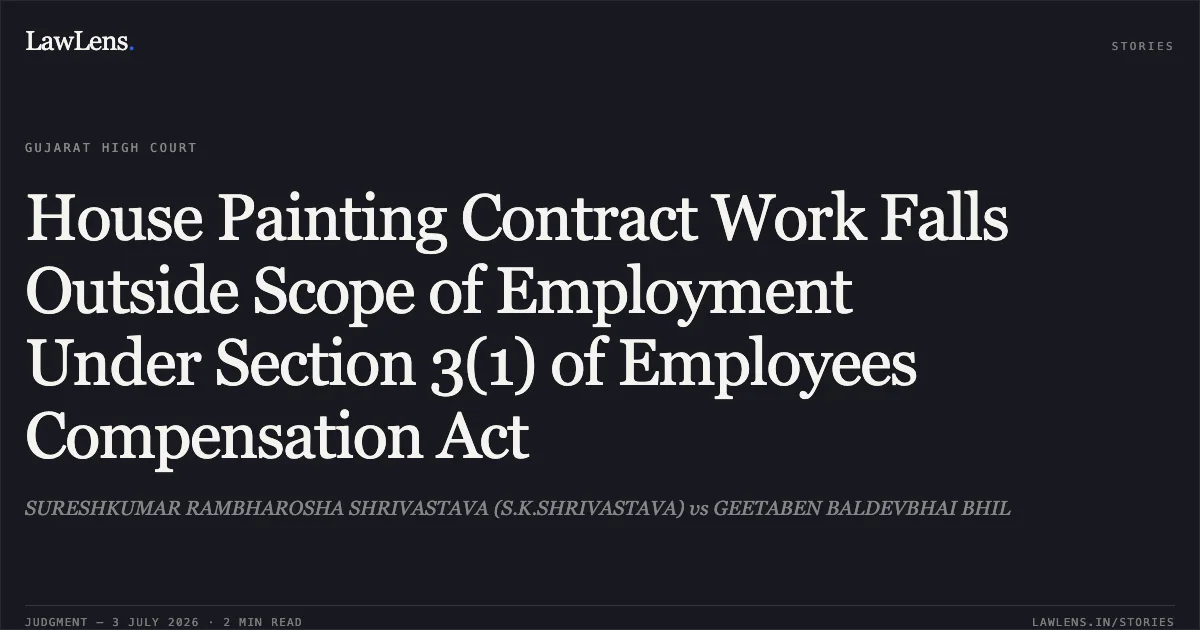
The court held that the accident did not fall within the domain of the Employees Compensation Act.
The Court allowed the appeal and set aside the judgment and award passed by the Workmen Commissioner, dismissing the original Fatal Application No. 2 of 2010.
Source reference: para. 11The Court ordered that any unpaid amount lying with the Commissioner be returned to the appellant, though any amount already paid to the claimant shall not be recovered.
Source reference: para. 12Acts & Sections Cited
2 provisions across 1 statute referred to in this judgment. Linked provisions open on LawLens.
Employee2
Original Court PDF
SURESHKUMAR RAMBHAROSHA SHRIVASTAVA (S.K.SHRIVASTAVA)vsGEETABEN BALDEVBHAI BHIL
Click to open original judgment
Original judgment, available to read, download and summarize on LawLens.in