01Facts
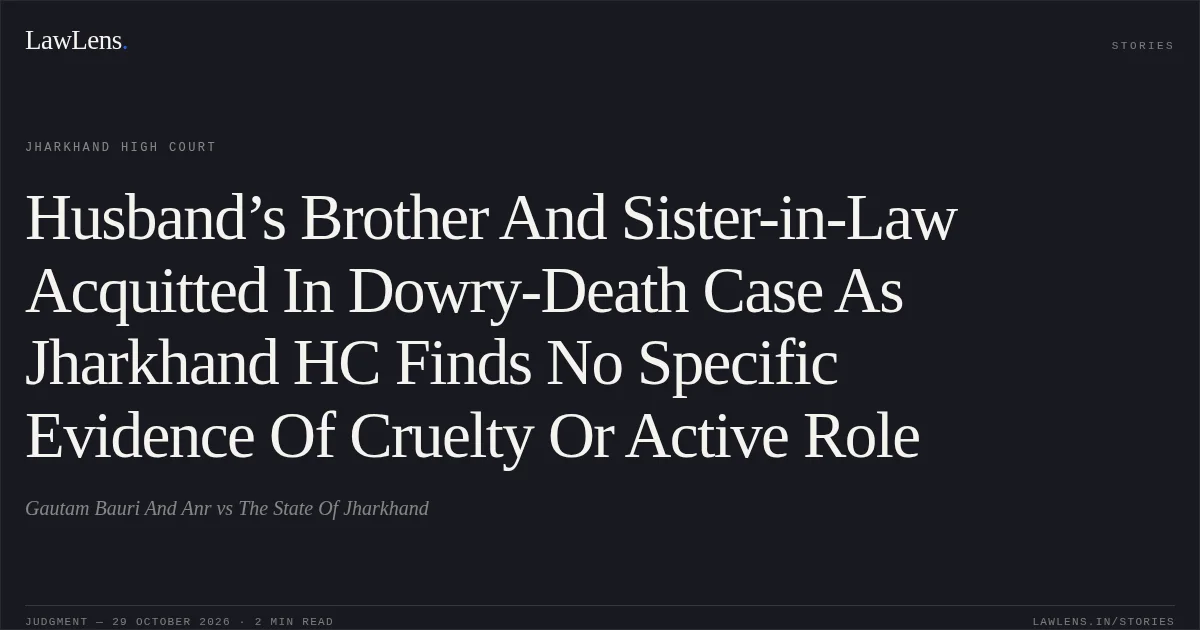
Rinku Devi died from burn injuries in May 2012, within two years of her marriage to Ratan Bauri.
¶ 6–15Her mother alleged that her in-laws had demanded ₹50,000 and a motorcycle and that her mother-in-law and husband set her on fire, while the appellants—her husband’s brother and sister-in-law—were present and did not intervene.
¶ 6–15The appellants were convicted under Section 304-B IPC and sentenced to seven years’ rigorous imprisonment. They appealed, disputing the evidence of dowry-related cruelty and their involvement.
¶ 25–3902Issues
i.Whether the prosecution established the essential ingredients of Section 304-B IPC against the appellants
¶ 44(i)ii.Whether reliable evidence established that the appellants subjected the deceased to dowry-related cruelty or harassment “soon before” her death
¶ 44(ii)iii.Whether the appellants were entitled to the benefit of reasonable doubt
¶ 44(iii)03Law Applied
Section 304-B IPC requires proof that a woman died from burns, bodily injury, or otherwise than under normal circumstances within seven years of marriage, and that soon before her death she was subjected by her husband or a relative of her husband to cruelty or harassment in connection with a dowry demand; “soon before” requires a proximate and live link, not necessarily conduct immediately preceding death (*Major Singh v. State of Punjab*; *Satbir Singh v. State of Haryana*; *Surinder Singh v. State of Haryana*).
¶ 45–52, 55Once those foundational facts are shown, Section 113-B of the Evidence Act requires the court to presume that the accused caused the dowry death.
¶ 53–56General or omnibus allegations against relatives, without specific supporting material, require careful scrutiny (*Monju Roy v. State of W.B.*; *Kans Raj v. State of Punjab*); the prosecution must prove the accused’s dowry-related cruelty or harassment.
¶ 67–70The prosecution must prove guilt beyond reasonable doubt, and reasonable doubt must benefit the accused.
¶ 88–93Provisions in the judgment · 5 · Linked ones open on LawLens
Indian Penal Code, 1860 Section 34Section 394
Code of Criminal Procedure, 1973 Section 374Section 313
Dowry Prohibition Act, 1961 Section 2
04Reasoning
The Court accepted that the deceased’s death was unnatural and occurred within seven years of marriage.
¶ 61–66However, the specific allegations that kerosene was poured and the fire ignited were directed at the mother-in-law and husband. As to the appellants, the evidence was general: they were said to have been present, to have failed to rescue the deceased, or to have been involved in a conspiracy.
¶ 61–66, 71–72The record did not establish specific dowry-related cruelty or harassment by either appellant, so the statutory foundation for applying Section 113-B was not made out against them.
¶ 71–72, 94–98The Court also noted that Section 34 IPC had not been invoked and found no cogent evidence of their active participation or shared common intention.
¶ 94–9805Holding
The High Court held that the prosecution had not proved the appellants’ guilt under Section 304-B IPC beyond reasonable doubt.
¶ 97–100It allowed the appeal, set aside their convictions, acquitted them, and discharged their bail bonds.
¶ 97–100Original Court PDF
Gautam Bauri And AnrvsThe State Of Jharkhand
Click to open original judgment
Original judgment, available to read, download and summarize on LawLens.in