Facts
The complainant alleged that, in 2011, petitioner no. 2, acting for petitioner no. 1, entered into a partnership with him for mechanised coach-cleaning work for Indian Railways at the Dhanbad site.
Source reference: p. 2–3, para. 3The complainant claimed a 25% share and alleged that he invested ₹19,50,000 towards labour payments, ₹13,50,000 towards materials, and ₹3,76,000 as a security deposit, which the petitioners did not repay.
Source reference: p. 2–3, para. 3The Judicial Magistrate First Class, Dhanbad, found a prima facie case under Sections 406 and 417 of the Indian Penal Code and issued summons in Complaint Case No. 10242 of 2024.
Source reference: p. 2, para. 2The petitioners sought to quash the proceeding and summoning order under Section 528 of the Bharatiya Nagarik Suraksha Sanhita, 2023.
Source reference: p. 2, para. 2Issues
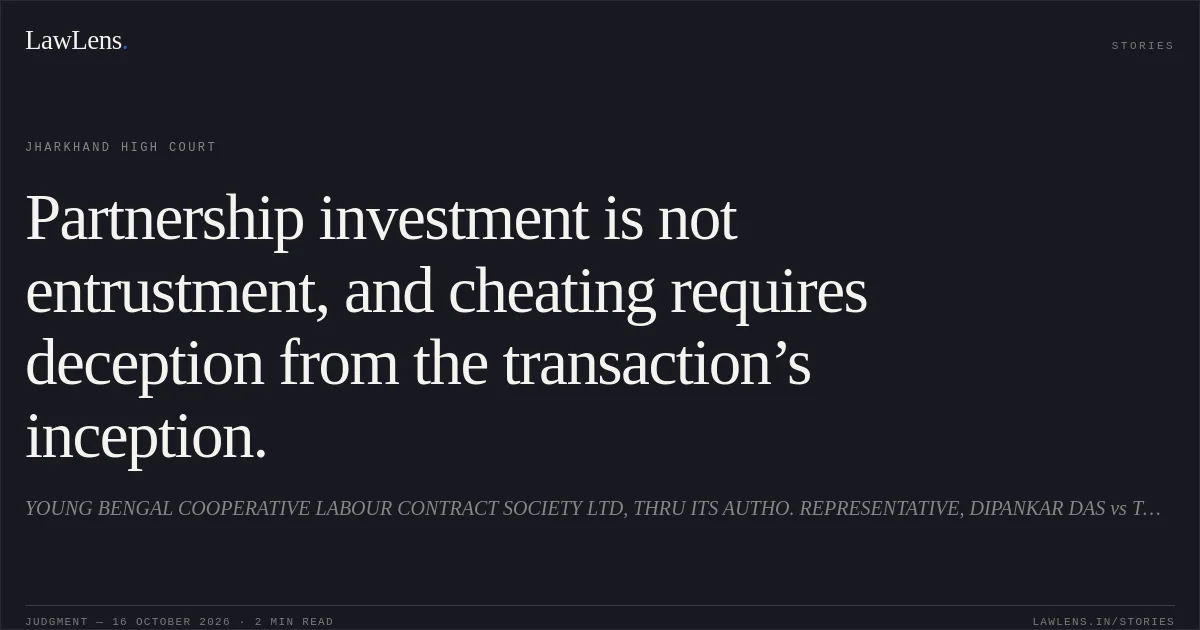
Whether the alleged investment in the partnership, without an allegation of entrustment or dishonest misappropriation, disclosed an offence under Sections 406/405 IPC.
Source reference: p. 7–9, paras. 8, 10–11Whether the allegations disclosed cheating under Section 417 IPC in the absence of an allegation that the petitioners intended to deceive the complainant at the inception of the transaction.
Source reference: p. 9–10, paras. 12–14Whether the criminal proceeding and summoning order should therefore be quashed.
Source reference: p. 10, paras. 15–16Law Applied
Section 405 IPC requires entrustment of property or dominion over it, followed by dishonest misappropriation, conversion, use, or disposal; mere retention or non-payment is insufficient to establish criminal breach of trust under Section 406 IPC.
Source reference: p. 8–9, para. 10; p. 5–6, para. 6A partner’s ordinary dominion over partnership property is not, without more, dominion resulting from entrustment for purposes of Section 405 IPC.
Source reference: p. 8–9, para. 10For cheating under Sections 415/417 IPC, fraudulent or dishonest intention must exist when the inducement or transaction begins; a subsequent failure to perform a contractual obligation does not, by itself, constitute cheating.
Source reference: p. 3–4, para. 4; p. 4–5, para. 5Reasoning
The Court noted that the complainant’s case was that the money was invested in a partnership in which he held a 25% share, and that the partnership entity continued to exist.
Source reference: p. 9, para. 11In those circumstances, the investment did not amount to property entrusted to the petitioners; the allegations also did not disclose dishonest misappropriation of entrusted property.
Source reference: p. 9, paras. 10–11As to cheating, the complaint contained no allegation that the petitioners had deceived the complainant from the outset of the transaction.
Source reference: p. 10, paras. 12–14Thus, even accepting the allegations in full, the essential ingredients of either offence were absent.
Source reference: no citationHolding
The Court held that the allegations did not make out offences under Sections 406 or 417 IPC and that continuing the prosecution would amount to an abuse of process.
It quashed and set aside, qua the petitioners, the criminal proceeding in Complaint Case No. 10242 of 2024, including the order dated 23 June 2025, and allowed the criminal miscellaneous petition.
Source reference: p. 10–11, paras. 16–17Acts & Sections Cited
6 provisions across 2 statutes referred to in this judgment. Each provision opens on LawLens.
Bharatiya Nagarik Suraksha Sanhita, 20231
Indian Penal Code, 18605
Original Court PDF
YOUNG BENGAL COOPERATIVE LABOUR CONTRACT SOCIETY LTD, THRU ITS AUTHO. REPRESENTATIVE, DIPANKAR DASvsTHE STATE OF JHARKHAND
Click to open original judgment
Original judgment, available to read, download and summarize on LawLens.in