Facts
The appellant was convicted under Section 376 of the Indian Penal Code and sentenced to seven years’ rigorous imprisonment by the Additional Judicial Commissioner, Ranchi
Source reference: p.1, para. 2The prosecution alleged that on 3 February 2001, while the appellant and the prosecutrix were travelling to a wedding, he raped her near a school and threatened her not to disclose the incident
Source reference: p.2, para. 3The prosecutrix reported the incident several days later, and the FIR was registered on 7 February 2001
Source reference: pp. 2, 5, paras. 3–4, 10(ii)The defence alleged that the rape case was fabricated as a counterblast to a murder case registered against the prosecutrix’s relatives after the appellant’s mother was killed on 6 February 2001
Source reference: pp. 4, 8, para. 8On appeal, the High Court examined the conviction and the evidence, including the prosecutrix’s testimony, the medical findings, and the circumstances surrounding the FIR
Source reference: pp. 11–17, paras. 13–16Issues
Whether the trial court’s judgment of conviction and sentence suffered from an error of law warranting appellate interference
Source reference: p.10, para. 13Whether the prosecutrix’s testimony, considered with the surrounding circumstances and other evidence, was sufficiently reliable to sustain the conviction under Section 376 IPC
Source reference: pp. 18–22, paras. 17–23Law Applied
The appellant was charged and convicted under Section 376 of the Indian Penal Code
Source reference: pp. 2, 4, paras. 4, 9A conviction for rape may rest on the prosecutrix’s sole testimony if it inspires confidence; corroboration is not a legal prerequisite, though the court may seek assurance where the testimony has material infirmities.
Source reference: no citationThe Court relied on Krishan Kumar Malik v. State of Haryana, (2011) 7 SCC 130, concerning the need for the testimony to be trustworthy and of sterling quality
Source reference: p.18, para. 18State of H.P. v. Manga Singh, (2019) 16 SCC 759, on the sufficiency of credible sole testimony and the non-essential nature of corroboration
Source reference: pp. 18–19, para. 19Sham Singh v. State of Haryana, (2018) 18 SCC 34, on assessing the prosecutrix’s evidence in the context of the broader probabilities and distinguishing material infirmities from minor discrepancies
Source reference: p.19, para. 20Reasoning
The Court accepted that a conviction may be based on the prosecutrix’s sole testimony, but found that her evidence in this case did not inspire confidence when assessed against the whole record
Source reference: pp. 18–19, 21–22, paras. 17–23It noted inconsistencies concerning when and to whom she first disclosed the alleged assault, her failure to report it at the wedding or to family members, and the delay in lodging the FIR; the prosecution also did not examine the wedding host or other witnesses who could support her account of attending the wedding
Source reference: pp. 19–20, para. 21The medical examination found no injuries and no definite evidence of rape, while the investigating officer recovered no signs of struggle or incriminating material from the alleged scene
Source reference: pp. 16, 20–21, paras. 15, 21The Court also considered the timing of the rape FIR, lodged after the murder case naming the prosecutrix’s relatives, and the evidence of longstanding hostility between the families. Taken together, these circumstances left the genesis and manner of the occurrence doubtful
Source reference: pp. 20–22, paras. 21–23Holding
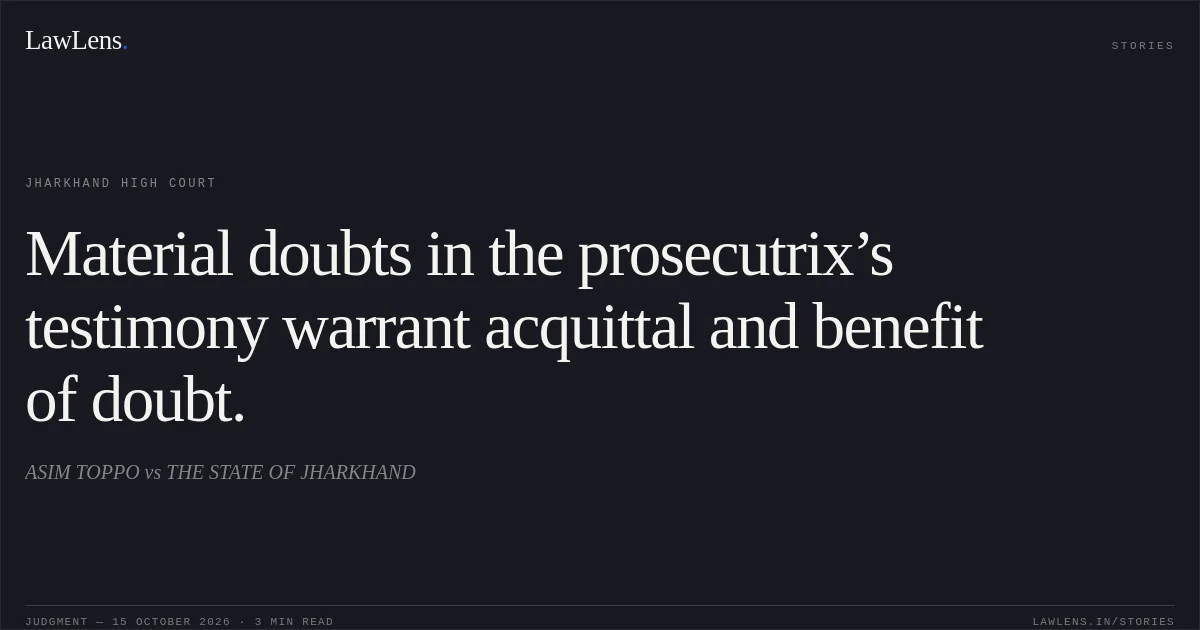
The High Court held that the prosecution had not proved the charge beyond reasonable doubt and that the appellant was entitled to the benefit of doubt
It set aside the conviction and sentence under Section 376 IPC, acquitted the appellant, discharged him and his sureties from their bail obligations, and allowed the appeal
Source reference: p.22, paras. 23–25Acts & Sections Cited
5 provisions across 1 statute referred to in this judgment. Each provision opens on LawLens.
Indian Penal Code, 18605
Original Court PDF
ASIM TOPPOvsTHE STATE OF JHARKHAND
Click to open original judgment
Original judgment, available to read, download and summarize on LawLens.in