Facts
The petitioner sought to quash the FIR and criminal proceedings in Telco P.S. Case No. 49 of 2026, registered under Sections 126(2), 127(2), 118(2), 117(2), 109(1), 140(3) and 3(5) of the Bharatiya Nyaya Sanhita, 2023, invoking Section 528 of the Bharatiya Nagarik Suraksha Sanhita, 2023.
Source reference: para. 2Investigation was ongoing and no charge-sheet had been filed.
Source reference: para. 2–3The petitioner and the informant, a minor represented by his father and natural guardian, filed affidavits stating that they had amicably settled the dispute and that the informant did not wish to proceed.
Source reference: para. 4–5The State had no objection to quashing.
Source reference: para. 4–5Issues
1. Whether the High Court should exercise its inherent jurisdiction under Section 528 BNSS to quash the FIR and proceedings on the basis of the parties’ settlement, although the alleged offences include Section 109(1) BNS.
Source reference: para. 2, 62. Whether the alleged offences and circumstances were such that continuation of the proceedings would serve no sufficient purpose, given the settlement and the stage of investigation.
Source reference: para. 7–8Law Applied
Section 528 BNSS preserves the High Court’s inherent power to quash criminal proceedings, corresponding to Section 482 of the Code of Criminal Procedure.
Source reference: para. 6Under Narinder Singh v. State of Punjab, (2014) 6 SCC 466, para. 29, that power is distinct from statutory compounding and may be exercised in non-compoundable cases where necessary to secure the ends of justice or prevent abuse of process.
Source reference: para. 6The Court should ordinarily not quash heinous or serious offences merely because of a compromise, but may consider the nature of the dispute, the likelihood of conviction, prejudice from continuation, and the stage of proceedings; a settlement reached while investigation is ongoing may favour quashing.
Source reference: para. 6Section 109 BNS corresponds to Section 307 IPC for purposes of the principles discussed in Narinder Singh.
Source reference: para. 6Reasoning
The Court accepted the parties’ affidavits and their joint submission that the dispute had been settled, and noted the informant’s wish not to proceed and the State’s lack of objection.
Source reference: para. 4–5It characterised the dispute as private, found that no public policy was involved and concluded that the offences were not heinous or otherwise indicative of serious mental depravity.
Source reference: para. 7In light of the complete settlement and the fact that investigation was still ongoing, the Court considered the prospect of conviction remote and bleak and continuation of the proceedings oppressive and prejudicial to the petitioner.
Source reference: para. 3, 8Holding
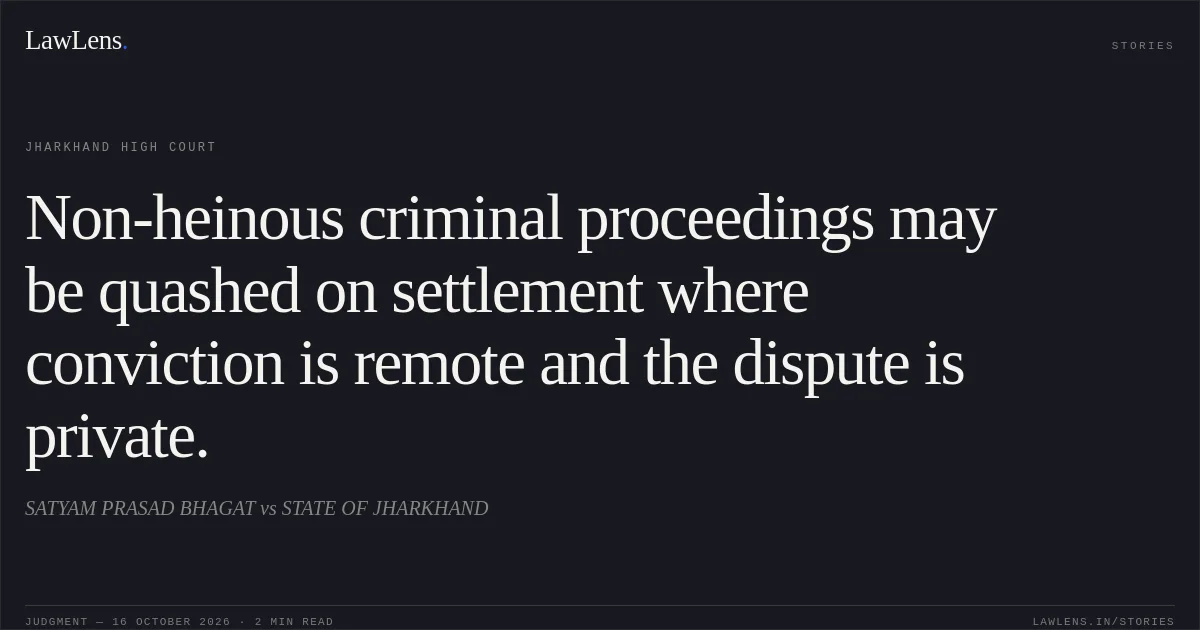
The High Court held that the case was fit for exercise of its inherent jurisdiction and quashed the FIR and entire criminal proceedings in Telco P.S. Case No. 49 of 2026 qua the petitioner.
The Criminal Miscellaneous Petition was allowed, and the interlocutory application was disposed of accordingly.
Source reference: para. 10–11Acts & Sections Cited
11 provisions across 4 statutes referred to in this judgment. Each provision opens on LawLens.
Bharatiya Nyaya Sanhita, 20237
Bharatiya Nagarik Suraksha Sanhita, 20231
Code of Criminal Procedure, 19732
Indian Penal Code, 18601
Original Court PDF
SATYAM PRASAD BHAGATvsSTATE OF JHARKHAND
Click to open original judgment
Original judgment, available to read, download and summarize on LawLens.in