Facts
The connected writ petitions were filed principally by secured creditors and banks challenging orders of the Debts Recovery Tribunal (“DRT”), Debts Recovery Appellate Tribunal (“DRAT”) and related authorities that restrained recovery and securitisation proceedings on the ground that interim moratorium under Section 96 of the Insolvency and Bankruptcy Code, 2016 (“IBC”) had been triggered by applications under Sections 94 or 95 of the IBC.
Source reference: paras. 1–3The petitions involved pending insolvency applications filed before 26 May 2026, including applications by or against personal guarantors to corporate debtors.
Source reference: paras. 1–3The Insolvency and Bankruptcy Code (Amendment) Act, 2026 introduced Section 96(4), effective from 26 May 2026, providing that Section 96 would not apply where an application was filed for initiating insolvency resolution proceedings in respect of a personal guarantor to a corporate debtor.
Source reference: paras. 1–3, 34The Court considered the legal question in Part I and thereafter applied its ruling to the individual petitions.
Source reference: para. 3Issues
Whether Section 96(4) of the IBC, introduced with effect from 26 May 2026, operates retroactively so as to apply to applications under Sections 94 or 95 that were already pending on that date?
Source reference: paras. 1, 17, 64Whether the interim moratorium under Section 96 constitutes a vested or substantive right of the personal guarantor, such that its withdrawal cannot affect pending proceedings?
Source reference: paras. 25, 29–32, 35Whether the pending recovery, securitisation, DRT and DRAT proceedings could continue after 26 May 2026 notwithstanding the earlier filing or registration of insolvency applications under Section 95?
Source reference: paras. 60, 67–70, 75, 107, 116Whether the impugned DRT and related orders restraining recovery, auction, issuance of sale certificates or taking physical possession were legally sustainable?
Source reference: paras. 77, 91–102, 111–118Law Applied
The Court applied Sections 94–101 of the IBC, particularly Section 96, which provides for an interim moratorium upon filing an application under Sections 94 or 95, and the newly inserted Section 96(4), which excludes personal guarantors to corporate debtors from that protection.
Source reference: paras. 29–34It held that the process from filing under Sections 94 or 95 until consideration under Sections 99 and 100 is procedural and incomplete, whereas the substantive insolvency process commences upon admission under Section 100, followed by the moratorium under Section 101.
Source reference: paras. 30–32Relying on Vineeta Sharma v. Rakesh Sharma, SEBI v. Rajkumar Nagpal, and State Bank’s Staff Union v. Union of India, the Court distinguished “retroactive” operation—application to an ongoing or incomplete proceeding—from true retrospectivity, which impairs vested rights.
Source reference: paras. 18–22It relied on BCCI v. Kochi Cricket Pvt. Ltd. for the principle that procedural amendments removing a statutory impediment may apply to pending proceedings where no vested right is impaired.
Source reference: para. 28The Court also applied the mischief rule or Heydon’s Rule, holding that legislation enacted to remedy a recognised abuse should be construed to suppress the mischief and advance the remedy.
Source reference: paras. 45–47The principles concerning vested rights in J.S. Yadav v. State of Uttar Pradesh and Howrah Municipal Corporation v. Ganges Rope Co. Ltd. were applied to hold that the interim moratorium was not an absolute or indefeasible vested right.
Source reference: paras. 26–27Reasoning
The Court held that the interim moratorium under Section 96 is a temporary procedural protection operating only while the resolution professional examines the application and prepares a report under Section 99.
Source reference: paras. 29–35It does not amount to a vested right to remain immune from lawful recovery proceedings.
Source reference: paras. 29–35Section 96(4) therefore did not retrospectively invalidate completed acts; rather, from 26 May 2026 it operated prospectively in relation to the future conduct of pending proceedings.
Source reference: paras. 31–33, 42, 57Since the applications under Sections 94 and 95 remained pending and the procedural process had not culminated in admission under Section 100, the amendment could apply to them without impermissibly impairing accrued rights.
Source reference: paras. 31–33, 42, 57The Court further relied on the legislative history and Select Committee materials, which recorded widespread misuse of Section 96 proceedings by personal guarantors to obstruct SARFAESI and other recovery measures, including through strategic or collusive filings.
Source reference: paras. 36–45A prospective-only interpretation would allow the very mischief identified by Parliament to continue in all pending matters.
Source reference: paras. 45–47The words “is filed” in Section 96(4) were therefore held capable of covering pending applications; the Court found no requirement that the provision be limited to applications filed after 26 May 2026.
Source reference: paras. 53–57Applying this interpretation, the Court found repeated and belated Section 95 filings in several matters to have been used as a protective shield against recovery, auction and possession proceedings.
Source reference: paras. 69–70, 75–76, 83–90, 107–110It consequently held that the interim moratorium ceased to operate in all such cases from 26 May 2026.
Source reference: paras. 69–70, 75–76, 83–90, 107–110Holding
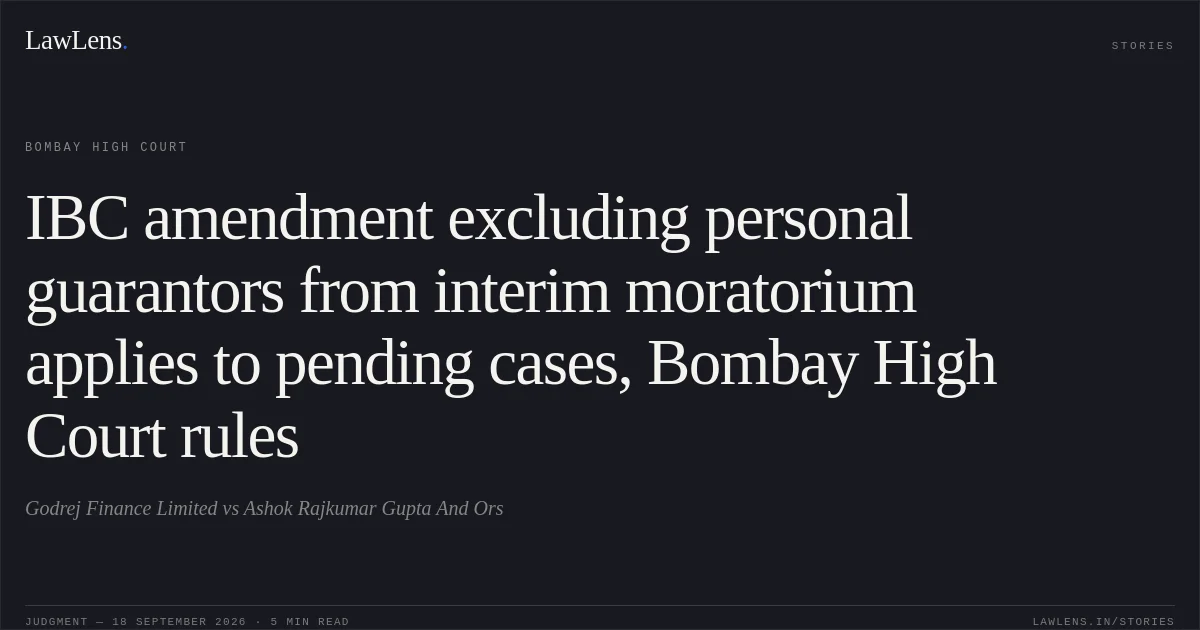
The Court answered the principal question in favour of the creditors and held that Section 96(4) of the IBC operates retroactively and applies to pending proceedings under Sections 94 and 95 as on 26 May 2026.
Although the provision operates from that date and does not retrospectively invalidate completed transactions, any interim moratorium existing in pending proceedings ceased to operate from 26 May 2026.
Source reference: paras. 64–65Consequently, the Court allowed all connected writ petitions.
Source reference: no citationIn Indian Bank v. Shabbir Abbas Patel, the DRT’s restraining orders were quashed; the auction sale and sale certificate were upheld, and possession proceedings were permitted to continue.
Source reference: para. 77In ARCIL v. Veer Gurjar Aluminium Industries, the DRAT and DRT were directed to proceed notwithstanding the Section 95 application.
Source reference: paras. 67–70In Godrej Finance Ltd. v. Ashok Rajkumar Gupta, the DRT’s restoration order was set aside and the respondents were directed to hand over possession within four weeks.
Source reference: para. 102The three Apna Sahakari Bank petitions were allowed and the orders restraining acceptance of the auction balance and issuance of sale certificates were quashed.
Source reference: paras. 103–111In the two RBL Bank petitions, the Court directed the Court Commissioners, with police assistance, to take physical possession of the secured properties pursuant to orders under Section 14 of the SARFAESI Act.
Source reference: paras. 112–118Acts & Sections Cited
44 provisions across 5 statutes referred to in this judgment. Each provision opens on LawLens.
Insolvency and Bankruptcy Code, 2016.
Securitisation and Reconstruction of Financial Assets and Enforcement of Security Interest Act, 20022
Arbitration and Conciliation Act, 19964
General Clauses Act, 18971
Hindu Marriage Act, 19551
Original Court PDF
Godrej Finance LimitedvsAshok Rajkumar Gupta And Ors
Click to open original judgment
Original judgment, available to read, download and summarize on LawLens.in