Facts
The respondents were engaged by the petitioner as peons through successive appointment letters, generally for fixed periods of 89 days, between 1994/1995 and 1996/1997. Their engagements were repeatedly extended through several appointment letters with short intermittent breaks. After the expiry of their last appointment periods, they were not permitted to resume duty.
Source reference: pp. 1–4; paras. 1–7The workmen raised industrial disputes alleging illegal termination without compliance with Section 25F of the Industrial Disputes Act, 1947 (“ID Act”). The Labour Court held that the termination amounted to retrenchment in violation of Section 25F and awarded reinstatement with continuity of service and full back wages. The petitioner challenged those awards under Articles 226 and 227 of the Constitution. During the proceedings, the workman in W.P.(C) 5362/2005 died and his legal representatives were impleaded.
Source reference: pp. 1–4; paras. 1–7Issues
Whether the termination of the workmen upon expiry of their successive 89-day appointment periods was excluded from the definition of “retrenchment” under Section 2(oo)(bb) of the ID Act.
Source reference: pp. 4–7; paras. 8–18Whether the intermittent breaks between the successive appointment periods disentitled the workmen from claiming 240 days of continuous service and protection under Section 25F of the ID Act.
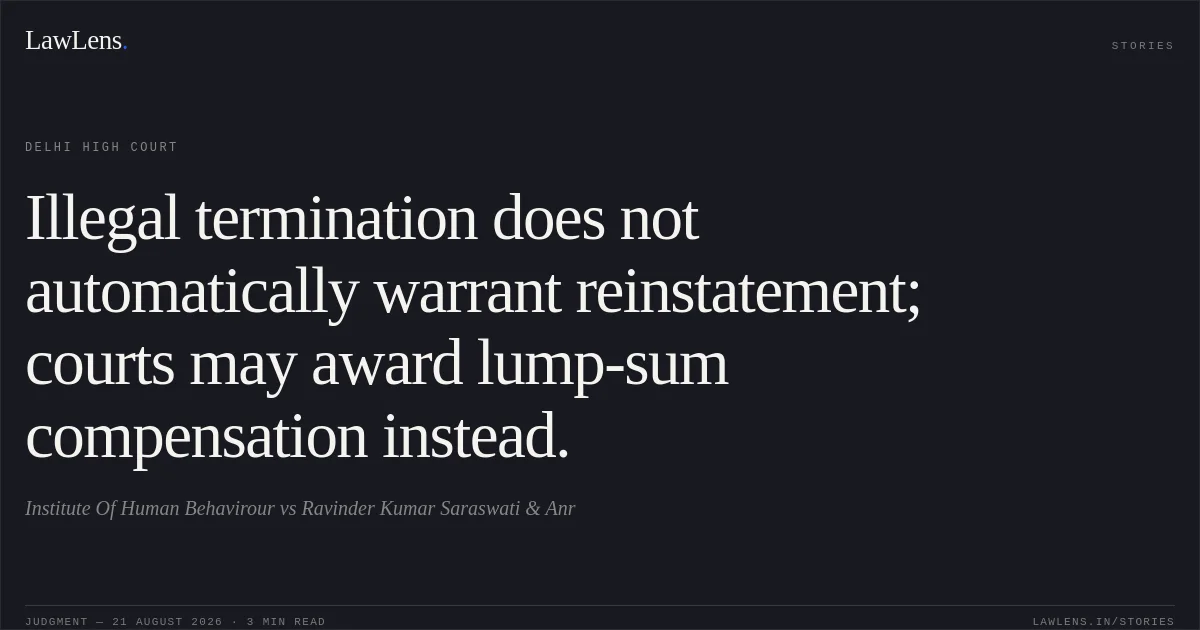
Source reference: pp. 4, 7; paras. 10, 18–20Whether, despite the finding of illegal termination, reinstatement with continuity of service and full back wages was an automatic or appropriate relief after nearly three decades.
Source reference: pp. 7–9; paras. 22–26Law Applied
The Court applied Section 2(oo) of the ID Act, under which retrenchment broadly includes termination by the employer for any reason other than the specified exclusions, including the non-renewal or contractual termination contemplated by Section 2(oo)(bb).
Source reference: p. 5; para. 15The employer bears the burden of proving that the case falls within Section 2(oo)(bb), including that the employment was pursuant to a genuine contract for specified work of a temporary nature and that termination occurred consistently with the contractual terms.
Source reference: pp. 5–6; para. 16Relying on S.M. Nilajkar v. Telecom District Manager, (2003) 4 SCC 27, the Court held that mere engagement as a daily wager does not attract Section 2(oo)(bb); the workman must have been made aware that the employment was connected with a temporary scheme or project and would end in accordance with it.
Source reference: pp. 5–6; para. 16Section 25F requires compliance with statutory conditions before retrenchment. The Court further applied the limited scope of judicial review under Articles 226 and 227, permitting interference only for patent illegality, perversity, or an error apparent on the face of the record.
Source reference: p. 4; para. 13On relief, relying on Allahabad Bank v. Krishan Pal Singh, (2021) 19 SCC 227, the Court held that reinstatement with full back wages is not automatic upon a finding of illegal termination and that monetary compensation may be awarded where the circumstances warrant.
Source reference: pp. 7–8; paras. 22–24Reasoning
The petitioner failed to establish that the workmen were engaged for any specified temporary work, project, or scheme within the meaning of Section 2(oo)(bb). Their duties as peons were of a continuing and ordinary nature, and the repeated extensions over approximately two years demonstrated that the work was not limited to a particular temporary period.
Source reference: p. 7; paras. 17–18The successive 89-day appointments and short breaks were treated as an artificial device to portray continuous employment as discontinuous; they could not defeat the workmen’s claim of continuous service or statutory protection under Section 25F. Accordingly, the Labour Court’s finding that the termination was illegal was neither perverse nor legally infirm and did not warrant interference under Article 226 or 227. However, considering that the workmen had served for only about two years, that nearly thirty years had elapsed since their termination, and that reinstatement was no longer a practical or equitable remedy, the Court moulded the relief by substituting lump-sum compensation for reinstatement, continuity of service, and full back wages.
Source reference: pp. 7–9; paras. 19–26Holding
The Court upheld the Labour Court’s finding that the workmen’s termination was illegal and was not protected by the exception in Section 2(oo)(bb) of the ID Act. Nevertheless, reinstatement with continuity of service and full back wages was held not to be automatic or appropriate in the circumstances.
The impugned awards were modified, and the petitioner was directed to pay lump-sum compensation of ₹3,00,000 each to the workman in W.P.(C) 18083/2005 and to the legal representatives of the deceased workman in W.P.(C) 5362/2005, within eight weeks. In default, penal interest at 12% per annum would apply. No further compensation or allowance was awarded; both petitions and pending applications were disposed of accordingly.
Source reference: pp. 8–9; paras. 25–30Acts & Sections Cited
2 provisions across 1 statute referred to in this judgment. Linked provisions open on LawLens.
Industrial Disputes Act, 19472
Original Court PDF
Institute Of Human BehavirourvsRavinder Kumar Saraswati & Anr
Click to open original judgment
Original judgment, available to read, download and summarize on LawLens.in