01Facts
Vijay Singh was engaged by the State Bank of India as a temporary Waterboy-cum-Messenger at its Baraut Branch from July 1994.
p. 2 · ¶ 2–3His services were discontinued on 10 October 1996 without notice, notice pay, or retrenchment compensation.
p. 2 · ¶ 2–3He raised an industrial dispute, and the Labour Court held that he had worked for more than 240 days and that the termination violated Section 25F of the Industrial Disputes Act, 1947.
p. 3 · ¶ 4It directed reinstatement with 50% back wages.
p. 3 · ¶ 4The Bank challenged the award under Articles 226 and 227 of the Constitution.
p. 3 · ¶ 5During the writ proceedings, operation of the award was stayed subject to the Bank depositing 50% of the back wages.
p. 3 · ¶ 502Issues
i.Whether the respondent had established that he had actually worked for at least 240 days during the twelve months preceding termination, thereby attracting the protection of Section 25F of the Industrial Disputes Act, 1947?
p. 9 · ¶ 24ii.Whether the termination was illegal for non-compliance with Section 25F notwithstanding the respondent’s temporary/daily-wage status and the absence of appointment against a sanctioned post?
pp. 17–18 · ¶ 39–44iii.Whether reinstatement with 50% back wages was an appropriate relief, or whether monetary compensation should be awarded instead?
pp. 18–21 · ¶ 45–5203Law Applied
Section 25B(2) of the Industrial Disputes Act, 1947 provides that a workman is deemed to be in continuous service if he has actually worked for at least 240 days during the twelve months preceding termination.
p. 11 · ¶ 26The initial burden of proving 240 days of actual work lies on the workman, who must ordinarily adduce cogent oral and documentary evidence; an adverse inference against the employer depends on the facts of the case, as held in R.M. Yellatti v. Assistant Executive Engineer, (2006) 1 SCC 106, and Municipal Corporation, Faridabad v. Siri Niwas, (2004) 8 SCC 195.
pp. 10–12 · ¶ 26–27Under Section 25F, a workman satisfying the continuous-service requirement cannot be retrenched without compliance with the statutory requirements of notice or notice pay and retrenchment compensation.
pp. 17–18 · ¶ 42–44In writ jurisdiction, the High Court does not ordinarily reappreciate factual findings of the Labour Court and may interfere only where the findings are perverse, unsupported by evidence, patently illegal, or jurisdictionally erroneous, as stated in International Airport Authority of India v. International Air Cargo Workers’ Union, (2009) 13 SCC 374.
p. 9 · ¶ 23Reinstatement with back wages is not automatic upon a finding of illegal termination; the relief may be moulded by awarding compensation depending on the nature and duration of employment and surrounding circumstances, as held in Jagbir Singh v. Haryana State Agriculture Marketing Board, (2009) 15 SCC 327, and Allahabad Bank v. Krishan Pal Singh, (2021) 19 SCC 227.
pp. 18–20 · ¶ 45–48Provisions in the judgment · 4
Industrial Disputes Act, 1947 Section 25FSection 25Section 10Section 17B
04Reasoning
The High Court found that the respondent had discharged the initial burden under Section 25B(2).
The Bank’s own communication dated 30 December 1997 recorded that Singh had worked as a daily-wage Waterboy for 712 days and had submitted 412 conveyance bills for official outdoor duties.
pp. 13–15 · ¶ 31–33This evidence was corroborated by duty charts, conveyance bills, Peon Book entries, the identity certificate describing him as a temporary Messenger/Waterboy, and the Branch Manager’s evidence that the relevant bills had been passed and included water-carrier, rickshaw, and other outdoor-service charges.
pp. 12–16 · ¶ 29–36, 40–41The fact that he worked only two or three hours on particular days did not negate the finding that he had worked on the requisite number of days.
p. 16 · ¶ 37Since the Bank admittedly did not issue notice, pay notice pay, or provide retrenchment compensation, the termination violated Section 25F; the absence of a sanctioned post or regular recruitment did not permit the Bank to bypass that statutory protection.
pp. 17–18 · ¶ 42–44However, considering that the engagement was temporary, lasted approximately two years, the termination occurred in 1996, nearly thirty years had elapsed, and the respondent had already received approximately ₹9,87,925 under Section 17B, the Court held that reinstatement with back wages would not be appropriate.
pp. 19–21 · ¶ 49–5205Holding
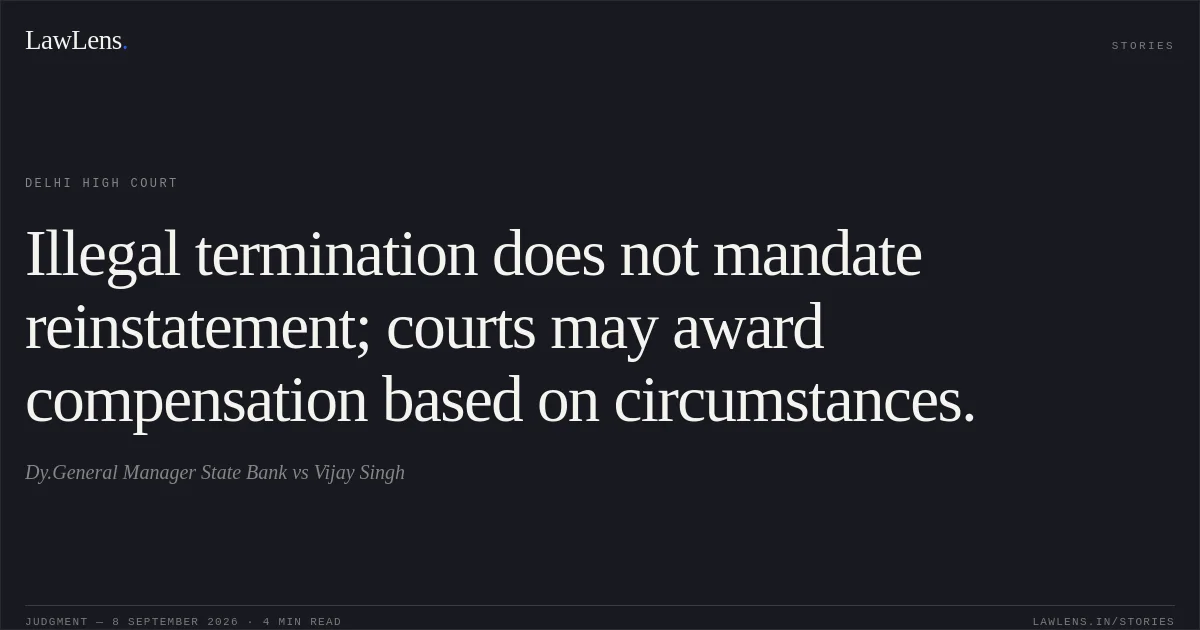
The High Court upheld the Labour Court’s finding that Singh had completed the requisite period of continuous service and that his termination without compliance with Section 25F was illegal.
p. 21 · ¶ 51–52Nevertheless, it modified the relief by substituting reinstatement and 50% back wages with lump-sum monetary compensation.
p. 21 · ¶ 52The amount deposited by the Bank pursuant to the interim order dated 14 July 2010 was directed to be released to Singh as compensation in lieu of reinstatement and back wages.
p. 21 · ¶ 52No further amount or Section 17B allowance was held payable.
p. 22 · ¶ 53The writ petition was accordingly disposed of and the Labour Court’s award was modified.
p. 22 · ¶ 54Original Court PDF
Dy.General Manager State BankvsVijay Singh
Click to open original judgment
Original judgment, available to read, download and summarize on LawLens.in