Facts
The petitioner, an academician, challenged the continuance of respondent No.4, Dr. S. Vidyashankar, as Vice-Chancellor of Visvesvaraya Technological University (“VTU”).
Source reference: no citationDr. Vidyashankar was initially appointed Vice-Chancellor for three years under Section 13(2) of the Visvesvaraya Technological University Act, 1994 (“VTU Act”), pursuant to a selection process and notification dated 29 September 2022.
Source reference: pp. 18–20Before expiry of the initial tenure, the Chancellor issued Notification dated 3 September 2025 under Section 13(4) of the VTU Act, extending Dr. Vidyashankar’s tenure for another three years from 30 September 2025.
Source reference: pp. 19–20His initial appointment had earlier been challenged through writ petitions seeking quo warranto on substantially similar grounds, including alleged non-compliance with the UGC Regulations, 2018. The Division Bench dismissed those petitions, and the Supreme Court found no merit in the challenge to the appointment, while granting limited liberty concerning adverse remarks against one petitioner.
Source reference: pp. 20–30Issues
1. Whether the Chancellor’s extension of the Vice-Chancellor’s tenure under Section 13(4) of the VTU Act required the constitution of a fresh Search Committee and repetition of the procedure applicable to an initial appointment.
Source reference: pp. 13–18, 69–762. Whether the alleged absence of a UGC nominee and other alleged defects in the original Search Committee could be reopened in a challenge to the incumbent’s immediate continuation, despite the earlier litigation concerning the initial appointment.
Source reference: pp. 20–30, 68–753. Whether the petitioner established a clear statutory or constitutional violation warranting issuance of a writ of quo warranto against the incumbent Vice-Chancellor.
Source reference: pp. 31–45, 66–76Law Applied
Section 13(2) and (3) of the VTU Act prescribe the initial appointment of the Vice-Chancellor through a panel recommended by a statutorily constituted committee, while Section 13(4) provides that the three-year tenure is “extendable by another term of similar period at the discretion of the Chancellor”.
Source reference: pp. 13–16A writ of quo warranto lies only where a person occupies a substantive public office without lawful authority, particularly where the appointment is contrary to statutory provisions or the incumbent lacks prescribed eligibility; the Court does not ordinarily examine comparative suitability or the wisdom of the appointing authority.
Source reference: pp. 31–66The Court relied on University of Mysore v. C.D. Govinda Rao, Statesman (P) Ltd. v. H.R. Deb, B. Srinivasa Reddy v. Karnataka Urban Water Supply & Drainage Board Employees’ Association, Gambhirdan K. Gadhvi v. State of Gujarat, State of West Bengal v. Anindya Sundar Das, and Premachandran Keezhoth v. Kannur University.
Source reference: pp. 31–66Under Anindya Sundar Das and Premachandran Keezhoth, immediate reappointment or continuation under a statutory provision need not undergo the same procedure as a fresh appointment where the statute does not require a renewed selection process.
Source reference: pp. 69–74Reasoning
The Court treated the impugned action as an extension or immediate continuation under Section 13(4), and not as a fresh appointment.
Source reference: pp. 13–18, 74–76The statutory language conferred discretion on the Chancellor to extend the tenure for another similar term and did not require a fresh Search Committee, fresh applications, or a second comparative assessment.
Source reference: pp. 13–18, 74–76The alleged defects concerning the original Search Committee, including the absence of a UGC nominee, related to the initial appointment and had already been raised in earlier quo warranto proceedings.
Source reference: pp. 20–30, 68–75That challenge had failed before the Division Bench, and the Supreme Court had expressly found no merit in the challenge to the appointment.
Source reference: pp. 20–30, 68–75The Court held that finality could not be defeated by presenting substantially the same grounds through a different petitioner.
Source reference: pp. 68–75Since the petitioner did not identify any clear statutory infirmity in the exercise of the Chancellor’s power to continue the incumbent, the strict requirements for quo warranto were not satisfied.
Source reference: pp. 75–76Holding
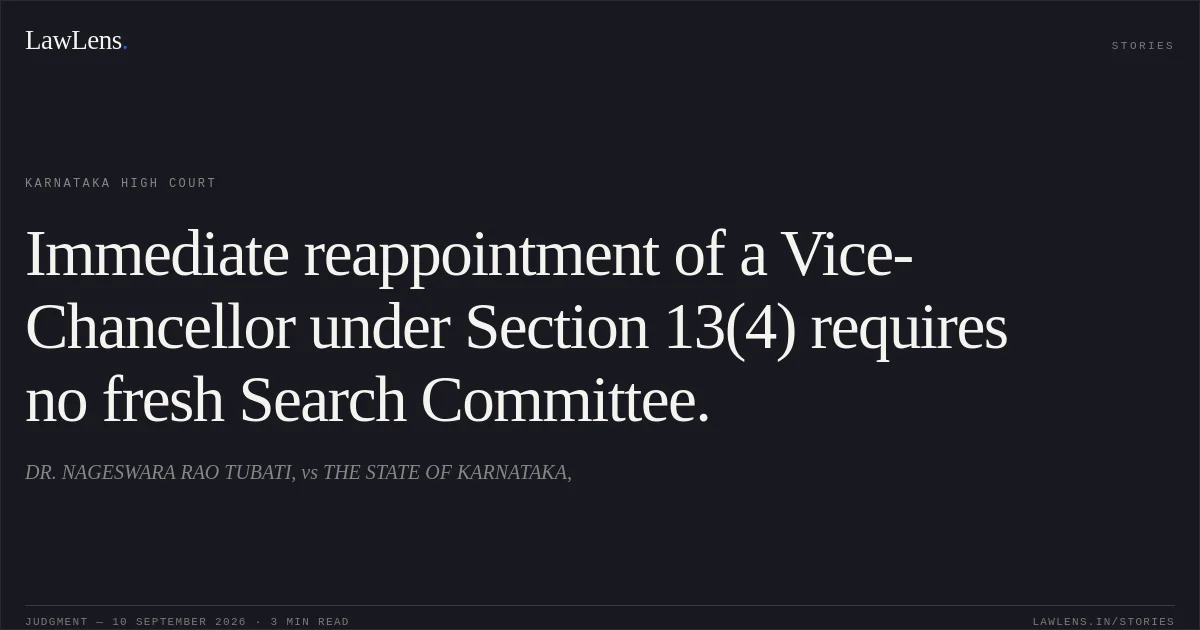
The Court held that Section 13(4) of the VTU Act authorises the Chancellor to extend the Vice-Chancellor’s tenure for another similar term without initiating the entire procedure applicable to an initial appointment.
The petitioner failed to establish that respondent No.4 was a usurper or that his continuation was contrary to any clear statutory requirement.
Source reference: pp. 76–77The writ petition seeking quo warranto, certiorari, mandamus, and fresh appointment proceedings was accordingly dismissed. Pending applications were also disposed of.
Source reference: pp. 76–77Acts & Sections Cited
9 provisions across 3 statutes referred to in this judgment. Each provision opens on LawLens.
VISVESVARAYA TECHNOLOGICAL UNIVERSITY ACT, 19943
University Grants Commission Act, 19564
Calcutta University Act, 19792
Original Court PDF
DR. NAGESWARA RAO TUBATI,vsTHE STATE OF KARNATAKA,
Click to open original judgment
Original judgment, available to read, download and summarize on LawLens.in