Facts
On March 23, 2016, police received information regarding illegal hunting of a blackbuck by individuals in a Toyota Qualis.
Source reference: para. 2On March 24, 2016, a carcass was recovered from a drain, and a post-mortem suggested firearm and sharp-edged weapon injuries.
Source reference: para. 2The accused were charged under Sections 9, 50, and 51 of the Wildlife (Protection) Act, 1972, and Sections 25 and 27 of the Arms Act.
Source reference: para. 2The Trial Court (JMFC, Bairasiya) acquitted the respondents on April 22, 2022, citing insufficient evidence.
Source reference: para. 1, 5The State appealed this acquittal, contending that the recovery of the weapon and the police testimony were sufficient for conviction.
Source reference: para. 6Issues
1. Whether the prosecution established the cause of death as a gunshot injury and linked the seized weapons to the accused beyond a reasonable doubt to attract liability under the Wildlife (Protection) Act.
Source reference: para. 11-122. Whether the appellate court should interfere with a judgment of acquittal when the Trial Court’s view is a "possible view" based on the evidence.
Source reference: para. 14, 18-19Law Applied
Section 378 of the Code of Criminal Procedure, 1973, concerning appeals against acquittal.
Source reference: para. 1Section 27 of the Indian Evidence Act regarding discovery of facts.
Source reference: para. 10The principles of appellate jurisdiction mandate that an appellate court shall not overturn an acquittal unless the findings are perverse, illegal, or the only possible conclusion is guilt, as established in H.D. Sundara v. State of Karnataka, Babu Sahebagouda Rudragoudar v. State of Karnataka, and Mallappa v. State of Karnataka.
Source reference: para. 14, 15, 18Reasoning
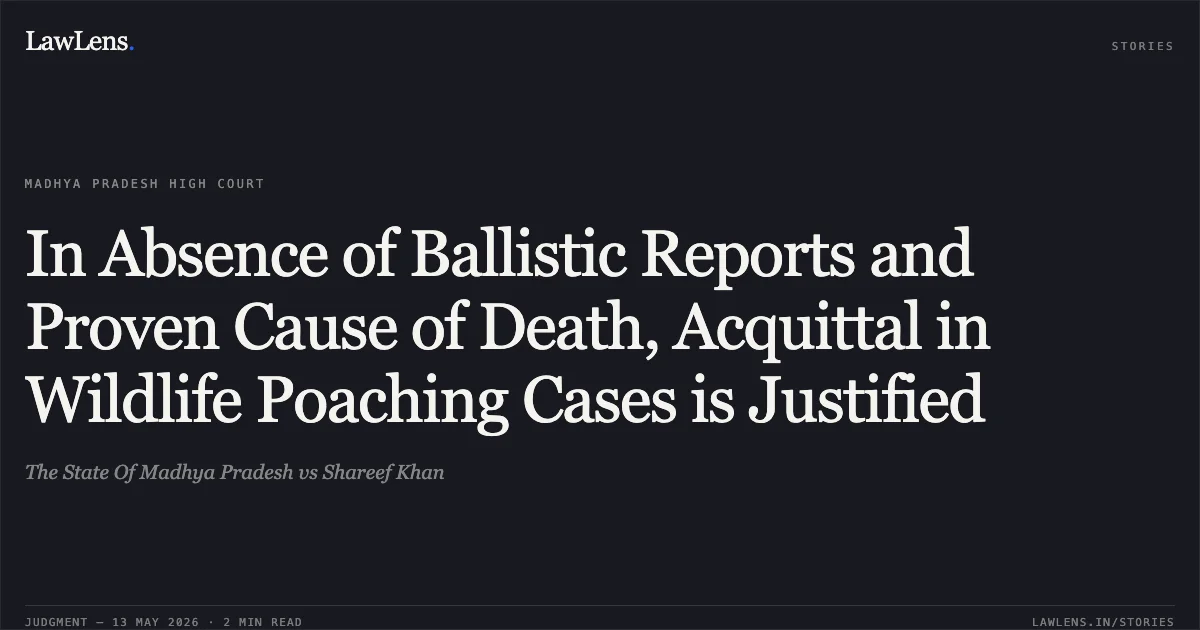
The Court observed that all independent witnesses (PW-1 to PW-3 and PW-8 to PW-10) turned hostile.
Source reference: para. 8The Veterinary Officer (PW-4) admitted no gunpowder or bullets were found in the carcass, contradicting the gunshot theory.
Source reference: para. 9The Investigating Officer (PW-7) failed to produce malkhana (storehouse) records or examine the malkhana in-charge to prove the safe custody of seized items.
Source reference: para. 10The Armorer (PW-11) testified that the weapon was an airgun, not a rifle, and noted that the items were received unsealed, creating a gap in the chain of custody.
Source reference: para. 11The Court found that without a ballistic report linking the airgun to the animal’s death, the prosecution's case was based on insufficient evidence.
Source reference: para. 12Applying the "possible view" doctrine, the Court held that the Trial Court's appreciation of these discrepancies was lawful and not perverse.
Source reference: para. 12, 19Holding
The prosecution failed to prove the charges beyond reasonable doubt due to the lack of ballistic evidence, the hostile nature of independent witnesses, and the failure to maintain the integrity of seized articles.
The High Court dismissed the appeal and affirmed the acquittal, concluding there was no ground to interfere with the Trial Court’s findings as they were neither patently perverse nor legally erroneous.
Source reference: para. 19-20Acts & Sections Cited
7 provisions across 3 statutes referred to in this judgment. Each provision opens on LawLens.
Code of Criminal Procedure, 19732
Wild Life (Protection) Act, 19723
Arms Act, 19592
Original Court PDF
The State Of Madhya PradeshvsShareef Khan
Click to open original judgment
Original judgment, available to read, download and summarize on LawLens.in