Facts
On November 16, 2018, the appellant was a pillion rider on a motorcycle (GJ-6-LC-2922) owned by Respondent No. 1 and insured by Respondent No. 2.
Source reference: para. 3An unknown truck dashed the motorcycle from behind and fled the scene, resulting in the death of the rider and severe injuries to the appellant.
Source reference: para. 3The appellant filed M.A.C.P. No. 179 of 2020 claiming ₹10 Lakhs in compensation.
Source reference: para. 2The Motor Accident Claims Tribunal (MACT), Dabhoi, dismissed the petition on March 4, 2025, essentially finding no negligence on the part of the motorcycle driver since the truck hit from behind.
Source reference: para. 2, 5Issues
1. Whether the Tribunal erred in dismissing the claim petition by failing to recognize the accident as a case of composite negligence.
Source reference: para. 62. Whether a pillion rider, as an innocent third party, can claim compensation from any of the joint tort-feasors in a case of composite negligence.
Source reference: para. 4.2Law Applied
The Court primarily applied the principle of "Composite Negligence" as elucidated by the Supreme Court in Khenyei v. New India Assurance Co. Ltd. Others (2015) 9 SCC 273.
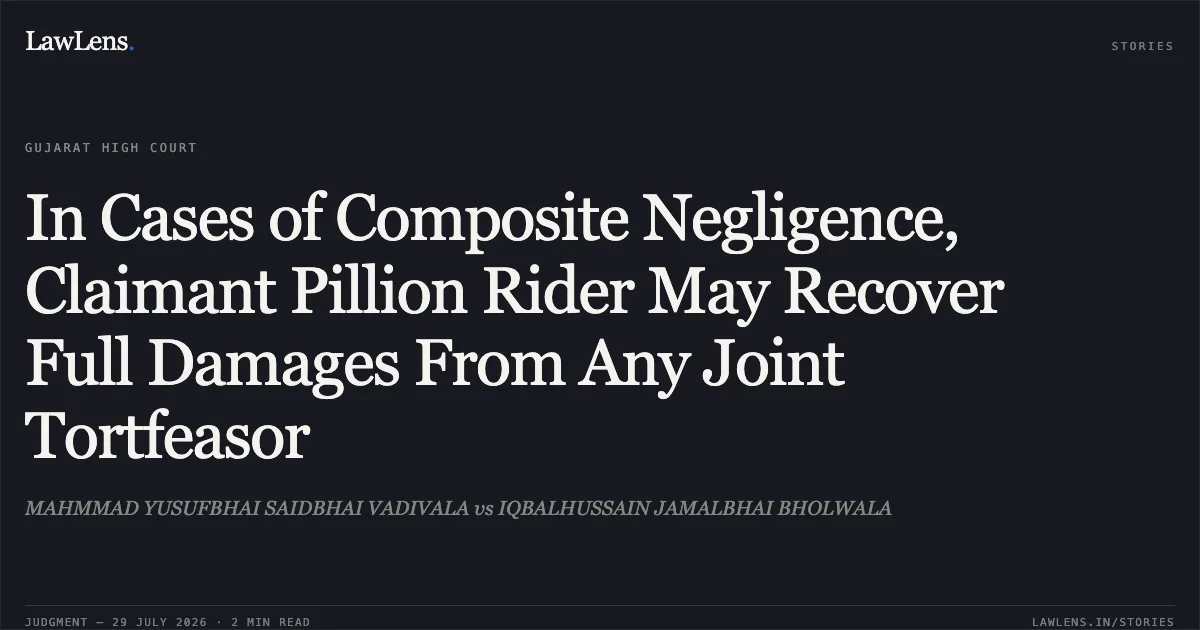
Source reference: para. 4.2Under this doctrine, where an accident occurs due to the negligence of two or more domestic vehicles, the tort-feasors' liability is joint and several. A claimant is entitled to sue any or all joint tort-feasors and recover the entire compensation from any one of them; the inter se apportionment of negligence between the drivers is a matter of recovery between the tort-feasors and should not impede the claimant's right to full compensation.
Source reference: para. 4.2, sub-points (i)-(iv)Reasoning
The High Court found that the Tribunal failed to appreciate the appellant’s status as a mere pillion rider.
Source reference: para. 7The Court reasoned that since the accident involved two vehicles (the motorcycle and the fleeing truck), it constituted a case of composite negligence.
Source reference: para. 6The Tribunal's decision to dismiss the claim solely because the truck fled (and was primarily responsible) was legally flawed because a victim of composite negligence has the option to recover damages from any of the joint tort-feasors involved.
Source reference: para. 4.2The Court held that the Tribunal's finding—that no negligence could be attributed to the motorcycle driver—was contrary to the material record and the legal protections afforded to innocent third parties (pillion riders) who cannot be held contributorily negligent.
Source reference: para. 7Holding
The High Court quashed and set aside the judgment of the MACT, Dabhoi.
The Court held that the matter required a fresh adjudication on merits, specifically regarding the quantum of compensation and the liability of the insurer of the motorcycle as a joint tort-feasor.
Source reference: para. 8The appeal was partly allowed, and the case was remanded to the Tribunal for disposal within six months.
Source reference: para. 9Original Court PDF
MAHMMAD YUSUFBHAI SAIDBHAI VADIVALAvsIQBALHUSSAIN JAMALBHAI BHOLWALA
Click to open original judgment
Original judgment, available to read, download and summarize on LawLens.in