Facts
The petitioner, claimant before the Motor Accident Claims Tribunal, filed a claim for compensation arising from the death of Ku. Rita Kahra, who was travelling as a pillion rider on motorcycle No. CG 11 CF 7183.
Source reference: paras. 1–2, 7The accident on 16 July 2017 also involved motorcycle No. CG 11 BA 2616.
Source reference: paras. 1–2, 7The claim was instituted against the driver, owner, and insurer of motorcycle No. CG 11 CF 7183, alleging that its driver was rash and negligent.
Source reference: paras. 1–2, 7The insurer of motorcycle No. CG 11 CF 7183 applied under Order I Rule 10 of the Code of Civil Procedure, 1908, seeking impleadment of the driver and owner of motorcycle No. CG 11 BA 2616, contending that their presence was necessary to determine the respective negligence and liability of both vehicles.
Source reference: paras. 1, 3–4The Motor Accident Claims Tribunal allowed the application by order dated 6 December 2019 and directed their impleadment.
Source reference: para. 1The claimant challenged that order under Article 227 of the Constitution.
Source reference: para. 1Issues
Whether the driver and owner of another vehicle involved in the accident are necessary parties to a motor accident claim merely because that vehicle was also involved in the occurrence?
Source reference: para. 6Whether the insurer can compel the claimant, through an application under Order I Rule 10 CPC, to implead all alleged joint tortfeasors when the claimant has chosen to proceed against the driver, owner, and insurer of one vehicle?
Source reference: paras. 6, 12–13Law Applied
The Court applied Article 227 of the Constitution and Order I Rule 10 CPC, holding that impleadment is warranted only where the proposed party is necessary for effective and complete adjudication and for passing an effective and enforceable award.
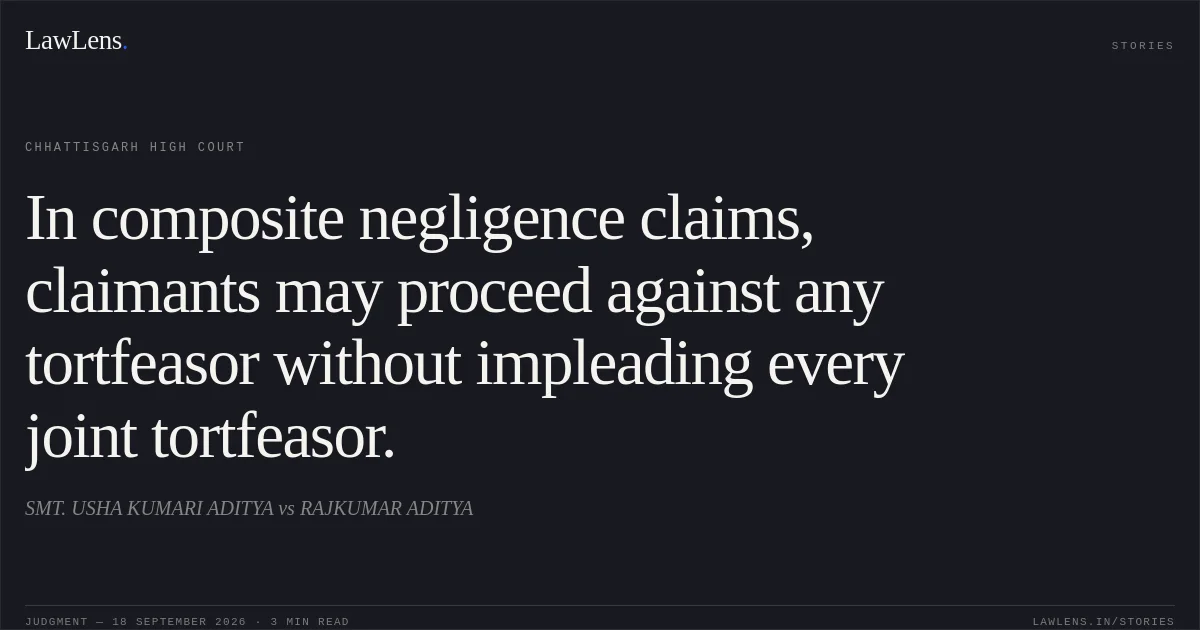
Source reference: para. 12Relying on Khenyei v. New India Assurance Co. Ltd., (2015) 9 SCC 273, and the principles in T.O. Anthony v. Karvarnan, the Court held that in cases of composite negligence, each joint tortfeasor is jointly and severally liable for the entire compensation, and the claimant may sue any one or all of them.
Source reference: para. 8; para. 10The Court also followed Pooja Chamecha v. Manchit Rao Bhaskar, MAC No. 1232/2011, and Savita Soni v. Benuram, 2011 SCC OnLine Chh 423, which recognise the claimant’s choice to recover the entire compensation from any one joint tortfeasor.
Source reference: para. 9; para. 10Composite negligence is distinct from contributory negligence: in composite negligence, the claimant need not establish the separate degree of negligence of each wrongdoer, whereas contributory negligence concerns negligence attributable to the injured person.
Source reference: para. 10Reasoning
The claimant specifically alleged that the accident was caused by the rash and negligent driving of motorcycle No. CG 11 CF 7183 and chose to proceed against the persons liable in respect of that vehicle.
Source reference: para. 11Although the accident involved a second motorcycle, the Tribunal could determine, on the evidence, whether the accident resulted from the sole negligence of the insured vehicle or from composite negligence involving both vehicles, without requiring the other vehicle’s driver and owner to be impleaded.
Source reference: para. 11Since the claimant could recover the entire compensation from any one joint tortfeasor in a case of composite negligence, the other vehicle’s driver and owner were not necessary parties.
Source reference: paras. 12–14Their possible relevance to the factual determination of negligence did not satisfy the stricter test under Order I Rule 10 CPC.
Source reference: paras. 12–14The insurer therefore could not use impleadment proceedings to defeat or restrict the claimant’s choice of tortfeasor.
Source reference: para. 13Holding
The High Court held that the driver and owner of motorcycle No. CG 11 BA 2616 were not necessary parties merely because that motorcycle was involved in the accident.
The Tribunal’s order dated 6 December 2019 allowing their impleadment under Order I Rule 10 CPC was set aside.
Source reference: para. 15The Claims Tribunal was directed to proceed against the parties already on record and decide the claim in accordance with law and the evidence.
Source reference: para. 16The Court clarified that its observations were confined to impleadment and would not prejudice the merits of the claim, including the questions of negligence and liability.
Source reference: para. 17The interim order dated 5 March 2020 was vacated.
Source reference: para. 18Original Court PDF
SMT. USHA KUMARI ADITYAvsRAJKUMAR ADITYA
Click to open original judgment
Original judgment, available to read, download and summarize on LawLens.in